Ships of the Outbound Fleet, 2219
Military Vessels
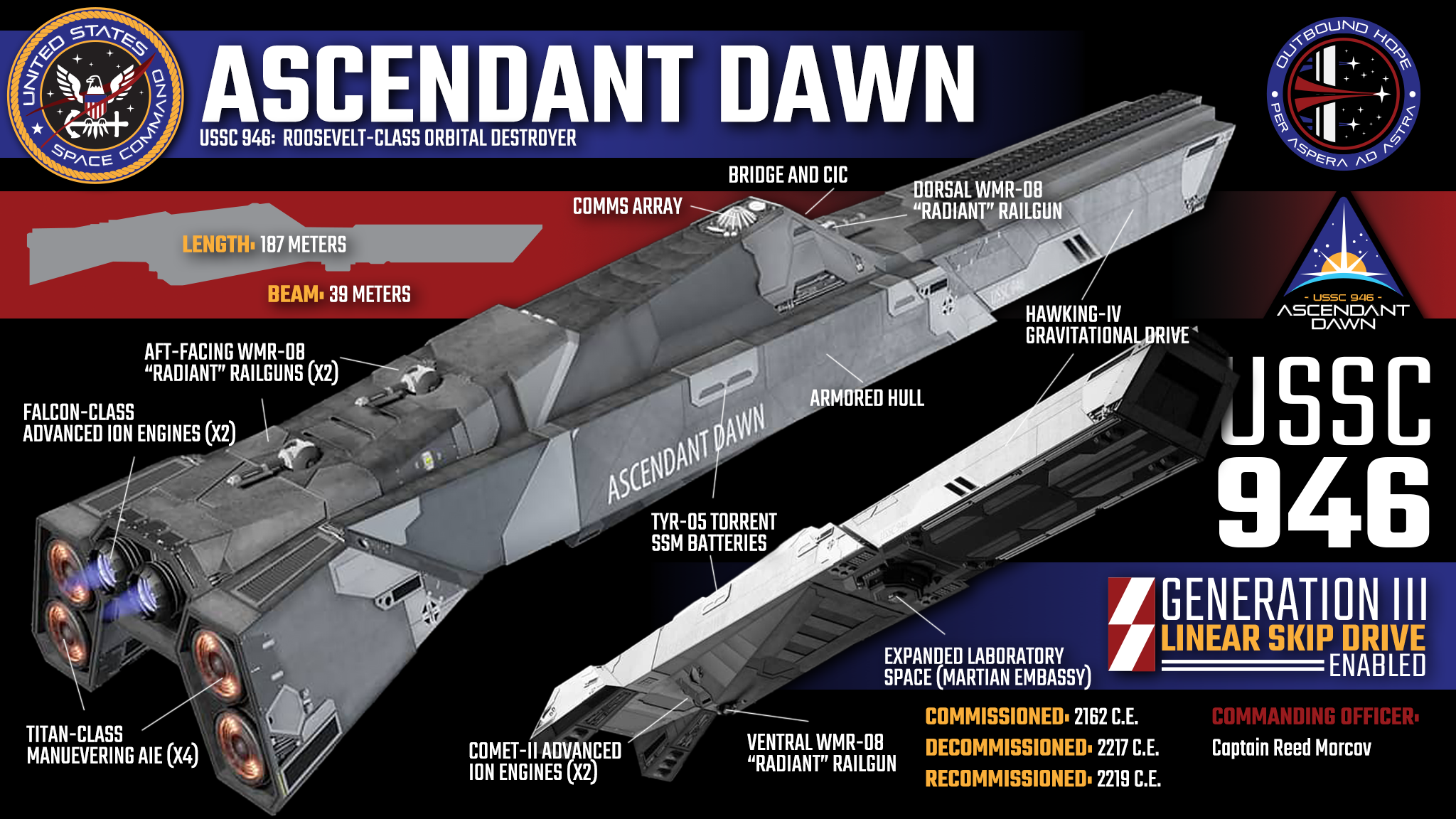
SHIP CLASS:
Roosevelt-Class Orbital Destroyer
MANUFACTURER:
Windfall Starship Systems, Inc.
ACTIVE COMMANDING OFFICER:
Capt. R. Morcov
COMMISSIONED:
2162
DECOMMISSIONED:
2217
RECOMMISSIONED:
2219
LENGTH:
187 Meters
BEAM:
39.5 Meters
COMPLEMENT:
40-95, Depending on configuration and mission profile
ARMAMENTS:
x4 WMR-08 “Radiant” Magnetic Railguns
x4 TYR-G5 Torrent SSM Batteries
DRONE SUITE:
(Removed in 2217)
STANDARD PROPULSION:
x2 Falcon-Class Advanced Ion Engines (AIE)
x2 COMET-II AIE
x4 Titan-Class Maneuvering AIE
GRAVITATIONAL PROPULSION:
x1 Hawking-IV Gravitational Drive
ADDITIONAL PROPULSION:
x1 Generation III Linear Skip Drive
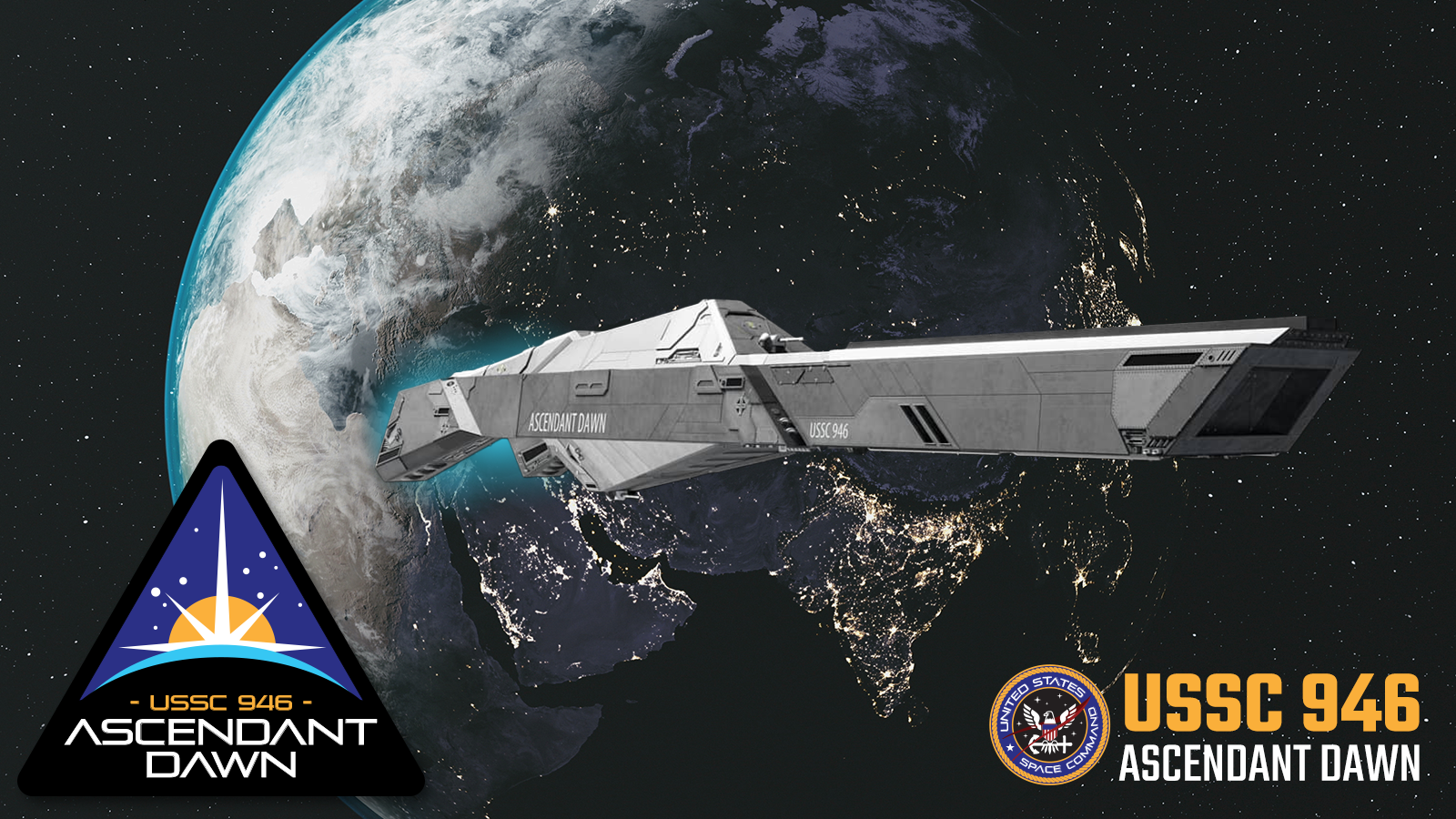
Since the Solar War, the famed USSC Ascendant Dawn has stood as a proud symbol of American military might, often referenced with the same awe and reverence as the USS Constitution. Though outdated and outgunned by most modern vessels, the Dawn was nonetheless chosen as the flagship of the Outbound Hope Mission in the earliest days of planning.
The Dawn was built as a part of a limited run of Roosevelt-Class destroyers, designed and constructed by Windfall Starship Systems at Titan. Ongoing American losses in the Solar War had prompted Windfall engineers to unveil many of their experimental designs in weapons, propulsions and defensive countermeasures. Nearly all of them came together in the relatively small package of an orbital destroyer. Smaller and sleeker than many of the American warships of its day, the Roosevelt design was fast and maneuverable. Meant to be used in conjunction with the New Liberty dreadnought, the Roosevelts could incorporate hit and fade tactics that were meant to draw enemies toward the significantly more formidable weapons systems of the New Liberty.
Despite the promise of these innovations, the real secret to the success of the Dawn and her sister ships was in the vessels’ linear skip drive (LSD), an experimental propulsion system that allowed the ship to transport itself instantaneously to a nearby location, appearing to “skip through space” by observers. The skip drive would prove immensely advantageous, though not without extreme risk.
The skip drive saw its first and only combat use at the Battle of Titan, a colossal orbital battle that would propel the Ascendant Dawn to American legend. As Chinese warships overwhelmed American defenses, even the great New Liberty flagship was crippled beyond repair. When a Chinese nuclear missile finally struck the command bridge of the New Liberty, the American high command was completely destroyed. The outnumbered US ships scrambled for leadership, with some calling for a complete retreat.
Yet famously, Captain Miles Edson of the Ascendant Dawn refused to back down, instead skipping to the forefront of the battle – and the New Liberty’s exposed reactor. In a fiery salvo, the Dawn struck at the wreck of the dreadnought, then disappeared before the hulk began to detonate. A massive burst of radiation crippled Chinese sensors and sent a wave of debris that devastated everything in its wake. Safely outside the blast, Edson rallied the remainder of the US fleet to ultimately win the day. The war concluded soon after, with Edson and the Dawn instantly cementing their place among the pantheon of American heroes.
Though Edson would go on to receive the Congressional Medal of Honor and a host of USSC accolades, the future of the Dawn was far less glamorous. In the decades to follow, the ship alternated between a military asset, a marketing tool for Windfall, and a favored prop of ambitious politicians. Officially, the ship was assigned to the defense of the shipyards at Titan, though lengthy studies and upgrades by its designers often saw the ship at Luna for months on end. Such tenures were often followed by expansive marketing packages that featured the ship heavily and reminded consumers of “the true value of Windfall Starship Systems.” Elected officials similarly paraded the vessel over the Terran United States and the extraplanetary colonies. The flamboyant President Dougy Olson – ever the showman – even insisted the Dawn and a squadron of Hawk-class gunships fly overhead immediately after he swore the oath of office.
By the 2190’s, the Dawn had begun to fade from public view and lengthy journeys between Titan and Earth and Luna proved increasingly expensive and difficult. The ship was reassigned to monitor shipping traffic against a sudden surge of piracy, a role which seemed unbecoming of such a famous vessel. It was here that key members of the Ascendant Dawn’s crew became involved in the Grayson Conspiracy, an ACA-backed uprising within the USSC that threatened to target several key military sites. Though rebels attempted to seize control of the ship, then-Captain Peter Kohler resisted. Reclaiming the Dawn, Kohler assumed command of the nearby loyal ships and ultimately took the fight back to so-called Admiral Grayson. The subsequent victory earned Kohler his admiralship and the Dawn a brief stint back in the public eye.
In 2217, the USSC concluded that the Ascendant Dawn was long overdue for retirement. The ship was officially decommissioned and relocated to a permanent drydock in New Washington’s Hero Plaza. The ship was outfitted as a museum ship intended to host millions of visitors every year.
But the Dawn’s residency as a museum ship would not last long. Even before the ship’s decommissioning, it had already been considered as the new flagship for the slowly-growing Outbound Hope Mission. As the DCA, USSC and Windfall agreed to assert a military escort for the civilian population, the Dawn’s role became all but assured, especially as the Flame of Liberty and Freedom’s Cry – two of the Dawn’s surviving sister ships from the Battle of Titan – were allocated to the project.
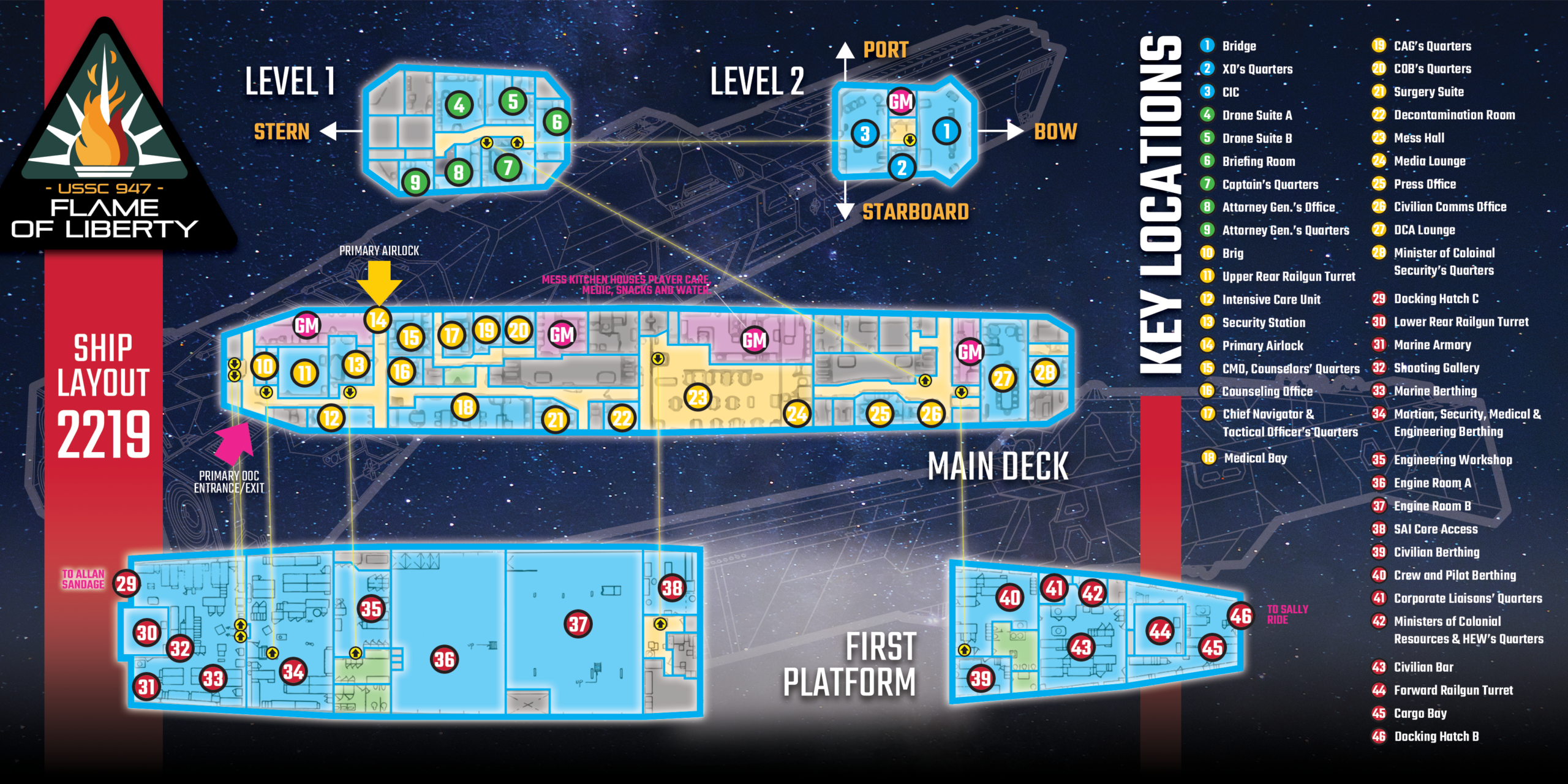
The Ascendant Dawn was hastily recommissioned and outfitted for the mission, turning the ship into a space-bound jack-of-all-trades. Officer areas were repurposed for the fleet’s colonial governor, who would stay aboard the vessel until the massive Bastion could be fully deployed at the destination. A secure portion of the ship was converted into a Martian embassy, supplementing the Martian work aboard their own vessel, the Allan Sandage. A region of the ship for Orbital Marines was established, a compliment the Dawn had lacked even in the days of the Solar War. Areas specifically for journalists were also set aside, allowing the press to document the monumental event at its source.
As the Outbound Hope fleet looks to venture beyond the Sol System and into the unknown, they bring with them the rich legacy of the Ascendant Dawn into a new and glorious future.
SHIP CLASS:
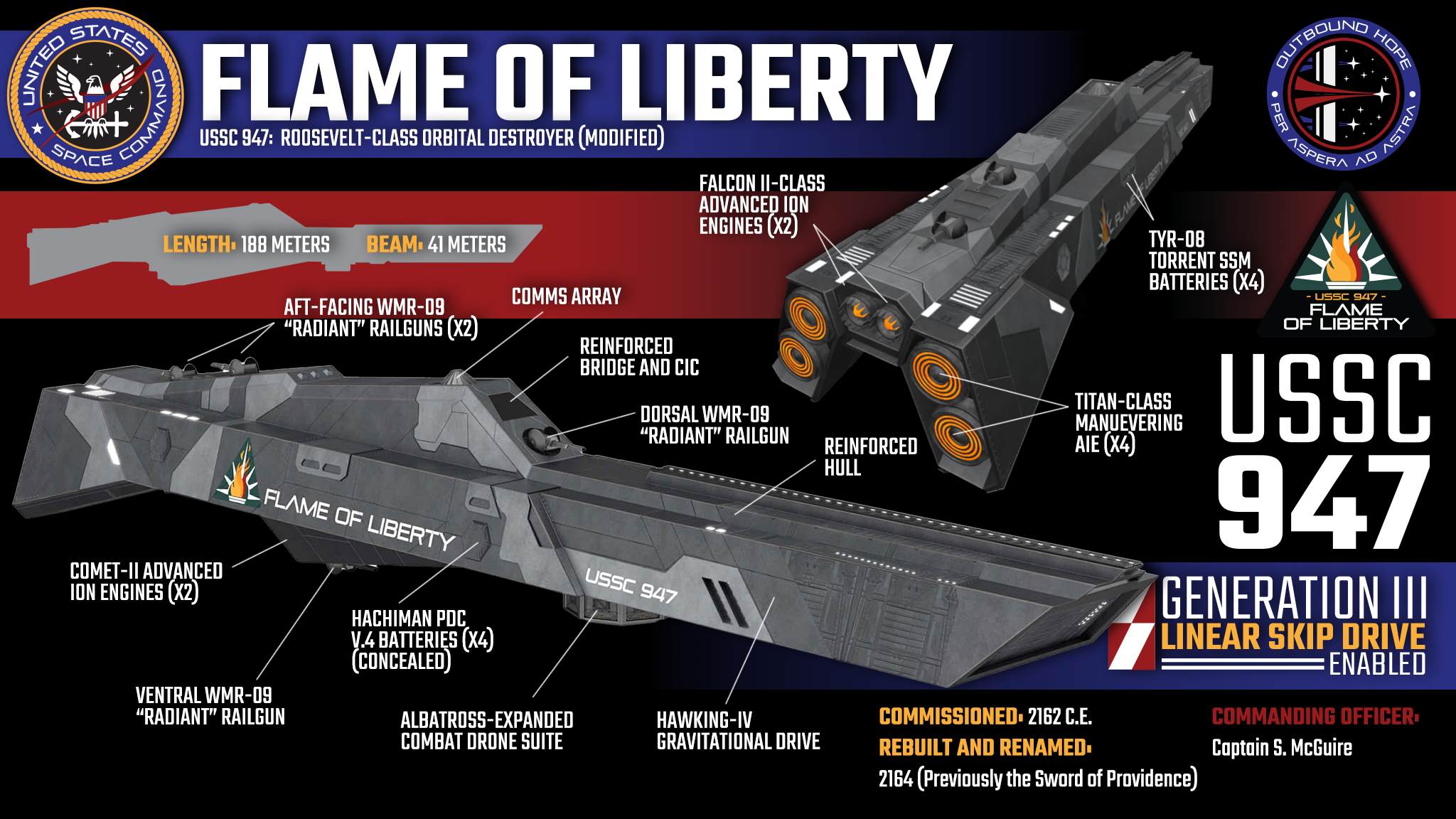
Roosevelt-Class Orbital Destroyer
MANUFACTURER:
Windfall Starship Systems, Inc.
ACTIVE COMMANDING OFFICER:
Capt. S. McGuire
COMMISSIONED:
2162 (As the Sword of Providence)
REBUILT AND RENAMED:
2164 (Renamed the Flame of Liberty)
LENGTH:
188 Meters
BEAM:
41 Meters
COMPLEMENT:
60-110, Depending on configuration and mission profile
ARMAMENTS:
x4 WMR-09 “Radiant” Magnetic Railguns
x4 TYR-G8 Torrent SSM Batteries
x4 Hachiman PDC v.4 Batteries
DRONE SUITE:
x1 Albatross-EXPANDED Combat Drone Suite
STANDARD PROPULSION:
x2 Falcon II-Class Advanced Ion Engines (AIE)
x2 COMET-II AIE
x4 Titan-Class Maneuvering AIE
GRAVITATIONAL PROPULSION:
x1 Hawking-IV Gravitational Drive
ADDITIONAL PROPULSION:
x1 Generation III Linear Skip Drive
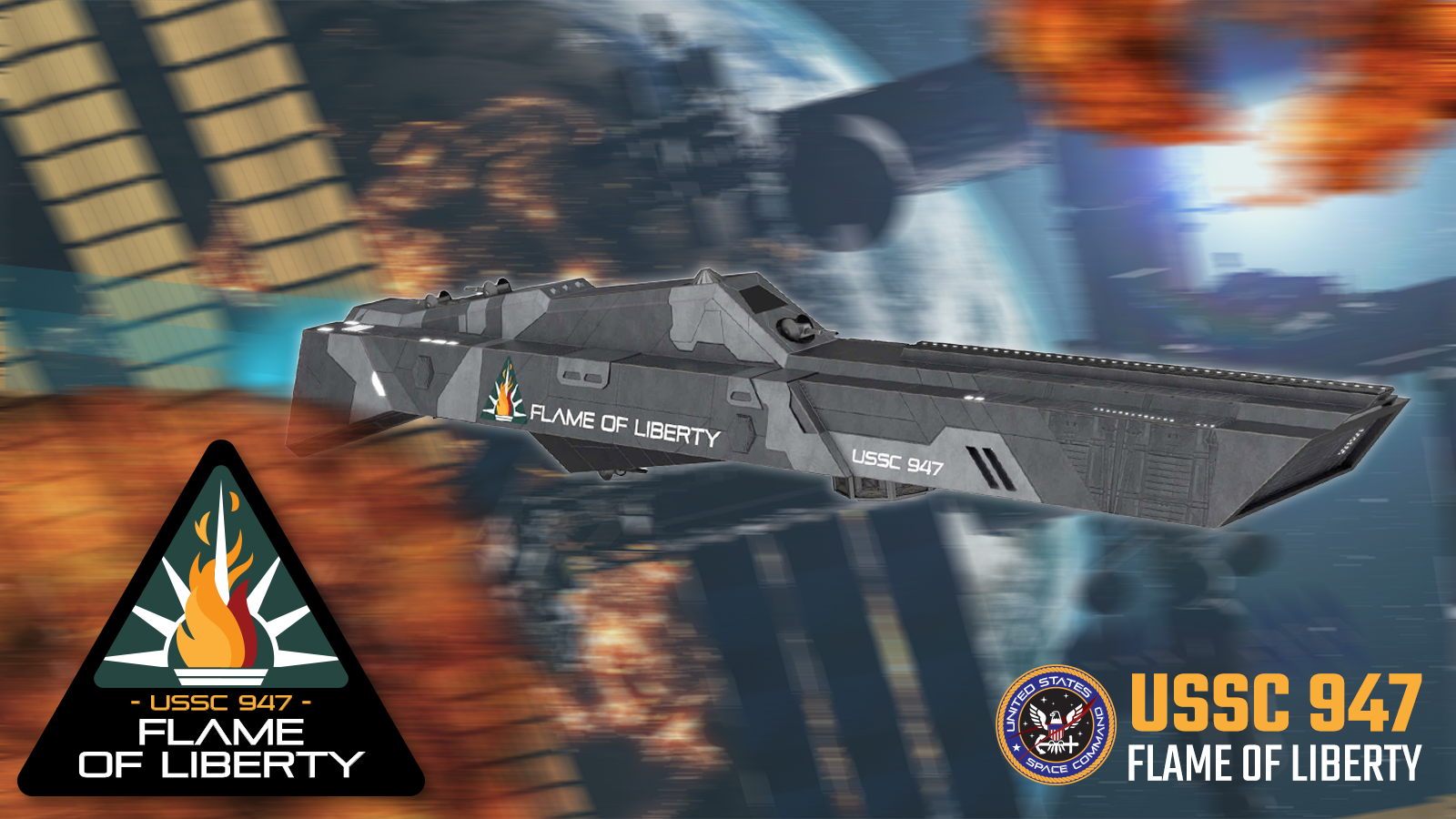
While the Ascendant Dawn was and continues to be considered the hero of the Solar War in the minds of the American public, some have asserted other vessels were far more worthy of the title. Such was the case for the Flame of Liberty, another Roosevelt-Class orbital destroyer that rose to notoriety during the war’s penultimate battle over Titan.
Much like the Dawn, the Flame was one of twelve Roosevelts constructed by Windfall Starship Systems and completed in the spring of 2162. Initially, the ship was christened as the Sword of Providence and was immediately given over to the command of Capt. Melanie Bhatia. The Sword’s agility, formidable armament and inclusion of the controversial linear skip drive made it a revolutionary design, meant to support the slower, hulking flagship – the New Liberty. The Sword of Providence was officially commissioned on April 2, 2162 and immediately deployed alongside her sister ships to defend the Windfall shipyards at Titan. Much like the bases at Luna, the shipyards had become a constant target for the superior numbers of the Chinese fleet since the conflict’s beginnings.
Just four months later, the Battle of Titan earned the Dawn its place in history with Capt. Miles Edson’s famous gambit. Maneuvering his vessel to strike at the crippled New Liberty, the Dawn fired on the reactor, igniting it and crippling the Chinese fleet. As the Dawn skipped away, Edson rallied the remaining American ships and soon won the day.
Yet far less known are the efforts of Capt. Bhatia and the crew of the Sword. After successfully harrying Chinese cruisers for several hours, the imminent destruction of the New Liberty dreadnought forced Bhatia to change tactics. The flagship, having borne the brunt of Chinese missiles and railguns, found itself on the brink of a complete systems collapse. As the crew of the New Liberty began an immediate evacuation, the all too fragile escape capsules became easy prey for enemy ships.
Hearing reports of the flagship’s defeat and with a sudden lack of communication from high command, Bhatia made the decision to disengage hostilities and launch a full-scale rescue operation. The Sword of Providence rushed toward the New Liberty, utilizing its skip drive to hop past storms of debris and enemy missiles. Engaging magnetic systems meant for securing cargo, the Sword gathered up over half a dozen escape capsules before skipping back to the Ark of Mercy – one of the fleet’s remaining medical cruisers. With its cargo delivered safely, Bhatia repeated the run four more times before Edson performed his famous maneuver aboard the Ascendant Dawn. The New Liberty was completely annihilated and much of the surrounding region was doused in a wave of deadly gamma radiation.
While Edson rallied the American ships to strike at the vulnerable Chinese fleet, Bhatia saw no reason to discontinue her previous efforts. Yet earlier runs had taken their toll, damaging many of the Sword of Providence’s systems, including radiological defenses. Knowing that continued radiation exposure would place all their lives in jeopardy, she addressed her crew as they unloaded their most recent batch of survivors:
“Crew, this is your captain speaking. What we have experienced here today is more than any should be asked to endure and yet, endure it you have. Each and every one of you is a reflection, not only of the best parts of our nation… but of all humanity. The lives we have fought for and saved here today are a testament to your selflessness, your courage, and your compassion.
“I have been informed that the radiation protections of the Sword have been compromised and, though not yet to lethal levels, we have all already received more than our fair share of rads. I cannot, in good faith, order you all back to stations. But there are still people out there, people who need our help. And so you all have a choice before you: For those of you who wish to stay aboard the Ark, I advise you to do so without shame or reservation. Go home to your families and your loved ones. Carry our spirit forward and tell our stories. You have fought this war to its end as far as I see it and you have earned your respite and honor.
But this ship… our ship… the Sword of Providence… stands ready to support our comrades left across the battlefield, no matter the cost. I ask not as your captain but as a fellow human being that you join me in bringing those people home. Let us be the flame that lights the path to hope…”
– FINAL TRANSMISSION OF CAPT. MELANIE BHATIA (USSC 947 SWORD OF PROVIDENCE)
As Bhatia concluded her words, she instructed her helmsman delay departure from the Ark of Mercy, to give those who wanted to leave time to do so. Yet immediately it became apparent: none of the crew sought to disembark. Bolstered by that knowledge, the Sword left the Ark of Mercy behind and skipped back into the irradiated battlefield, completing another three successful runs.
On her fourth run, a Chinese destroyer delivered a direct hit to the now-limping Sword, crippling the ship’s engines and shutting down its reactor. The disabled vessel careened into the debris field, bouncing from impact to impact. Within moments, the entire crew – including Capt. Bhatia – were lost and the Sword became another wreck adrift over Titan.
In the months to follow, American haulers returned to the site of the battle to begin gathering the dangerous scrap that now floated perilously close to the bases over Titan. Among the recovered debris was the wreckage of the Sword of Providence, which was hauled back to drydock to remove its classified – and by that time illegal – skip drive technology.
Though the USSC intended to scrap what was left of the Sword, the former vessel quickly found a swell of support. From the ship’s eight successful rescue runs, 186 individuals from the New Liberty’s crew had been saved. 152 of them would survive their injuries past the war. The survivors demanded that the Sword be rebuilt and restored in honor of those that had given their lives for their sake. The USSC denied the request at first, but the survivors continued to petition the American government, earning the support of several high-profile members of Congress. The USSC finally conceded. And the ship was rebuilt and returned to active status in October of 2164, its crew comprised exclusively of service members who had survived the New Liberty because of Bhatia and her crew’s efforts. To further commemorate the valiant act, the Sword of Providence was renamed the Flame of Liberty, commemorating both the words of Captain Bahtia’s famous speech and the vessel the crew had once served.
Though other Roosevelt destroyers that survived the Battle of Titan would continue on into active service, the Flame of Liberty was in a class all its own. Its reconstruction had further updated the vessel, adding significantly more armor plating and a new complement of weapon systems. While most Roosevelt ships were intended to support larger craft, the Flame had been outfitted to operate far more independently. As a result, most of the Flame’s future missions over the next several decades paid homage to the ship’s moment of glory. While patrols of trade convoys were always on the table, the Flame was often utilized for high-profile extractions, refugee support and humanitarian escort.
In the 2190’s, as most Roosevelt destroyers were beginning to be retired, the Flame was given another series of technological upgrades and began to be utilized as a transport for covert operations. Its drone suite was significantly upgraded, allowing for a complement of remote fighters. Working with the US Orbital Marines, a full barracks was added to the ship’s lower levels, assisting a series of black ops missions that have only recently been declassified. Their engagements included everything from undermining the growth of the Grayson Rebellion to countering attacks by the Guardians of the Gates of Heaven. Most recently, two pairs of Hachiman perimeter defense cannons were added to the Flame’s already impressive armament, greatly improving the vessel’s ability to repel enemy attacks.
Though the ship’s linear skip drive remained aboard the vessel throughout the decades, reports show it was never utilized. Doing so would violate any number of interplanetary treaties. Its use was seen as something only for the most extreme of emergencies that fortunately never came to pass.
In 2218, the Flame of Liberty was, at long last, slated for decommissioning. Its final duties were to patrol the busy shipyards at Titan, who were already alive with the construction of the new Outbound fleet. When Admiral Peter Kohler caught wind of the intended retirement, he quickly intervened and suggested “the tough old girl” be given one last assignment within the ranks of the Outbound fleet and to fly once more with her sisters.
SHIP CLASS:
Roosevelt-Class Orbital Destroyer
MANUFACTURER:
Windfall Starship Systems, Inc.
ACTIVE COMMANDING OFFICER:
Cpt. K. Halloway
COMMISSIONED:
2162
LENGTH:
188 Meters
BEAM:
39.5 Meters
COMPLEMENT:
40-95, Depending on configuration and mission profile
ARMAMENTS:
x4 WMR-08 “Radiant” Magnetic Railguns
x4 TYR-G5 Torrent SSM Batteries
DRONE SUITE:
None
STANDARD PROPULSION:
x2 Falcon II-Class Advanced Ion Engines (AIE)
x2 COMET-II AIE
x4 Titan-Class Maneuvering AIE
GRAVITATIONAL PROPULSION:
x1 Hawking-IV Gravitational Drive
ADDITIONAL PROPULSION:
x1 Generation III Linear Skip Drive
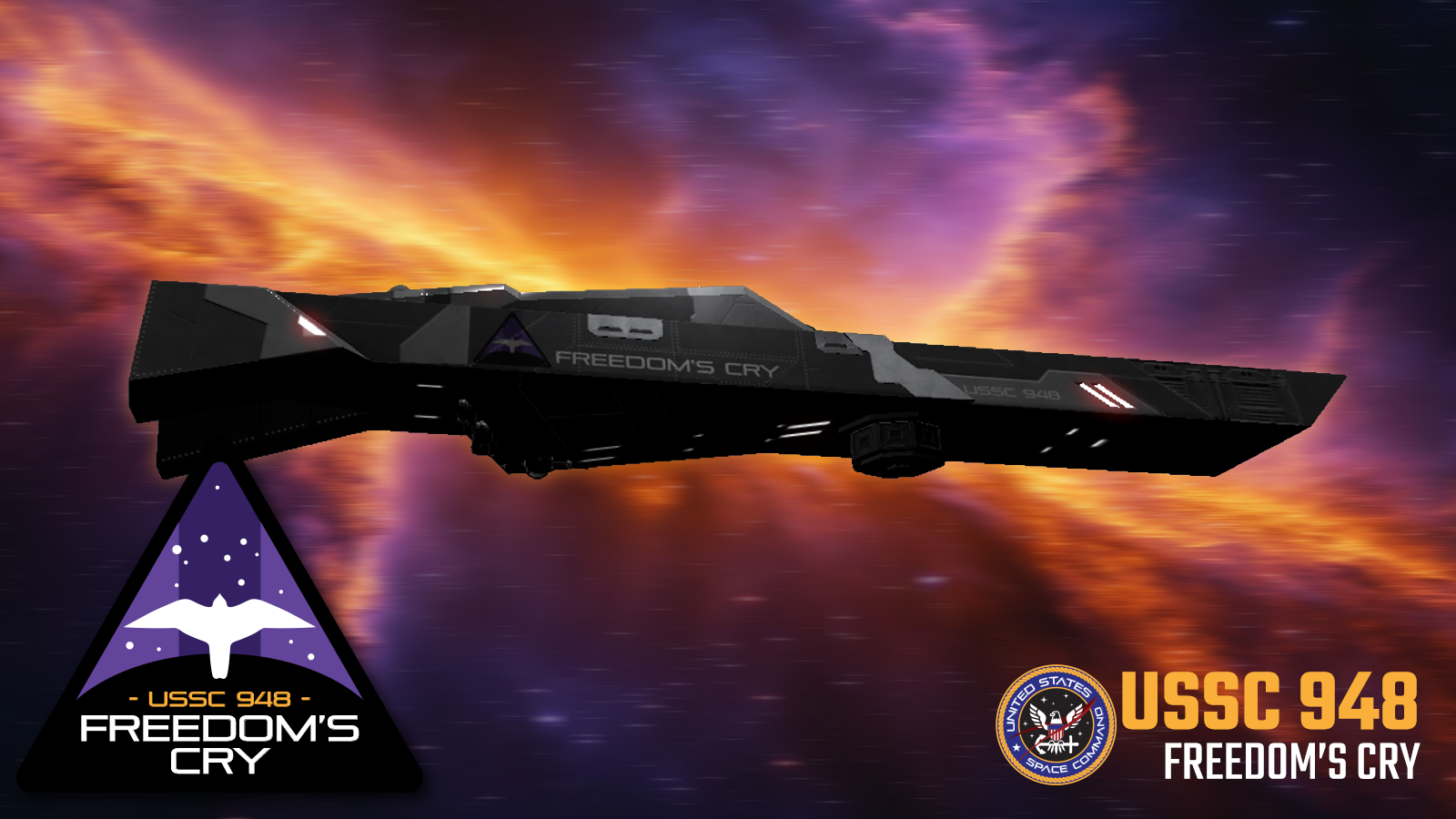
Like her sister ships, the Freedom’s Cry was born of desperation. Constructed during the height of the Solar War, the Roosevelt-Class represented Windfall Starship Systems’ willingness to deploy experimental technologies into active combat. Agile, heavily armed for their size, and equipped with the controversial linear skip drive, these destroyers were designed to complement the massive dreadnought New Liberty.
However, unlike many of her sister ships, the Freedom’s Cry was never heavily modified for specialized roles. This relative “purity” of design would prove to be her greatest strength.
During the Battle of Titan, the Freedom’s Cry was assigned to the outer defensive screen, operating in tandem with several other Roosevelt destroyers to delay advancing Chinese formations. While ships like the Ascendant Dawn executed daring offensive maneuvers and the Sword of Providence (later Flame of Liberty) undertook rescue operations, the Freedom’s Cry remained locked in sustained combat along the periphery.
Over the course of the battle, the Cry engaged multiple enemy cruisers and missile platforms, relying on coordinated maneuvering and precise railgun fire to disrupt incoming waves. Though heavily strained, the ship avoided catastrophic damage—due in no small part to disciplined command decisions that prioritized survivability over risky engagements.
When Captain Miles Edson’s decisive strike triggered the destruction of the New Liberty, the Freedom’s Cry was positioned far enough from the blast center to avoid the worst of the radiation and debris wave. While many ships were crippled or destroyed outright, the Cry emerged battered—but intact.
This status made her an immediate asset in the aftermath of the battle. As the American fleet regrouped, the Freedom’s Cry served as a command relay node, coordinating damaged vessels and helping reestablish operational cohesion in the absence of centralized leadership.
Following the war, the Freedom’s Cry was reassigned to the Homefront Armada, a temporary defensive fleet stationed in orbit over the United States in the post-Solar War era. Though lacking the fame of her sister ships, the Freedom’s Cry became one of the most consistently deployed vessels in the USSC. Officers often referred to her as “the ship that stayed ready.”
By 2218, the Freedom’s Cry—like the rest of the Roosevelts—was deemed outdated. Plans were made for her decommissioning, with discussions ranging from scrapping to limited preservation.
However, the emergence of the Outbound Hope Mission changed her fate.
With the Ascendant Dawn selected as flagship, it became clear that the symbolic and practical value of the Roosevelt-Class had not yet faded. The Freedom’s Cry sprang back into relevance, undergoing a modest retrofitting to support long-duration escort operations beyond the Sol System.
If the Ascendant Dawn inspired a nation and the Flame of Liberty embodied its compassion, then the Freedom’s Cry ensured that both legacies endured. The Freedom’s Cry represents a different kind of heroism—one not defined by singular acts of brilliance or sacrifice, but by consistency, discipline, and survival.
SHIP CLASS:
Lincoln-Class Light Cruiser
MANUFACTURER:
Windfall Starship Systems, Inc.
ACTIVE COMMANDING OFFICER:
Capt. N. Cortes
COMMISSIONED:
2182
LENGTH:
332.5 Meters
BEAM:
82 Meters
COMPLEMENT:
125-160, Depending on configuration and mission profile
ARMAMENTS:
x1 Onager-Class Heavy Railgun (v.8)
x8 WMR-12 “Old Glory” Magnetic Railguns
x6 TYR-G9 Torrent SSM Batteries
x2 TYR-G7 Torrent SSM Batteries
x6 Endeavor (WSS 6.2) PDC Batteries
DRONE SUITE:
x2 NIMITZ-2 EXPANDED Heavy Combat Drone Suite
STANDARD PROPULSION:
x3 Imperial-Class Advnaced Ion Engines (AIE)
x16 Titan3-Class Manuevering AIE
GRAVITATIONAL PROPULSION:
x1 Excelsior II Gravitational Drive
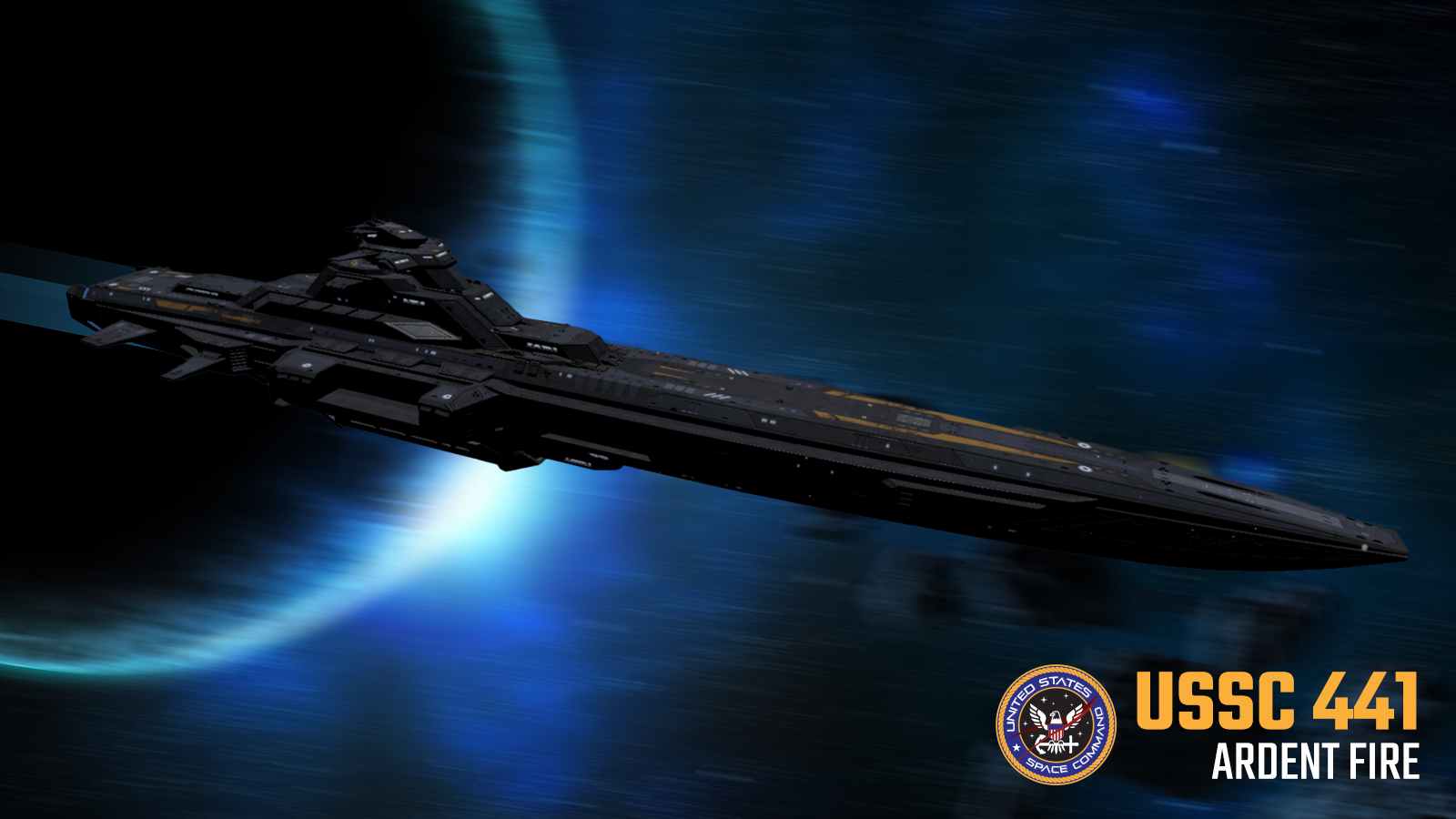
The Lincoln-Class cruiser evolved out of a need for heavy warships in the wake of the Solar War of the mid-22nd century. With US interests now stretched across every corner of the Sol system, the navy needed a vessel that was capable of substantial speeds, heavy armament and – when necessary – operational independence. While some factions within the Windfall Starship Corporation and the US Congress encouraged the United States to disregard the treaties that had mothballed the Linear Skip Drive technology characterizing the Roosevelt line, more pragmatic voices began work on what would ultimately prove to be a far more lasting design.
From their launch in the early 2180’s, the Lincoln class of light cruisers would become the workhorse of the USSC over the next three decades.
The Ardent Fire was commissioned at Titan Shipyards in 2182 along with six of her sister ships – including the Bright Pinnacle. Her early years were lackluster, with several early missions patrolling Minerva Station from pirate raids or protecting the Bifrӧst against ambitious rival factions that never materialized.
When the Grayson Rebellion broke out in the mid-2190’s, the Fire and its sister ship, the Pinnacle, were mobilized by then-Captain Peter Kohler in the daring counter-attack that would ultimately topple Grayson and crush the rebellion. As the remaining traitors retreated into hiding obscurity, the USSC organized a specialized task force, Gold Group, to hunt down the survivors. With Kohler – now elevated to the rank of admiral – uninterested in overseeing the task force, the role passed to Captain Evangeline Knapp who utilized the Fire as her flagship. Over the next ten years, Gold Group was able to recapture 23 rebel vessels, destroy 12 more, and recover trillions in US property and Windfall technologies.
Frequent engine issues became a hallmark of the Lincoln line by the 2210’s, with the Fire spending more time in drydock than on active duty for several years. In 2215, the USSC made the decision to decommission half of the remaining Lincolns by the following year. The remaining ships – the Ardent Fire and the Bright Pinnacle among them– would receive full engine retrofits, but would thereafter be retained only for simple patrols and base defense. The newly-minted Dauntless– and King-Class Cruisers would replace the Lincolns’ former niche.
The Fire and Pinnacle were pulled from this fate by Admiral Kohler himself, who personally requested the ships be added to the Outbound Fleet. The request shocked many naval and congressional leaders, especially considering the longstanding personality conflicts that existed between Kohler and the sometimes-abrasive Commander Nathaniel Cortes of the Fire. Still, the moved pleased warhawks within the USSC and the two ships were proudly added to the roster, substantially increasing the firepower of the Outbound escort.
SHIP CLASS:
Lincoln-Class Light Cruiser
MANUFACTURER:
Windfall Starship Systems, Inc.
ACTIVE COMMANDING OFFICER:
Comm. Joan Thompson
COMMISSIONED:
2182
LENGTH:
332.5 Meters
BEAM:
82 Meters
COMPLEMENT:
125-160, Depending on configuration and mission profile
ARMAMENTS:
x1 Onager-Class Heavy Railgun (v.7b)
x8 WMR-12 “Old Glory” Magnetic Railguns
x6 TYR-G9 Torrent SSM Batteries
x2 TYR-G7 Torrent SSM Batteries
x6 Endeavor (WSS 6.2) PDC Batteries
DRONE SUITE:
x2 NIMITZ-2 EXPANDED Heavy Combat Drone Suite
STANDARD PROPULSION:
x3 Imperial-Class Advnaced Ion Engines (AIE)
x16 Titan3-Class Manuevering AIE
GRAVITATIONAL PROPULSION:
x1 Excelsior II Gravitational Drive
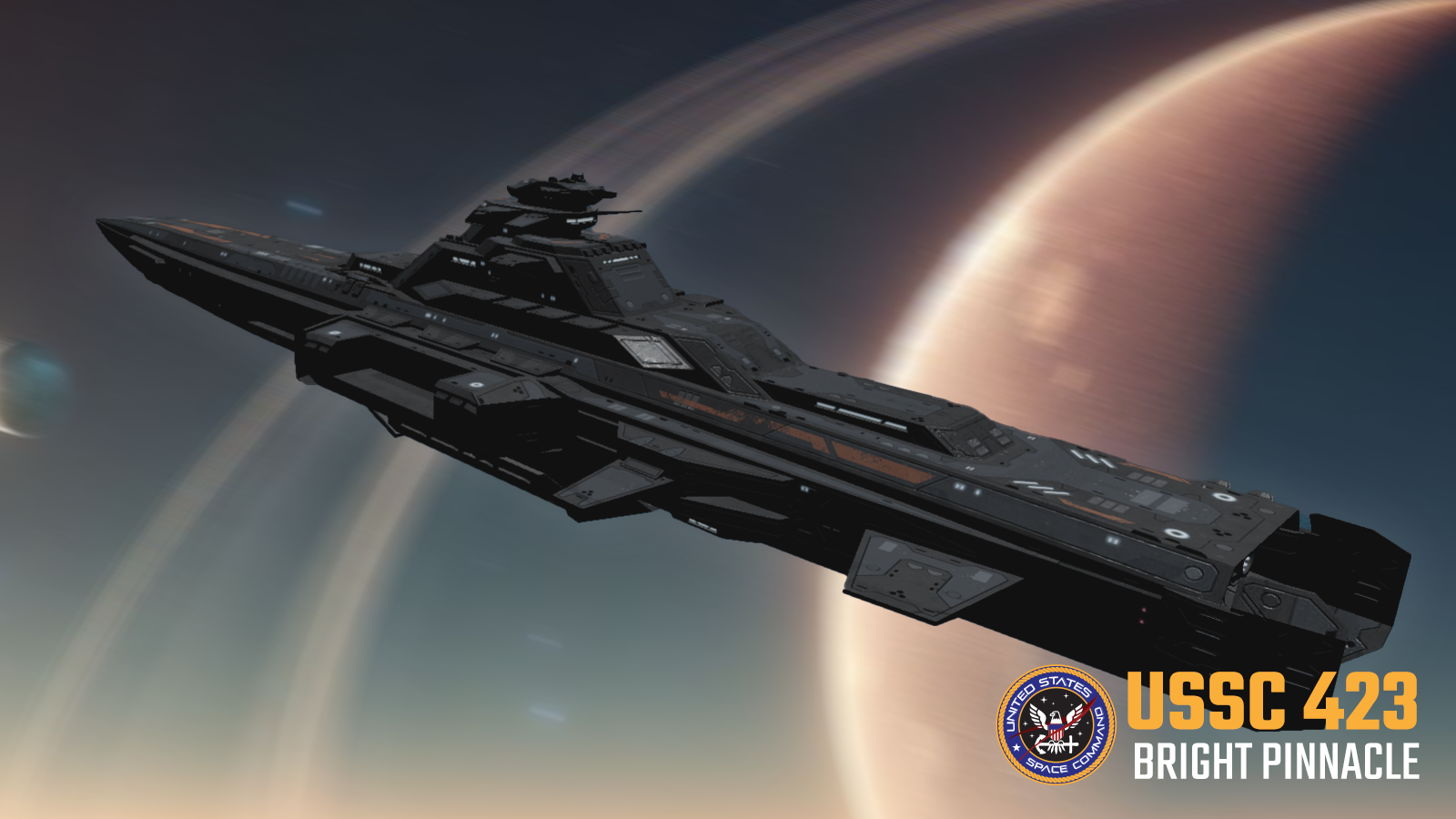
Much like its sister ship, the Ardent Fire, the Bright Pinnacle was one of seven Lincoln-class cruisers brought into service in 2182. Through much of the 2180’s and into the 2190’s, the Pinnacle served in patrolling the often-targeted supply lines between Earth and the rapidly expanding Titan Shipyards.
The Pinnacle and the Fire were reunited once again in 2194, when Windfall engineers recalled the Lincoln ships to fix a faulty power grid that had plagued the ships for years. The retraction was the catalyst for the famed Grayson Rebellion at the end of that year, but also placed both the Pinnacle and the Fire in a perfect position to strike back against the rebel fleet. Under Captain David Zhao, the Pinnacle soon joined Captain Peter Kohler in crushing the rebels over Enceladus. The response claimed Zhao’s life, but earned him the Medal of Honor in 2196.
After extensive repairs – including a complete reconstruction of the ship’s primary bridge – the Pinnacle was soon assigned to the Gold Group taskforce, assisting in the hunt for remaining Grayson sympathizers throughout the system.
In the early months of 2219, Kohler – now an admiral – requested that the aged Pinnacle once more join the Fire in escorting the Outbound Fleet. Commander Joan Thompson, previously a junior officer aboard the Ascendant Dawn during the Grayson Affair, was honored to accept Kohler’s invitation. She looks forward to assisting the Outbound Hope Mission in the new star system.
Unlike the lighter-armed Roosevelts, the Lincoln vessels are considerably more formidable. Boasting 23 weapons hardpoints and two enormous combat drone hangars, the Lincolns are able to serve as both a battleship and a carrier in equal measure. Mission profiles typically station four dozen marines aboard the vessels, though significantly fewer are assigned for the Outbound Hope Mission.
Instead, the marine barracks has been retrofitted to house the Outbound Hope Mission’s USSC science team. While Martian teams exist on both the Ascendant Dawn and the Allan Sandage, the Pinnacle’s American science team are in place to support the DCA leaders also stationed aboard the vessel – namely the Ministers of Colonial Development and the Environment.
SHIP CLASS:
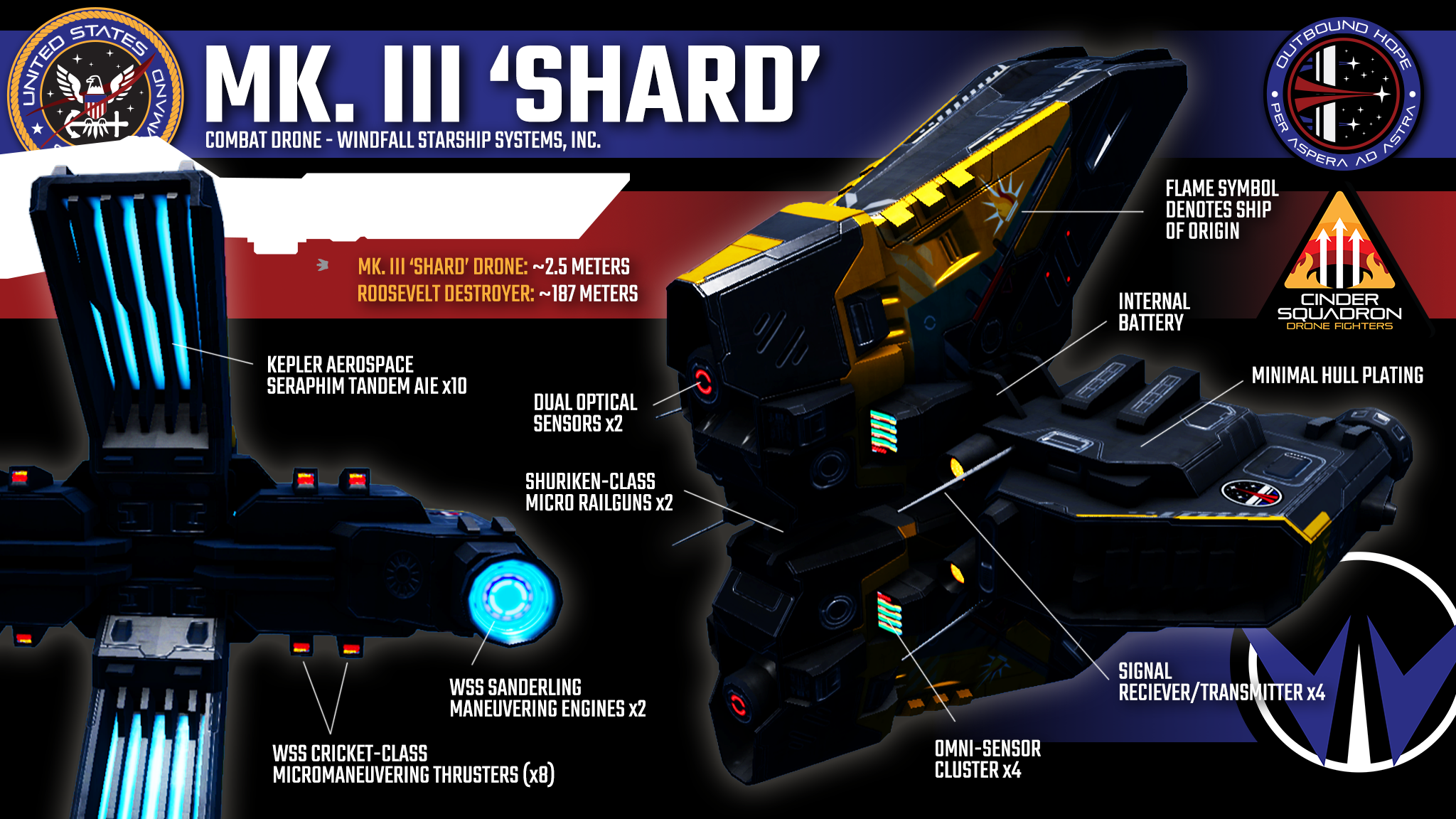
Mk. III “Shard” Drone Fighter
MANUFACTURER:
Windfall Starship Systems, Inc.
PRODUCTION
2218 to PRESENT
LENGTH:
2.5 Meters
HEIGHT:
2.7 Meters
COMPLEMENT:
None (single or double-pilot in remote hub)
ARMAMENTS:
x2 Shuriken-Class Micro Railguns
STANDARD PROPULSION:
x10 Kepler Aerospace SERAPHIM Tandem AIE
x2 WSS Sanderling Maneuvering Engines
x8 WSS Cricket-Class Micromaneuvering Thrusters
GRAVITATIONAL PROPULSION:
None
THE HISTORY OF DRONE FIGHTER COMBAT
Throughout the twentieth and early twenty-first centuries, high-speed, single-pilot aircraft dominated warfare. As humanity took to the stars, these fighter craft took on new forms, updated their technologies, and promptly followed along. Space-bound fighters – colloquially known as “starfighters,” played an integral role in every major conflict from the Orbital War to the Solar War. Massive carrier ships – capable of carrying both starfighter squadrons and their pilots – became an integral piece of national fleets throughout the Sol System.
Yet in every decade of the Space Age, starfighters possessed a fundamental problem: At such high speeds, even the smallest piece of debris could shred both ship and pilot. Attempts to add gravitational shielding proved unfeasible due to a starfighter’s small size and minimal reactor output, making starfighters one of the most statistically-dangerous vessels to serve in. Even at the peak of their use during the Solar War, starfighter pilots saw casualty rates more than three times as high as their counterparts aboard capital ships. As designers attempted to minimize cockpit space in the name of armor plating and replace glass canopies with steel hulls and video monitors, the so-called “speedy coffins” became less and less appealing to new recruits.
By the end of the Solar War, the USSC began to experiment with a return to drone technologies, suggesting a pilot would be far safer on board a capital ship while the automated fighter journeyed out and into the fray. While drone fighters had once controlled the skies of twenty-first century warfare, the speed and distances associated with space combat made drone usage unfeasible well into the twenty-second century. Windfall engineers scrambled to find solutions, ultimately turning to their often-mysterious OMEGA project.
Though specifics are highly classified, OMEGA technologies networked together a subject’s neural systems with advanced technologies, bridging the gap between humanity and machine. The earliest programs had focused on better integration between SAI systems or mechanized warsuits, but Windfall engineers proposed similar systems could be utilized to better network pilot and drone. While the technology took several generations to perfect and saw sporadic use in the decades to follow, the system proved sufficiently safe for mass deployment of integrated “Omega-C” drone pilots by the beginning of the 2210’s. Communication delays between pilot and drone dropped dramatically, allowing for drones to deploy over a far larger area – and maintain their remarkable speeds – while their pilots continued to operate from the safety of a larger vessel.
As the Omega-C program took hold, the USSC found itself facing a new problem – a lack of qualified pilots. Traditionally recruited from the ranks of commissioned officers, the rigors of training as drone pilot – combined with the genetic lottery of being a viable candidate to undergo the Omega-C implant procedures – proved to be a significant barrier that left the USSC starved for suitable candidates. In 2212, the USSC changed its doctrine, testing incoming enlisted recruits for implant compatibility and immediately placing those who passed into accelerated drone training programs.
Recently, reports of increased risk-taking behavior, impulsivity and deteriorating mental health amongst enlisted drone pilots have brought the wide spread “test-and-chip” policy of the USSC under scrutiny. The USSC has denied any correlation and assures the public that the people it entrusts with this powerful technology undergo the best in screening and continued mental health check-ups.
THE MK. III SHARD DRONE FIGHTER AND THE OUTBOUND FLEET
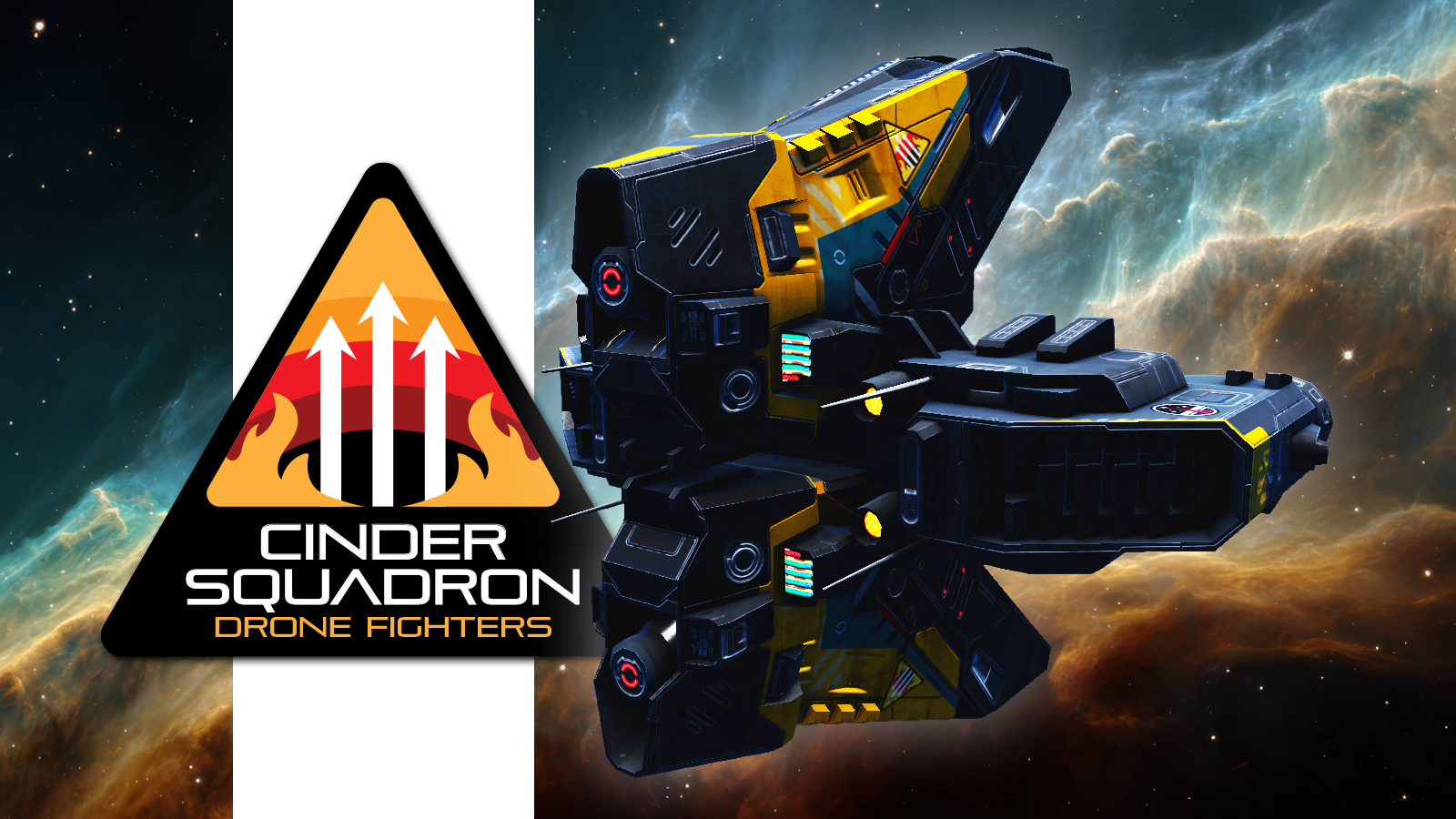
The Mk. III is the latest generation of Windfall’s combat drones, combining an outstanding balance of speed, maneuverability, firepower, and pilot-to-drone networking. Incorporating the latest Omega-C technology, drone pilots can maintain near-instantaneous communication with their craft with only minimal neural side effects.
Though usually deployed from a specifically-designed carrier, Shard fighters can also be utilized using a drone suite, an inclusive attachment that can be fitted onto any capital ship of sufficient size. Acting as a signal transmitter, a docking bay and a recharging station, drone suites have allowed for widespread deployment of Omega-C drone squadrons in the recent decade, without a full rebuilding of the USSC fleet.
Within the Outbound Hope fleet, three military vessels possess Drone Squadrons. The Lincoln-Class Light Cruisers Ardent Fire and Bright Pinnacle were each fitted with NIMITZ-2 EXPANDED Heavy Drone Combat Suites immediately upon assignment to the mission. Each vessel can field three squadrons – two utilizing standard Mk. III fighters and a third with modified Mk. IIIB sensor-configured drones.
The Roosevelt-Class Destroyer Flame of Liberty possesses a far-smaller Albatross-Expanded Combat Drone Suite, allowing it to field a half squadron of six drones at a time, with an additional six units held in reserve. The new suite – and updated drones – replace earlier models that were already fitted for previous missions undertaken by the Flame, but the ship’s squadron name – Cinder Squadron – remains a steadfast tradition.
SHIP CLASS:
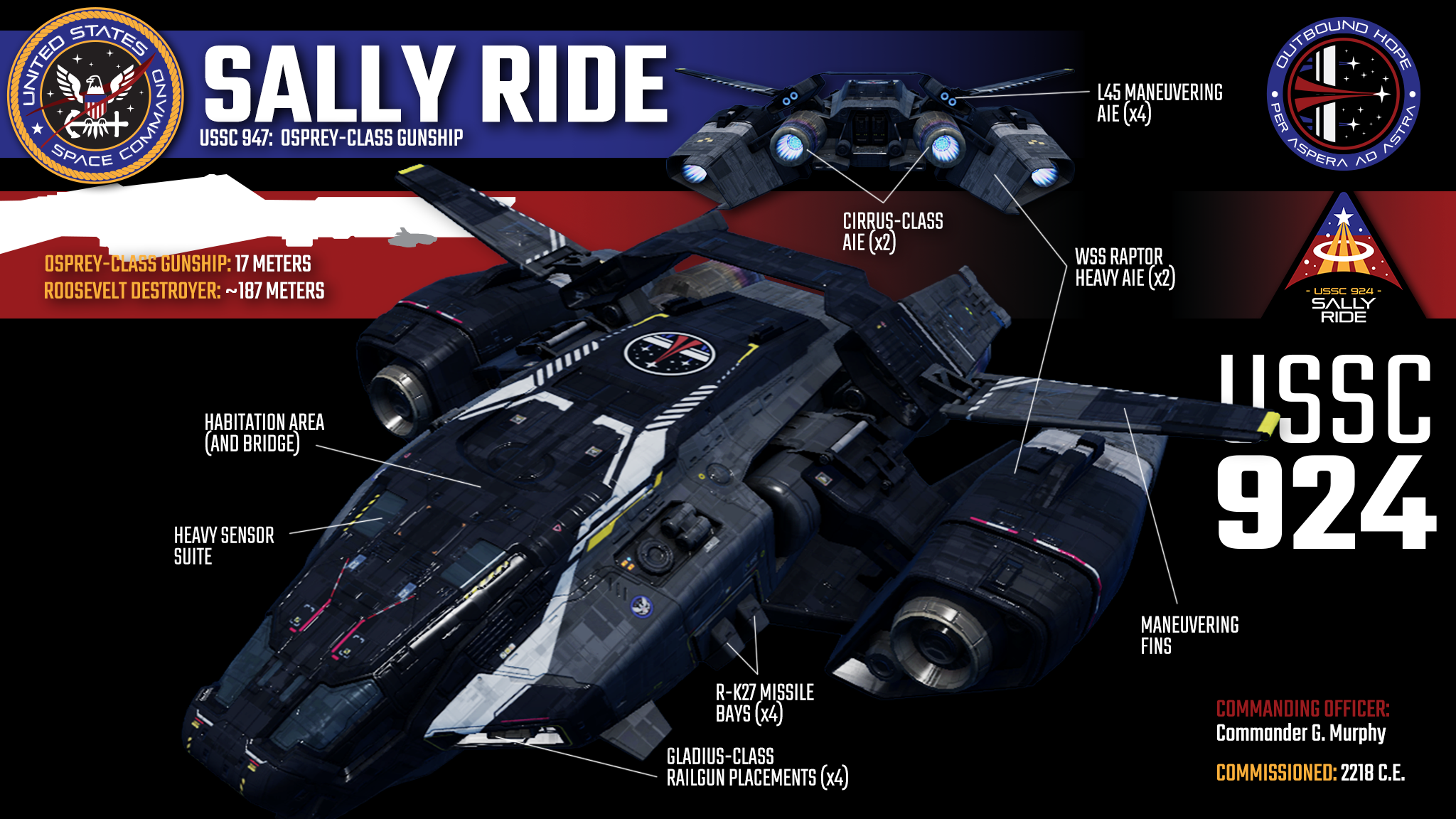
Osprey-Class Gunship
MANUFACTURER:
Windfall Starship Systems, Inc.
PRODUCTION
2218
LENGTH:
17 Meters
COMPLEMENT:
6
ARMAMENTS:
x2 Gladius-Class Railgun Placements
x4 R-K27 Missile Bays
STANDARD PROPULSION:
x2 Cirrus-Class AIE
x2 WSS Raptor Heavy AIE
x4 L45 Maneuvering AIE
GRAVITATIONAL PROPULSION:
None
Gunships are small, maneuverable vessels meant to fulfill any number of mission profiles, including scouting, surveillance, escort, and even customs and law enforcement. In combat, their heavy armament makes them ideal for capital ship support and – with proper atmospheric ratings — ground support.
The Osprey-Class Gunship was designed by Windfall Starship Systems to replace the earlier Kite-Class that had served as a workhorse of the USSC since the 2180’s. Though reliable, the Kite’s sensitive power systems and high-maintenance reactors were a frequent drain on naval resources, prompting the USSC to push Windfall into contemplating new designs. The resulting Osprey-Class improved the Kite’s design in almost every metric, boosting everything from engine speeds to magazine sizes to make an efficient and powerful weapon of war.
The Osprey is configured around a high-yield, multi-vector weapons architecture designed for rapid, large-scale target neutralization. Its missile system consists of armored launch bays housing a mix of munitions capable of independent target acquisition and course correction in contested environments. These systems enable saturation strikes across dense target zones, overwhelming both active defenses and hardened infrastructure. Complementing this is a pair of railgun placements, utilizing high-capacity capacitor banks and superconducting rails to accelerate deadly tungsten projectiles. In short, a single Osprey is capable of leveling an entire orbital station with ease.
The Osprey-Class is built to support a crew of six, relying on improved SAI integration to reduce the number of servicemembers required for sustained missions. Though a fully-outfitted Osprey is capable of operating for up to six months without resupply, such an event is unlikely. Like most gunship types, the Osprey lacks a gravitational drive. This makes the ship highly dependent on orbital or deep-space stations or capital ships and operating more often within short range mission parameters.
If the Osprey lacks anything compared to its predecessor, it would be its loss of atmospheric capability. While the Kite had an impressive atmospheric rating that allowed it to do everything from bombing runs to troop support, the Osprey’s larger frame and heavier engines made atmospheric missions untenable. The Osprey’s inabilities in this area come at no great loss to the USSC. In recent years, the change is reflective of a greater policy shift within the USSC that favors tactical orbital strikes and ground troop support, making the change a minor loss able to be reassigned to other, older vessels.
First assembled at Titan in 2218, the Osprey line has been largely untested in modern combat. Even with a general replacement of Kite gunships with newer Ospreys, military budget issues – complicated by public feuds over the funding of the Outbound Hope Mission – have made the rollout slow and lackluster. By supplying the Outbound Hope Mission with six Ospreys, Windfall hopes they can showcase their new design by making it part of one of the most important moments in human history.
INDIVIDUAL VESSELS
USSC 922
WILLFUL SOUL
COMMANDING OFFICER:
M. Suzuki
ACTIVE COMPLMENT:
6
USSC 923
SOLAR FLARE
COMMANDING OFFICER:
A. Perez
ACTIVE COMPLMENT:
6
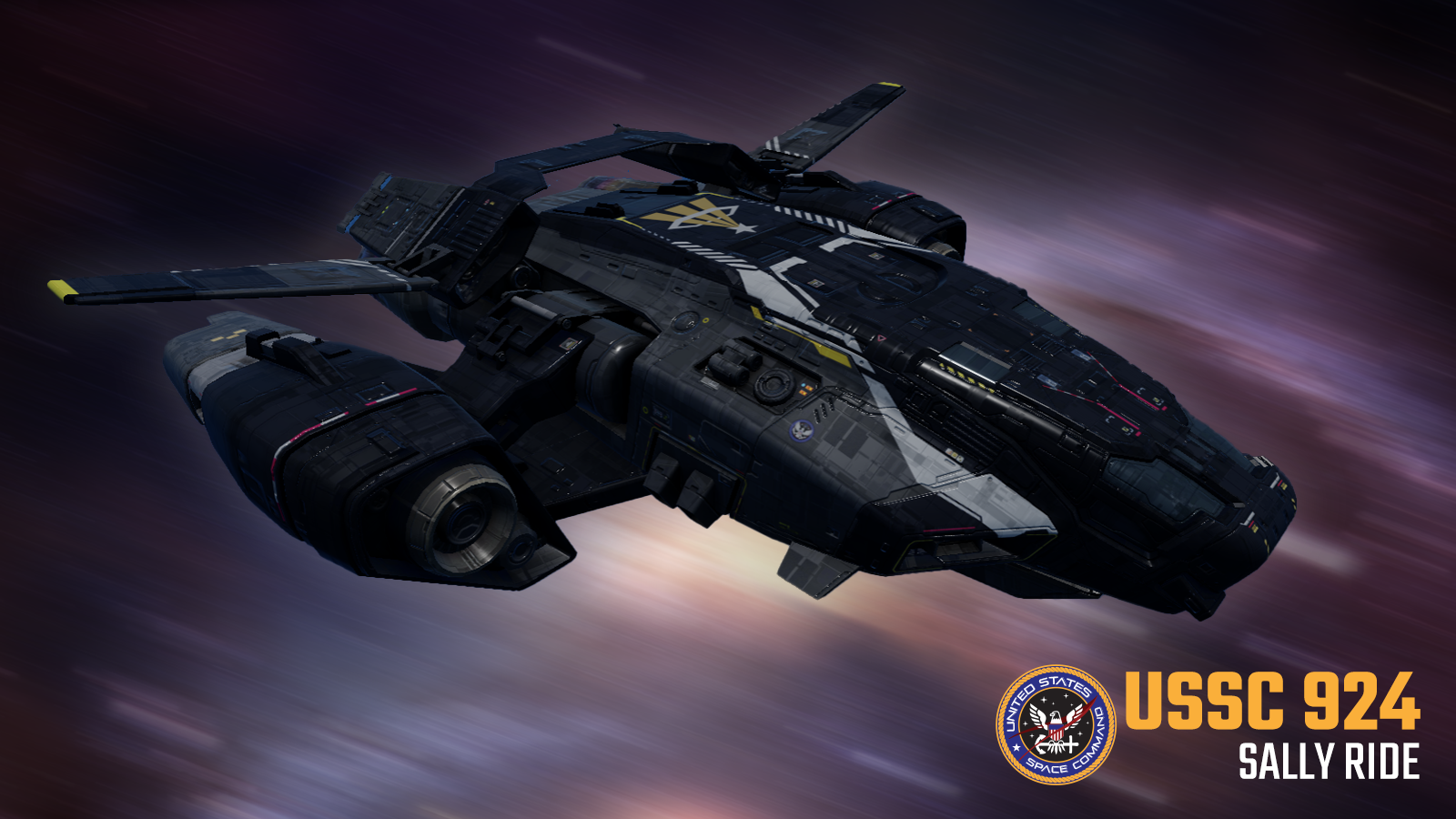
USSC 924
SALLY RIDE
COMMANDING OFFICER:
G. Murphy
ACTIVE COMPLMENT:
6
USSC 925
GOLDEN EAGLE
COMMANDING OFFICER:
T. Kato
ACTIVE COMPLMENT:
6
USSC 926
TEMPEST FORCE
COMMANDING OFFICER:
L. Fofana
ACTIVE COMPLMENT:
6
Civilian Administrative and Research Vessels
SHIP CLASS:
Citadel-Class Base Ship
MANUFACTURER:
Windfall Starship Systems, Inc.
ACTIVE COMMANDING OFFICER:
Capt. A. Booker
COMMISSIONED:
2219
LENGTH:
1705 Meters
COMPLEMENT:
Crew: 50, Passengers/Inhabitants: 700-12,000, depending on transit or settlement configuration
ARMAMENTS:
None
STANDARD PROPULSION:
x3 Goliath Heavy Transport AIE
x4 Y4400 Maneuvering AIE
GRAVITATIONAL PROPULSION:
x1 Bastion-Edition Hermes Heavy Gravitational Drive
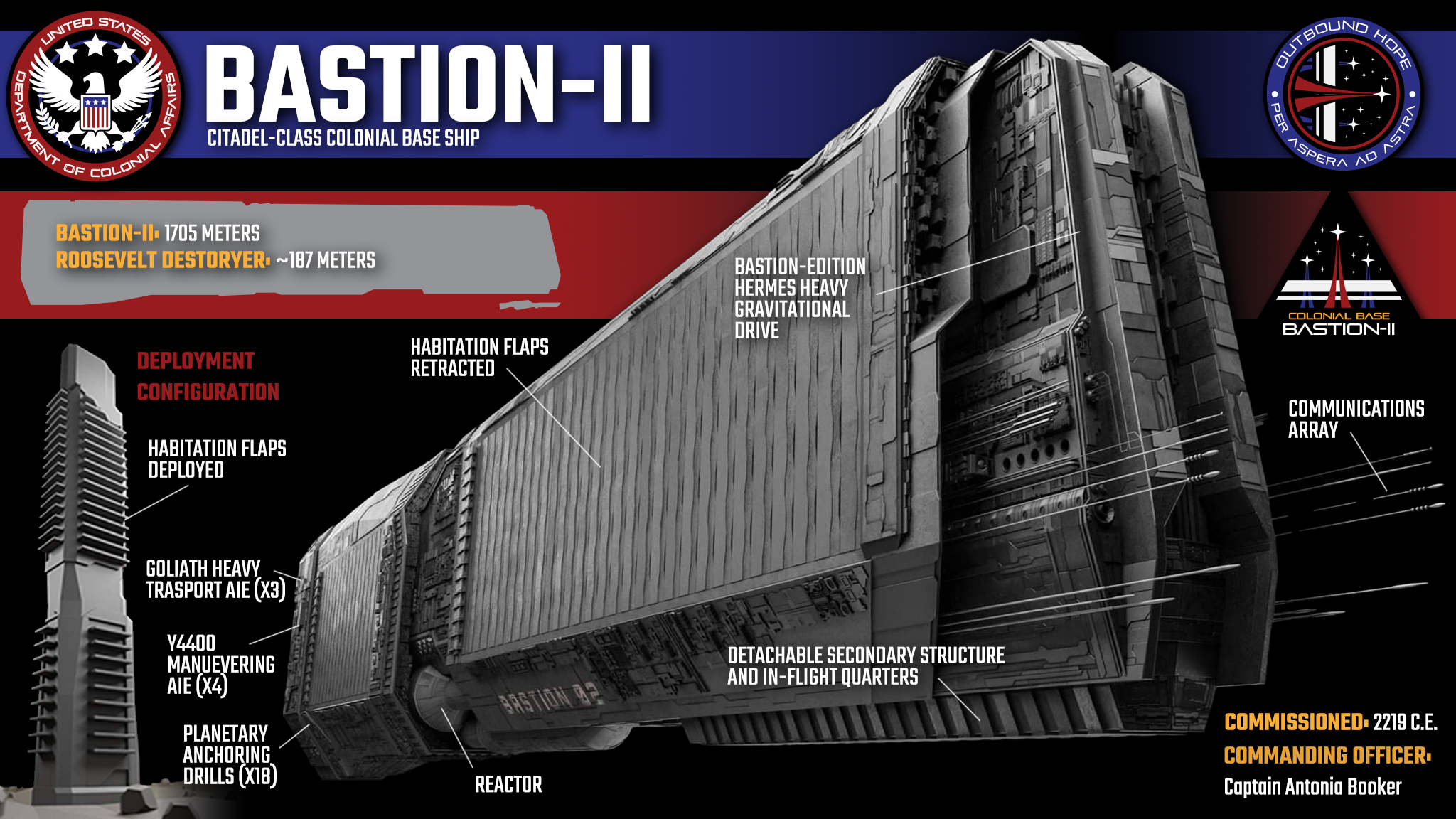
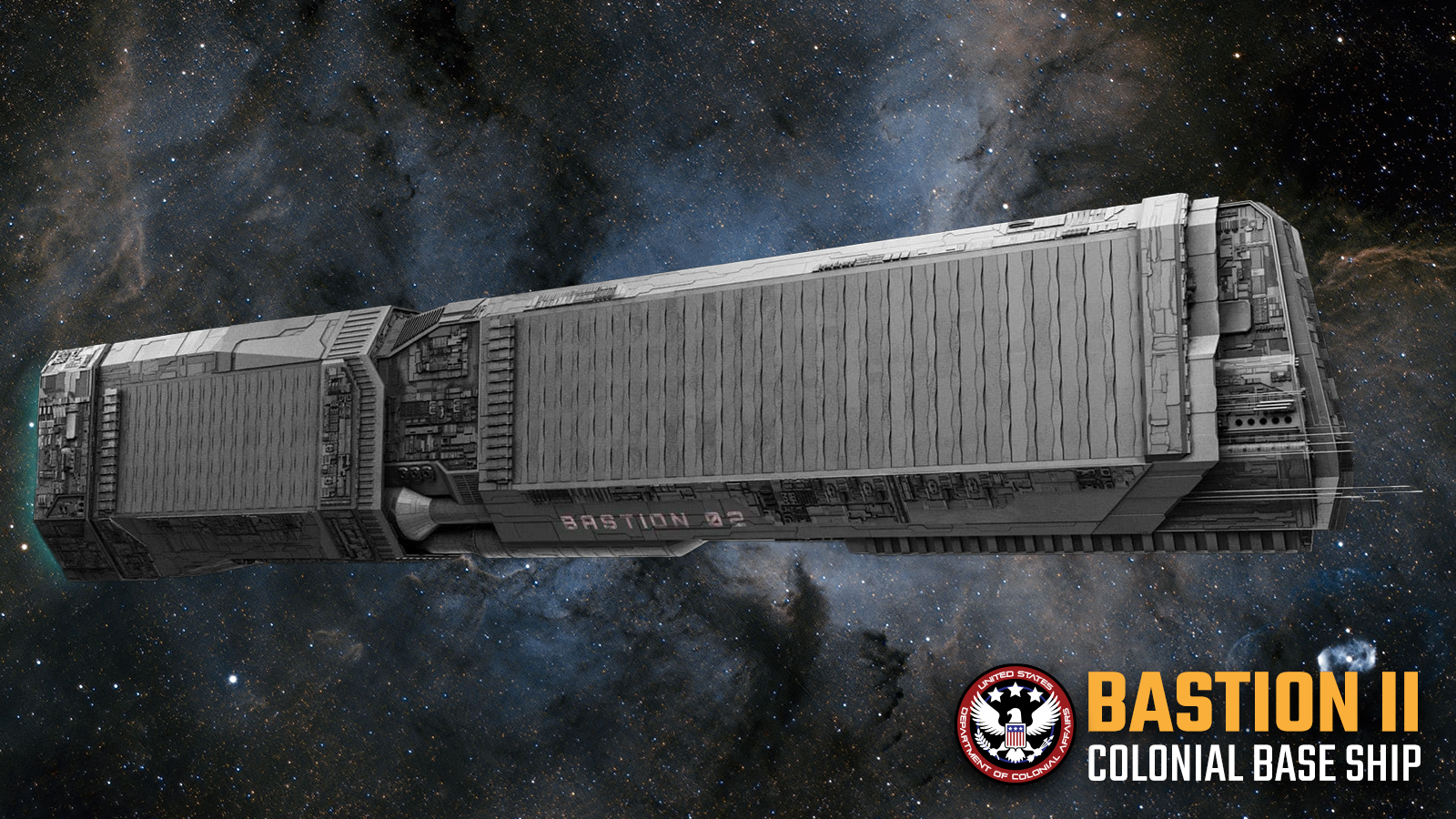
The Bastion-II is the second incarnation of base ships designed by Windfall Starship Systems for use in Outbound missions through the Bifröst. Its predecessor, the nearly-identical Bastion, was lost along with the rest of the Outbound Discovery fleet in 2169. Both Bastion ships are wonders of engineering: At nearly two kilometers in length, each was designed to be a city in and of itself.
The Bastion-II design is intended to accommodate two distinct phases of the journey through the Bifröst Station. For the transport phase, the ship is configured to travel much in the same way as any of the other vessels in the fleet, making good use of both sizable advanced ion engines and an impressive gravitational drive. Though well-equipped, the Bastion is still considered slow and will likely trail behind the far smaller and more maneuverable escort and transport ships.
Despite its massive size, the ship has been designed to fit perfectly through the Bifröst’s central opening. With less than ten meters of space for error, the actual traversing of the station will be handled exclusively by the ship’s robust Systems Artificial Intelligence (SAI) so as not to damage the vessel. Such narrow margins ensure that the Bastion is able to maximize space that will later be utilized by the Outbound colonists themselves.
In this travel configuration, the vast majority of the Bastion is intended to remain unoccupied and atmospherically decompressed, saving the bulk of the vessel’s life support systems for the next phase of the journey. The roughly 50 crew persons – as well as more than 700 passengers – occupy only a minor portion of the forward hull, often referred to simply as “The Pod.” The Pod’s orientation runs perpendicular to the rest of the ship, a configuration remedied only in the next phase of the ship’s design. In the event of extreme emergencies, The Pod is capable of detaching much like an escape capsule but lacking any significant propulsion systems beyond basic maneuverability.
Once the Outbound Fleet arrives at the intended destination, the next phase of the ship’s design will begin. Upon entering the atmosphere, the Bastion – again guided by the ship’s SAI – will pitch sharply skyward, ultimately landing with its propulsion systems planted firmly on planetary soil. At this point, a series of 18 massive drills will open at the aft of the ship, anchoring the ship into the ground as a permanent and leveled structure. Once secured, dozens of habitation levels will fold outwards, allowing glass-covered ‘exterior’ spaces that will eventually be opened to the outside environment once the atmosphere is secured.
During this process, The Pod will jettison away from the now-towering skyscraper. Its thrusters will land it safely on the ground where another set of anchor drills will work to establish a smaller – though still sizable – seat for the new government. In this way, the Pod is able to maintain its interior orientation and establish a separate and secure space for colonial administration.
Once fully deployed, the Bastion will serve as the focal point of the new Outbound colony, with thousands of residences and countless shops, restaurants and recreational areas. A central atrium will reflect natural sunlight to the structure’s lowest depths, feeding scores of gardens and interior green spaces. The top levels include an impressive auditorium space capable of holding more than 2500 people and can be used for large gatherings such as academic presentations, political meetings or even concerts and dramatic performances. The structure’s bulky communications array will quickly be activated to intercept and broadcast Sol-based interweb feeds, providing news and entertainment to the entire colony by means of the oscillator deployed at the Bifröst.
Though the Bastion — and in particular, The Pod — will eventually serve as the seat of the new government, the USSC and the DCA have both agreed the Bastion should not be the exclusive transport for colonial officials through the Bifröst and on to the planet. This decision was partly to curb the effects of accidents while in transit but also to offer officials extended facetime with members of the fleet. Government leaders should be dispersed, travelling safely within the security of USSC vessels. Only Hellen Perry, the deputy governor, will be stationed aboard the Bastion itself, with the governor and other ministers distributed between the Roosevelt and Lincoln-Class military escorts.
While the Bastion is undoubtedly an essential piece of the Outbound mission, it is not without its controversy. American taxpayers paid over four trillion dollars to construct the vessel, though many believed the funds would be better allocated toward a greater number of smaller ships and structures. Such an alternative would minimize the transit risks and costs associated with such a colossal design. Last-minute budget shortfalls caused some to question the viability of the Bastion‘s life support systems and wonder whether they will be able to persist until the planet’s atmosphere can be made stable and its air breathable. Still, American politicians and Windfall engineers continue to hail the Bastion-II as “one of the great engineering marvels of our age,” and look forward to its use as a centerpiece of a bustling and thriving extrasolar colony.
SHIP CLASS:
Turing-III Research Platform
MANUFACTURER:
Martian Engineering Union, Inc.
ACTIVE COMMANDING OFFICER:
Dr. L. Chandrasekhar
COMMISSIONED:
2216
LENGTH:
312 Meters
COMPLEMENT:
Crew: 20, Passengers (Staff): 210-230
ARMAMENTS:
None
STANDARD PROPULSION:
x8 Quasar-Class MEU2 AIE Drives
GRAVITATIONAL PROPULSION:
x8 Herschel-IV Gravitational Drive
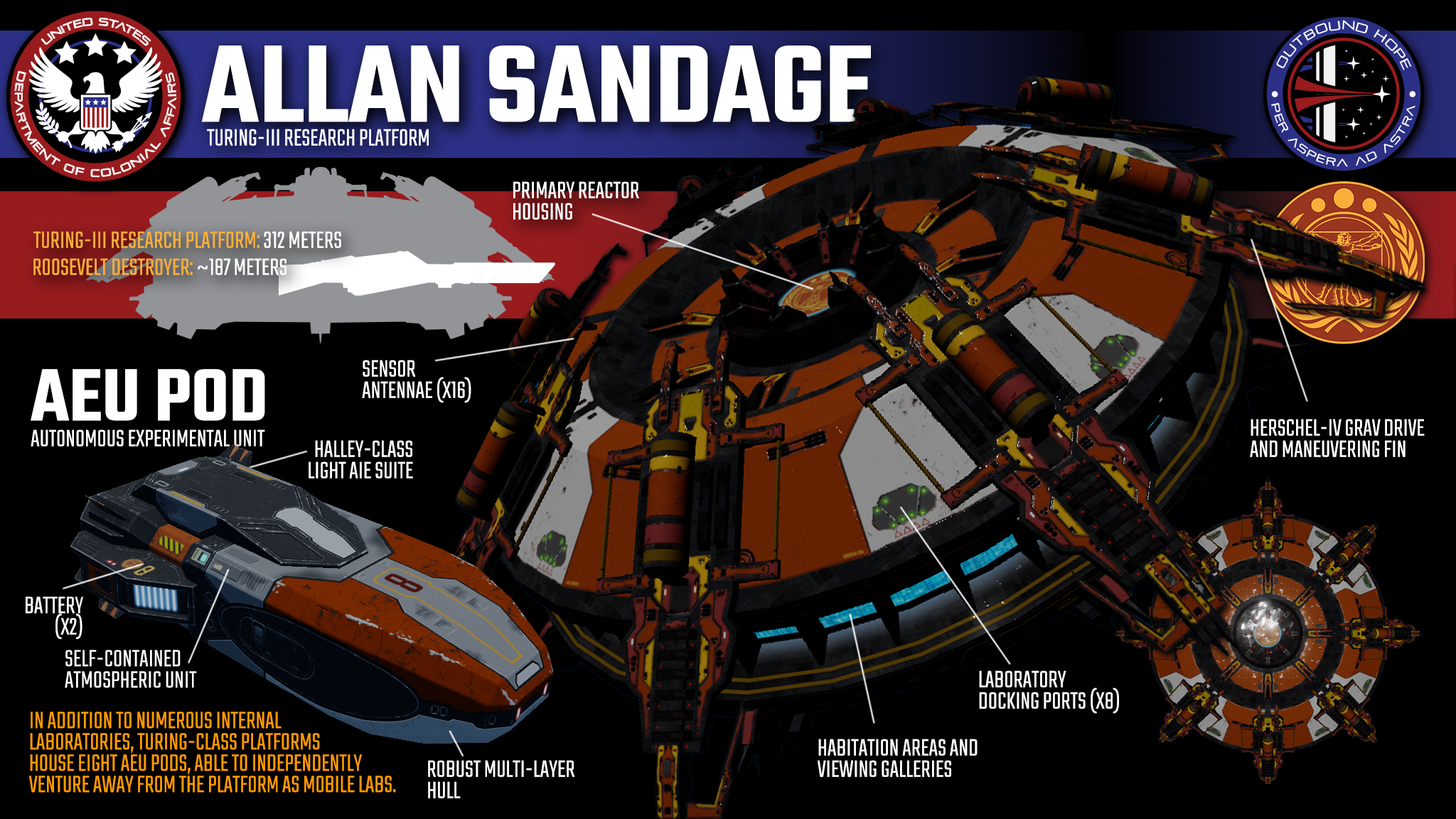
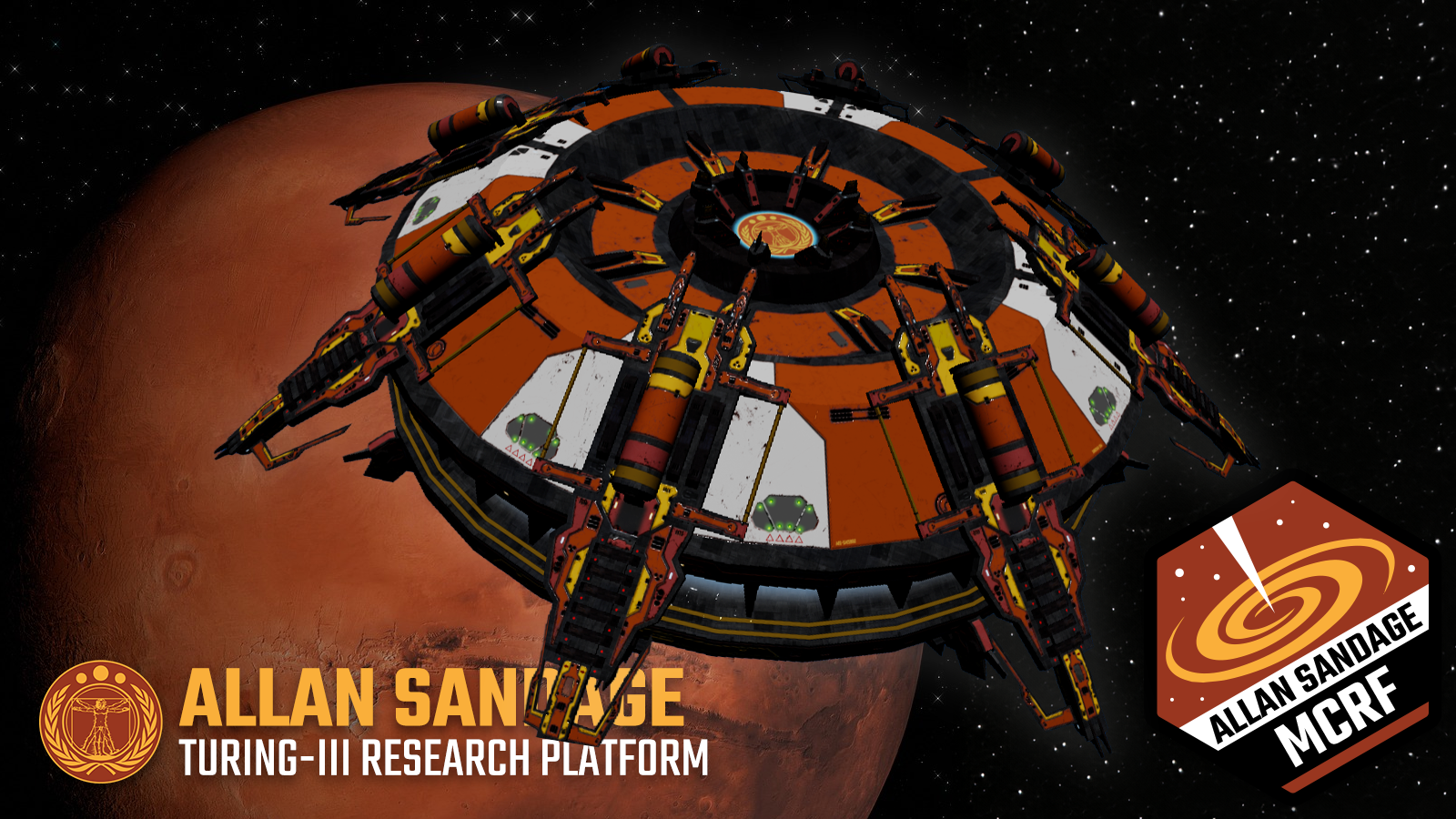
The Turing-III Research Platform is the third generation of a mobile research station developed by the Martian Engineering Union. Intended to deploy Martian scientific efforts to the farthest reaches of the Sol System – and now beyond – the vessel incorporates all the elements of both a sophisticated starship and a major research laboratory.
Boasting the unique, circular design common to many Martian vessels – a trend birthed from early stereotypes about Martians in flying saucers – the platform lacks a distinct “fore” and “aft” section and operates from a bridge situated at the structure’s interior. While the vessel benefits from eight Quasar-Class Advanced Ion Engines on its belly, Martians tend to prefer the delicate use of gravitational drives as a means of propulsion. Eight Herschel-IV units exist on massive maneuvering fins surrounding the central circle structure and allow for a slow but precise and fuel-efficient vessel.
The Allan Sandage was originally constructed for use by Dawes University of Sisyphus as a mobile research platform for post-graduate studies. Built in 2216, it was one of four Turing-III vessels and included state-of-the-art research facilities and living spaces. Returning from Saturn shortly after the announcement that the Martian Collective would be participating in the Outbound Hope Mission, the vessel was leased by the government and incorporated into the growing Outbound Fleet. Chancellor Nabhitha Singh personally selected the leaders and scientific teams that would participate as part of the daring interstellar project.
The Sandage’s sixteen laboratory spaces run the gamut of scientific disciplines, incorporating everything from geologic analysis suites and zero-gravity voids to experimental colliders and genetic libraries. A wide tube-like corridor that runs around the central structure incorporates greenspace walls used to study a multitude of plants and insect colonies. Much of the rest of the ship is devoted to residential areas, where scientists-in-residence can sleep, eat, exercise and relax from their often-regimented work schedules.
Beneath the bridge in the platform’s center is an expansive computer core which acts as the server for the ship’s Martian Artificial Intelligence, a Mars-specific counterpart of the famed SAI found on most USSC vessels. Commonly referred to as “MAI-A,” the intelligence specializes in data analysis, allowing for detailed scientific examinations in a fraction of the time. Unlike typical SAI models, MAI-A is able to split her attention between multiple functions and physical locations, monitoring both ship systems and numerous laboratory experiments with only a minor loss of processing speed.
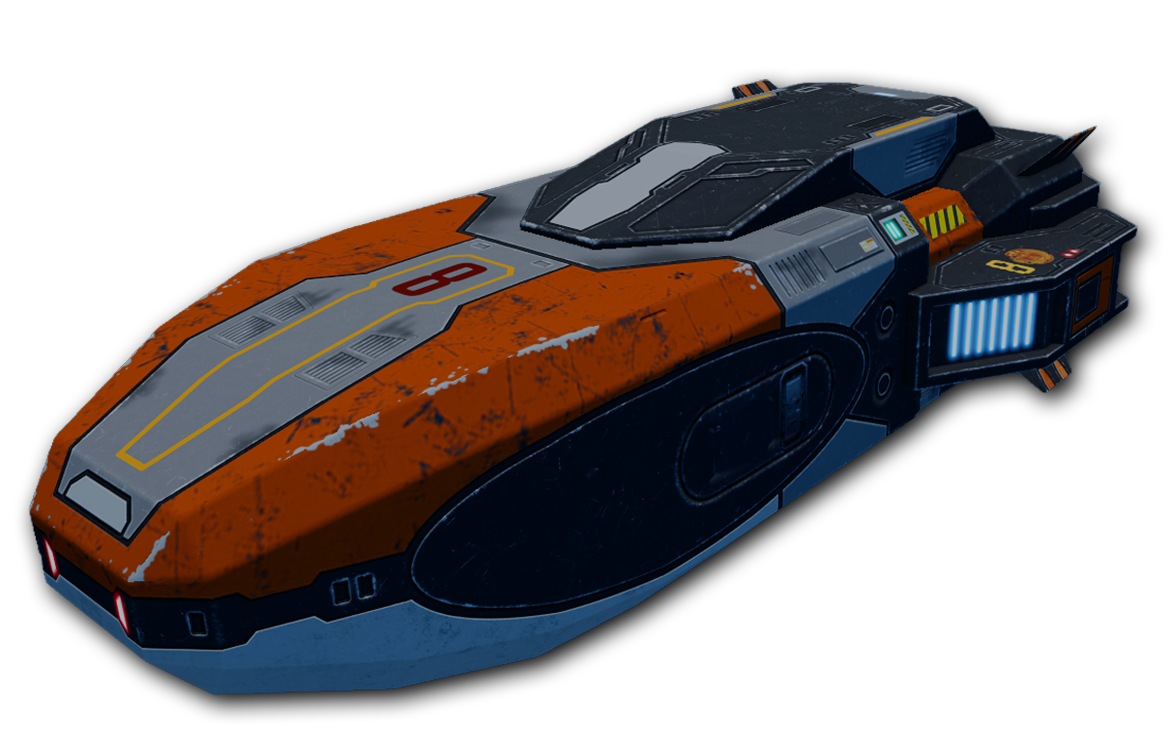
Eight of the Sandage’s sixteen laboratories are housed within an Autonomous Experimental Unit (AEU) pod, a small vessel in its own right. If needed, an AEU can eject from the Sandage, allowing it to independently venture away from the platform for a time. The purposes for this are many – while independence can allow the lab to study a structure or phenomenon up close, it also allows for the immediate isolation of a lab in the event of a containment breach or other emergency. While AEU’s contain all the necessities of a standard starship – crew space, ion engines, atmospheric units, and NearGrav projectors – they lack an independent power core and depend on a limited pair of battery units. A self-contained MAI-A processor allows for use of the system even when detached, though at significantly reduced capacity.
AEU PODS
Complementing the work aboard the Sandage is a separate Martian facility aboard the Ascendant Dawn, the flagship of the Outbound fleet. While laboratory space there is minimal, the additional locale acts as a sort of embassy for Martian political interests and allows them greater access to Admiral Kohler and Governor Delacruz. It is for this reason that Dr. Shineman – head of the Martian delegation into 354-PA – will actually complete the weeks-long journey starward aboard the Dawn and not the Sandage, leaving the Martian vessel under the command of the esteemed astrophysicist Leia Chandrasekhar.
Civilian Transport Vessels
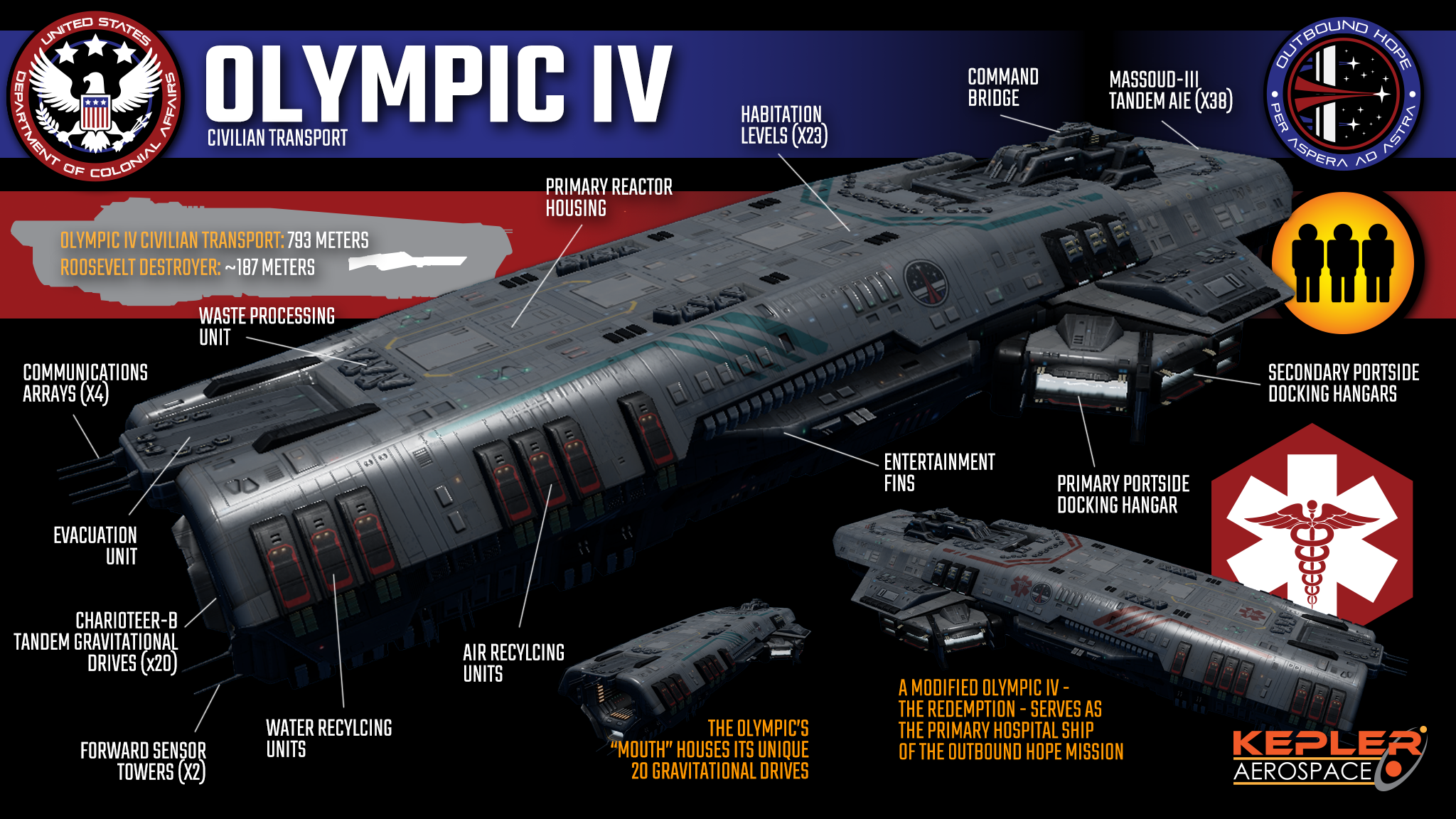
MANUFACTURER:
Kepler Aerospace, Inc.
COMMISSIONED:
2218-9
LENGTH:
793 Meters
COMPLEMENT:
Crew: 150, Passengers: ~1100 (Standard long-distance/OHM passenger configuration)
ARMAMENTS:
None
STANDARD PROPULSION:
x38 Massoud-III Tandem AIE
GRAVITATIONAL PROPULSION:
x20 Charioteer-B Tandem Gravitational Drives
THE HISTORY OF KELPER AEROSPACE
Founded in 2163, Kepler Aerospace is a company built not on speed or scale, but on elegance. Its ships are the cruise liners of the stars: orbital resorts and deep-space leisure craft for the expanding wealthy classes of the late-22nd century. Kepler’s signature quiet drives, panoramic hulls, and interiors crafted like art galleries earned it a reputation as “the top brand for interstellar luxury.”
Yet by the dawn of the 23rd century, Kepler’s place in the domestic market had nearly vanished. The Windfall Starship Corporation, flush with government contracts and defense work, dominated American shipbuilding. Kepler found itself pushed offshore – its factories orbiting Venezuelan and Brazilian stations, its clientele drawn mostly from the upper echelons of South American and Pacific trade routes.
Then came 2204. Following an economic contraction that crippled much of the orbital manufacturing sector, the U.S. government extended a massive stimulus package to preserve strategic aerospace capacity. Windfall predictably received the lion’s share until Kepler Aerospace and its smaller competitor, Winston Spaceworks, filed a landmark antitrust suit. They won against all odds, securing trillions in a payout of their own.
Kepler’s leadership, led by CEO Elias Maren, funneled nearly every dollar into research and development. What followed was an astonishing technological renaissance for the company. Their engineers pioneered tandem engine systems – smaller drive systems that, when multiplied and used collectively, allowed for unprecedented efficiency and smoother acceleration transitions. Even Windfall’s own executives privately called the results “remarkably impressive.”
The fruits of that innovation were the Olympic-class liners: Olympic III, Olympic IV and finally the Harmony-class. These ships were masterpieces of engineering known to be massive, graceful and almost absurdly comfortable.
But such elegance came at a cost. The Harmony line, though technologically sublime, proved too expensive to market. Six vessels languished unfinished in Kepler’s main orbital shipyard above Recife and threatened to bankrupt the company.
But once more, politics intervened. Fearing accusations of monopoly, Windfall and its allies in Congress supported a proposal to include Kepler vessels in the quickly-building Outbound Hope Mission. Kepler, desperate for liquidity, agreed. Windfall and the DCA quietly purchased and retrofitted the six stagnant Harmony transports, along with eleven Olympic ships, for pennies on the dollar. The deal allowed Kepler to keep its doors open – if only barely.
Officially, the partnership is hailed as a sign of renewed American unity in the stars. Unofficially, insiders whisper that Windfall’s true motive is far less noble: to test Kepler’s superior engineering firsthand before moving to absorb the company entirely.
THE OLYMPIC IV
Each Olympic IV Civilian Transport was designed to carry as many as 6000 vacationing passengers, though rarely for more than a week and always stopping at key ports of call. Given the tremendous amount of cargo required by the Outbound Hope Mission – and the longer duration of the voyage through uninhabited space – Kepler engineers insisted on dramatically reducing that number. Ships outfitted for the mission now accommodate 1100 passengers (as well as roughly 150 crew) in far more comfortable accommodations. Between the eleven ships, Kepler’s Olympic flotilla will support more than 12,000 colonists on the weeks-long journey starward.
Both Kepler and Windfall leaders insisted on the very best amenities for the Outbound colonists, which meant few changes from Kepler’s traditional standards. Ambient lighting mimics Earth’s daylight cycles while long promenades harken to lush gardens and exterior spaces. Several panoramic observation galleries offer full-spectrum views of the void, with pre-sale tickets already sold out for launch and landing parties at the bookends of the voyage. Passenger rooms – often created by merging together the floorplans of several standard rooms – are spacious and lush, often incorporating kitchenettes, living quarters, private bathrooms, and comfortable bedrooms. “Entertainment fins” – multilevel projections that reach out on either side of the ship – offer all the vibrancy and opportunity of a downtown metropolis, with restaurants, clubs, arcades, and gaming halls all unique to each ship.
Like many modern Kepler ships, the Olympic IV supports two systems of “tandem” drives in opposition to the massive advanced ion engines common to many Windfall configurations. At the stern of the ship, 38 smaller Massoud-III AIE units propel the ship forward, arranged across the width of the ship’s stern. By varying intensity in regions of the engine block, the ship can control its pitch and yaw without the need for additional maneuvering units. The tandem model also creates an intense system of redundancy, able to accommodate the loss of up to a half dozen engines before affecting ship performance.
In a similar vein, the bow of each vessel opens into a maw commonly referred to as “The Mouth” where a system of 20 smaller Charioteer-B gravitational drives can accelerate and decelerate with far more efficiency than most other ships of its size.
INDIVIDUAL VESSELS
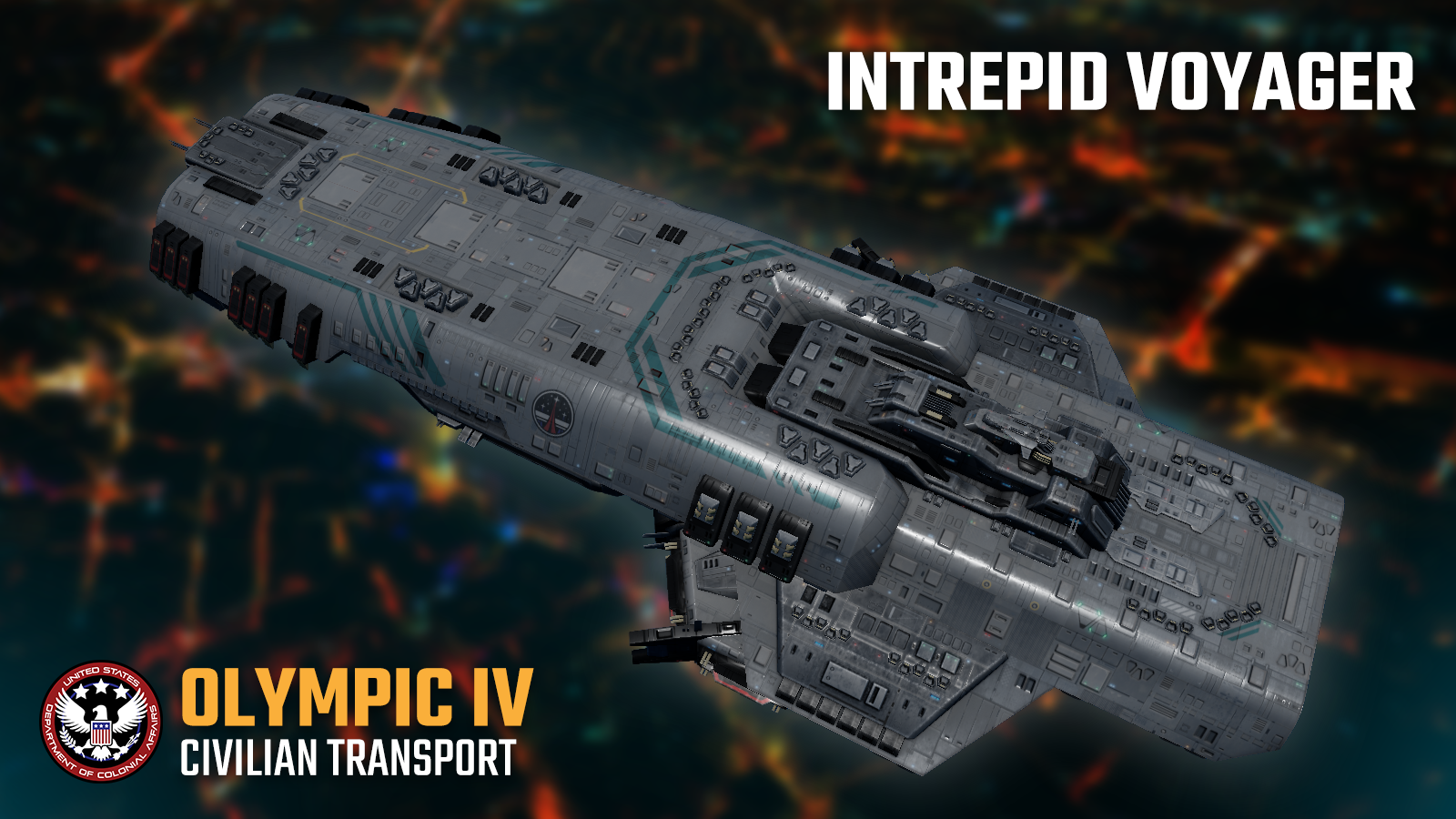
INTREPID VOYAGER
COMMANDING OFFICER:
A. Lee
ACTIVE COMPLEMENT:
1254
The Intrepid Voyager is famed for its forward “Solarium Deck,” a transparent tri-layer dome offering 270-degree starfield views and real-time celestial overlays. Designers describe sunrise simulations here as the closest thing to dawn on Earth.
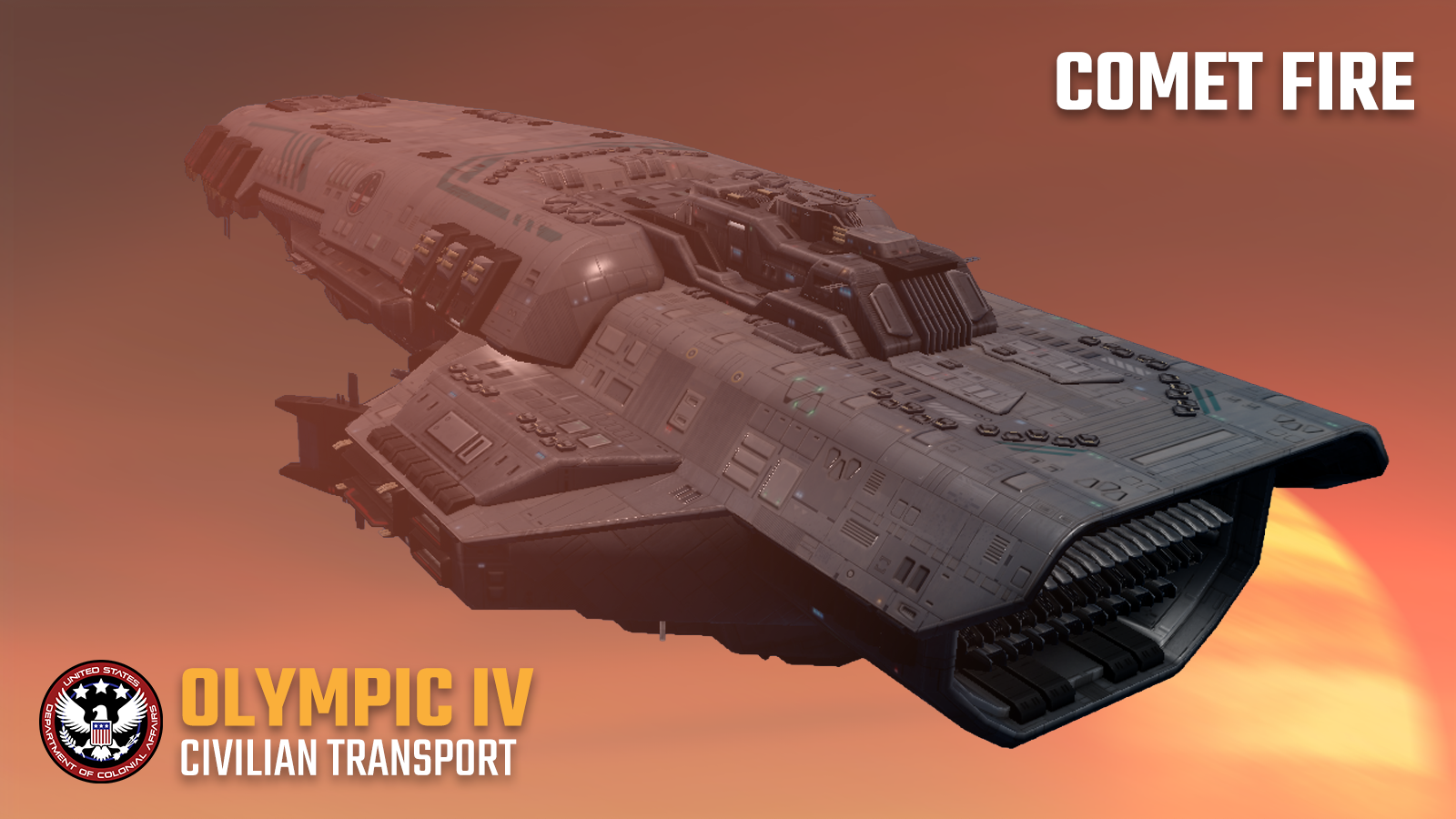
COMET FIRE
COMMANDING OFFICER:
F. Cruz
ACTIVE COMPLEMENT:
1223
Known as the “festival ship” of the fleet, Comet Fire’s starboard entertainment fin is known as the Emberway, where projection stages and light drones recreate city skylines and concerts in vibrant displays. Its interior color scheme shifts daily in rhythm with the ship’s thermal cycle, giving every corridor a subtle, living glow.
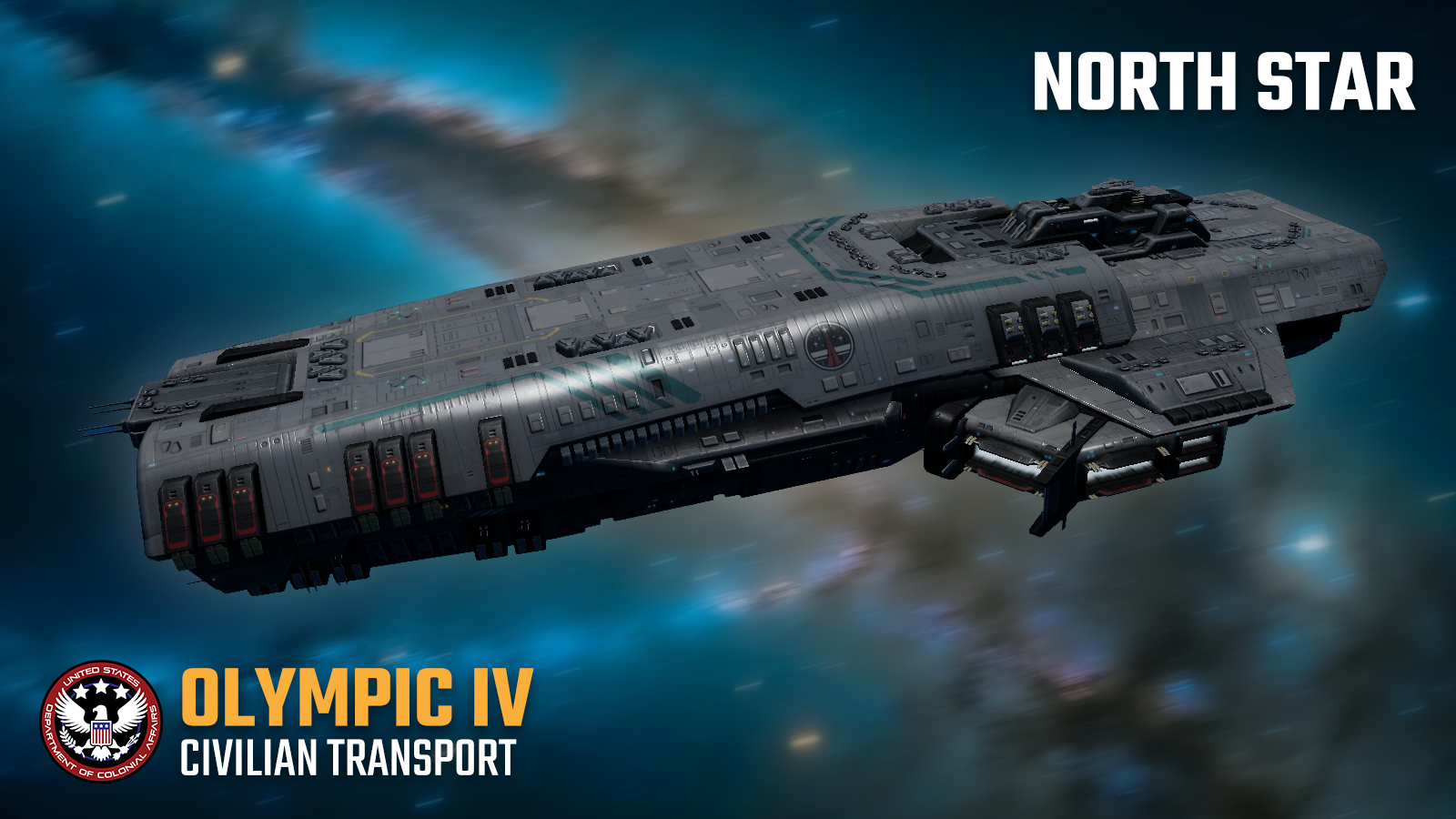
NORTH STAR
COMMANDING OFFICER:
J. Patel
ACTIVE COMPLEMENT:
1255
The North Star is best known for its so-called “Aurora Hall” — a spacious corridor that runs for several hundred meters between the ship’s two entertainment fins. Here, projections simulate earth’s polar lights in a colorful blend of music, science and spectacle.
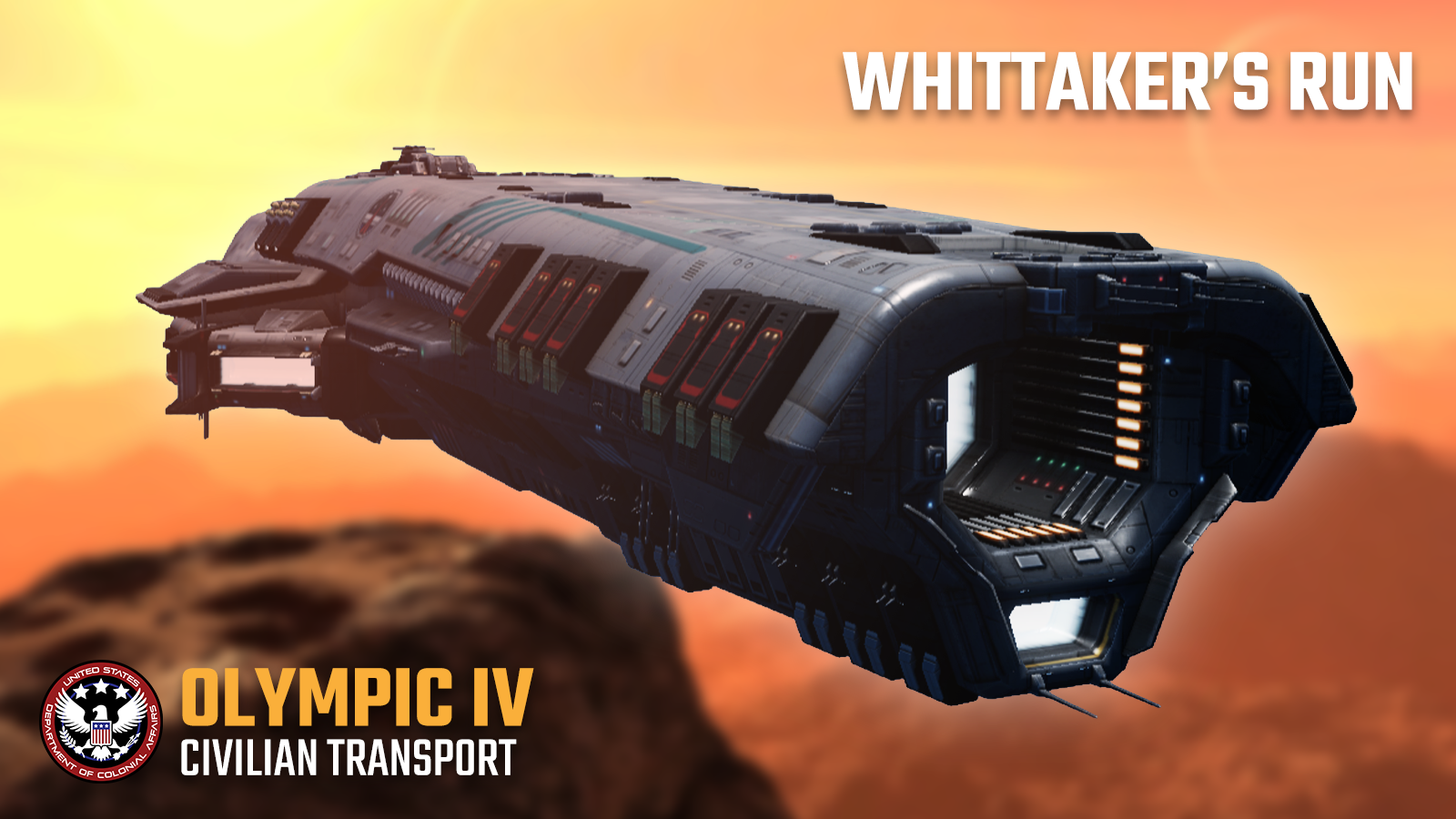
WHITTAKER’S RUN
COMMANDING OFFICER:
P. Kim
ACTIVE COMPLEMENT:
1231
With the support of the National Archives, the DCA insisted a large collection of art pieces accompany the Outbound Hope Mission to 354-PA. Whittaker’s Run houses this museum, bringing these invaluable cultural pieces to the stars. It intends to maintain visiting hours throughout the voyage starward.
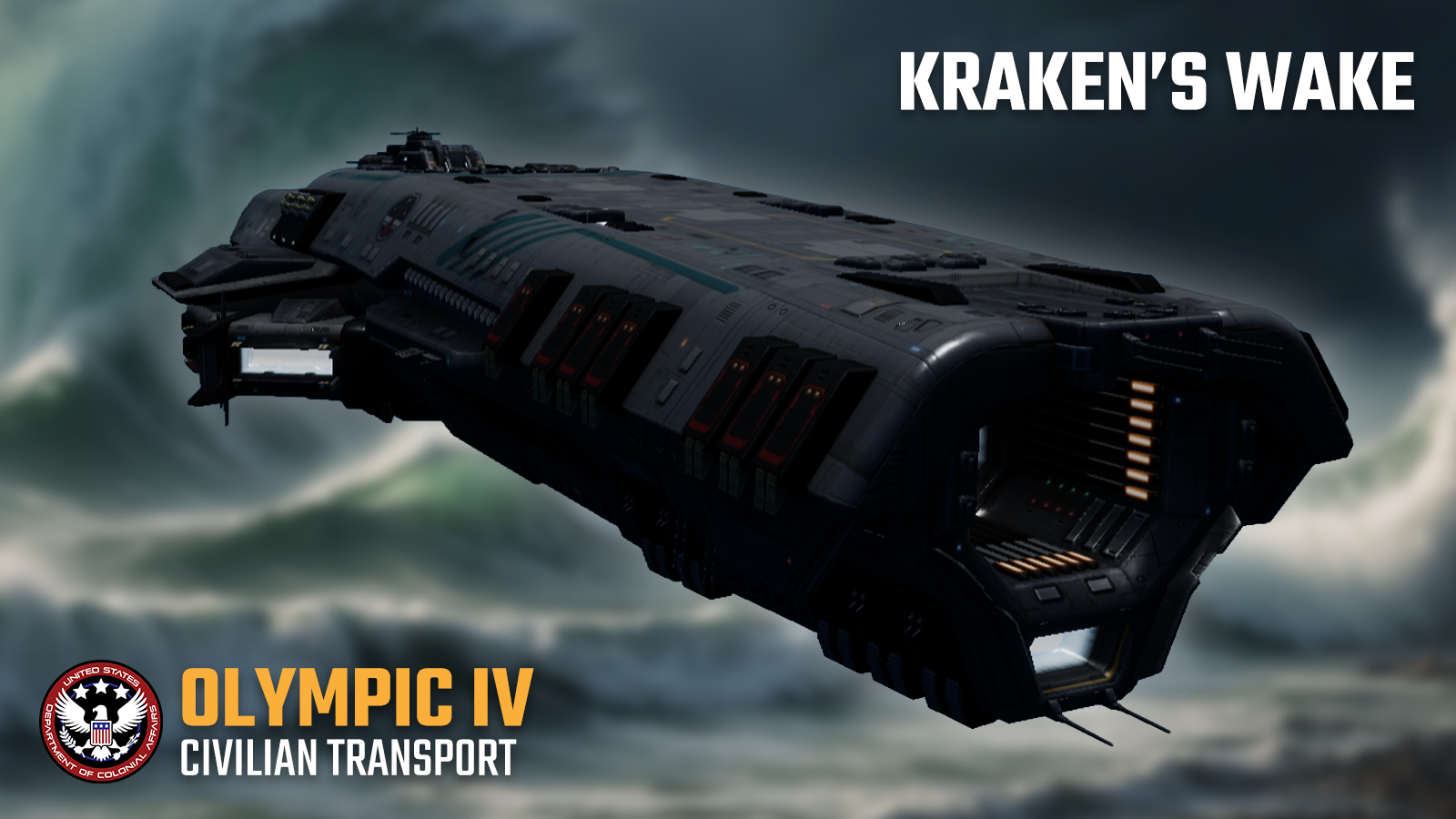
KRAKEN’S WAKE
COMMANDING OFFICER:
E. Silva
ACTIVE COMPLEMENT:
1244
Once intended as an ocean-themed leisure liner, Kraken’s Wake retains vast reservoirs repurposed into habitat tanks and relaxation pools. The ship’s gentle humidity and soft blue lighting make it the most comfortable vessel for long-term passengers, earning it the nickname “the tide between the stars.”
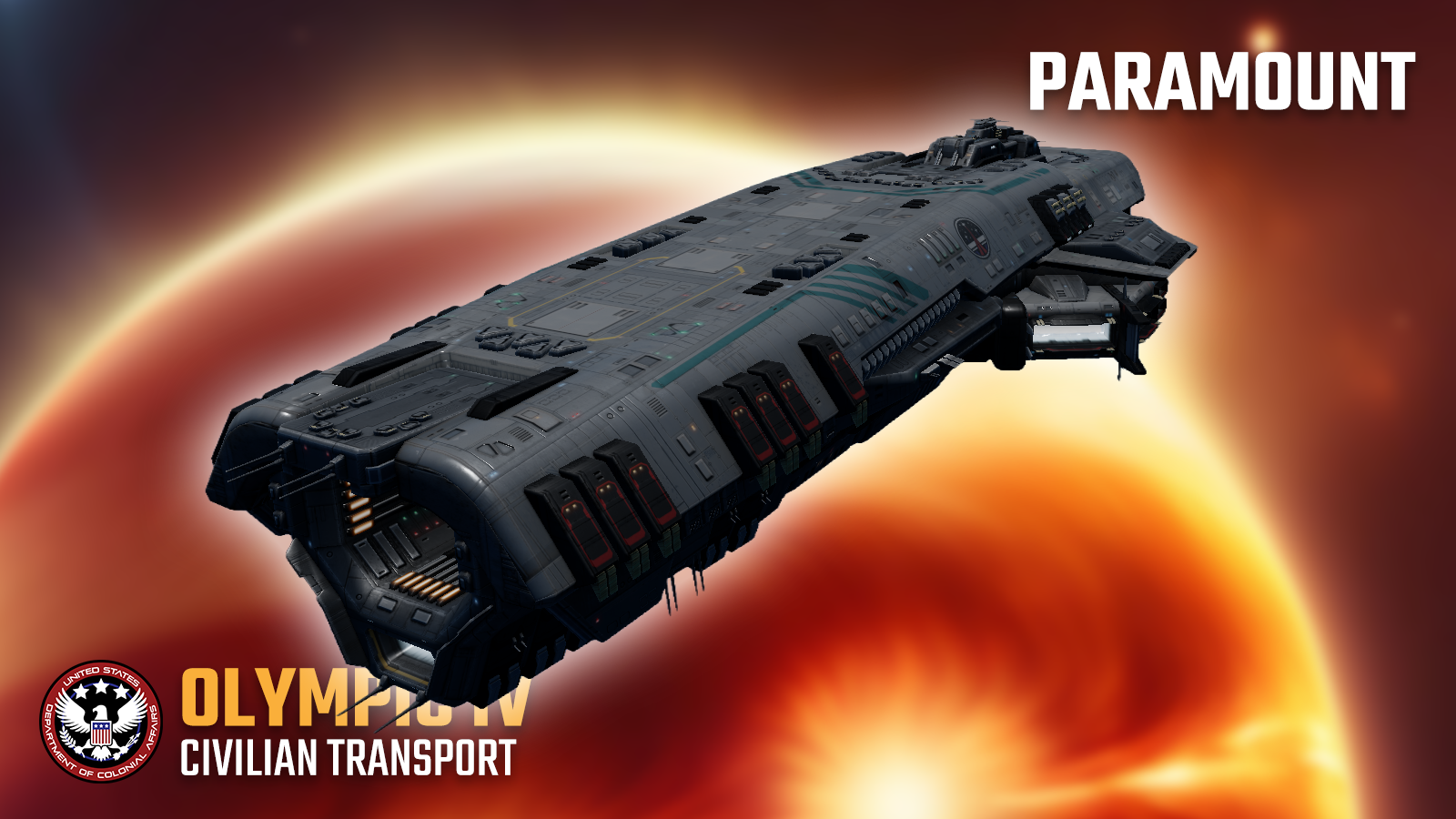
PARAMOUNT
COMMANDING OFFICER:
W. Khan
ACTIVE COMPLEMENT:
1227
The Paramount’s vaulted amphitheater, The Horizon Stage, streams performances across the entire Outbound fleet, ensuring no colonist ever feels completely cut off from home. The artist Yo-Yo was intended to headline the voyage from the Paramount before their unfortunate death.
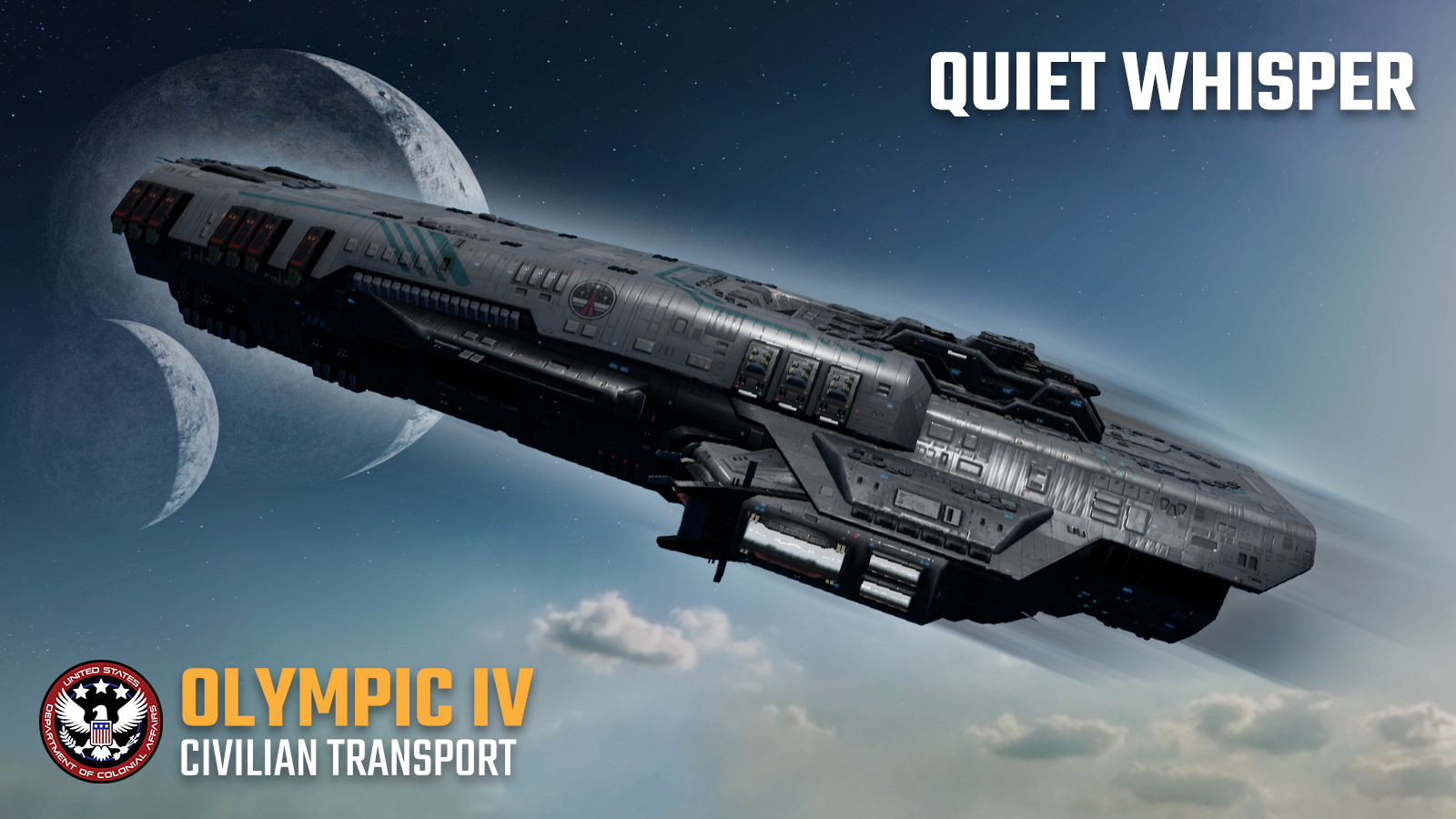
QUIET WHISPER
COMMANDING OFFICER:
G. Rossi
ACTIVE COMPLEMENT:
1254
Renowned for its tranquil atmosphere, Quiet Whisper operates with adaptive acoustic damping that mutes engine hum and human chatter alike. Designers refer to it as the “Floating Monastery,” home to meditation chambers and softly lit memory gardens that appeal to many of the mission’s more spiritual passengers.
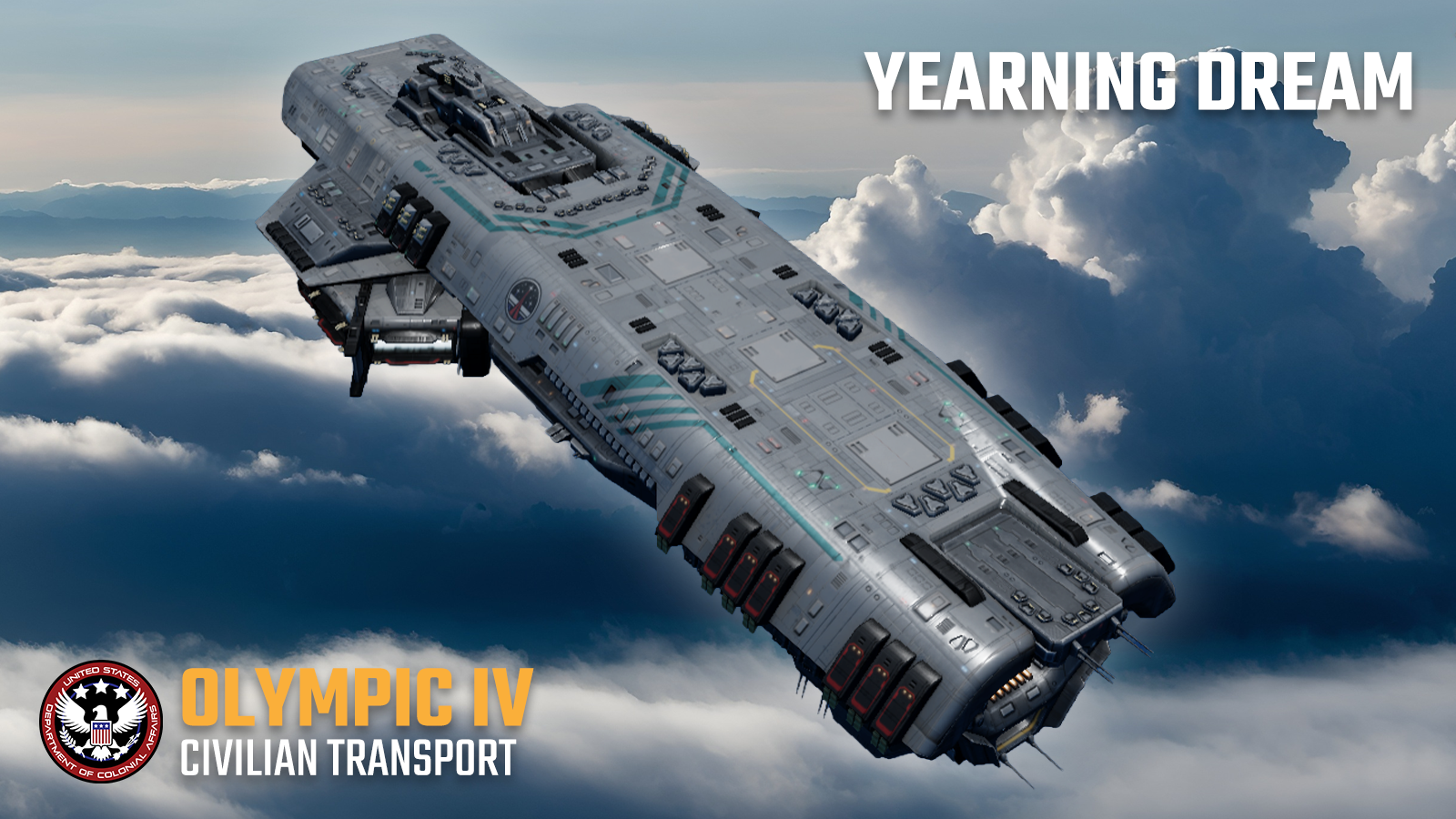
YEARNING DREAM
COMMANDING OFFICER:
K. Rivera
ACTIVE COMPLEMENT:
1250
Yearning Dream cultivates a romantic atmosphere with its “Twilight Arcade,” a long, open gallery illuminated by simulated dusk. The ship’s walls display shifting horizon scenes from earth’s coastlines, giving colonists the illusion of a sunset that never ends.
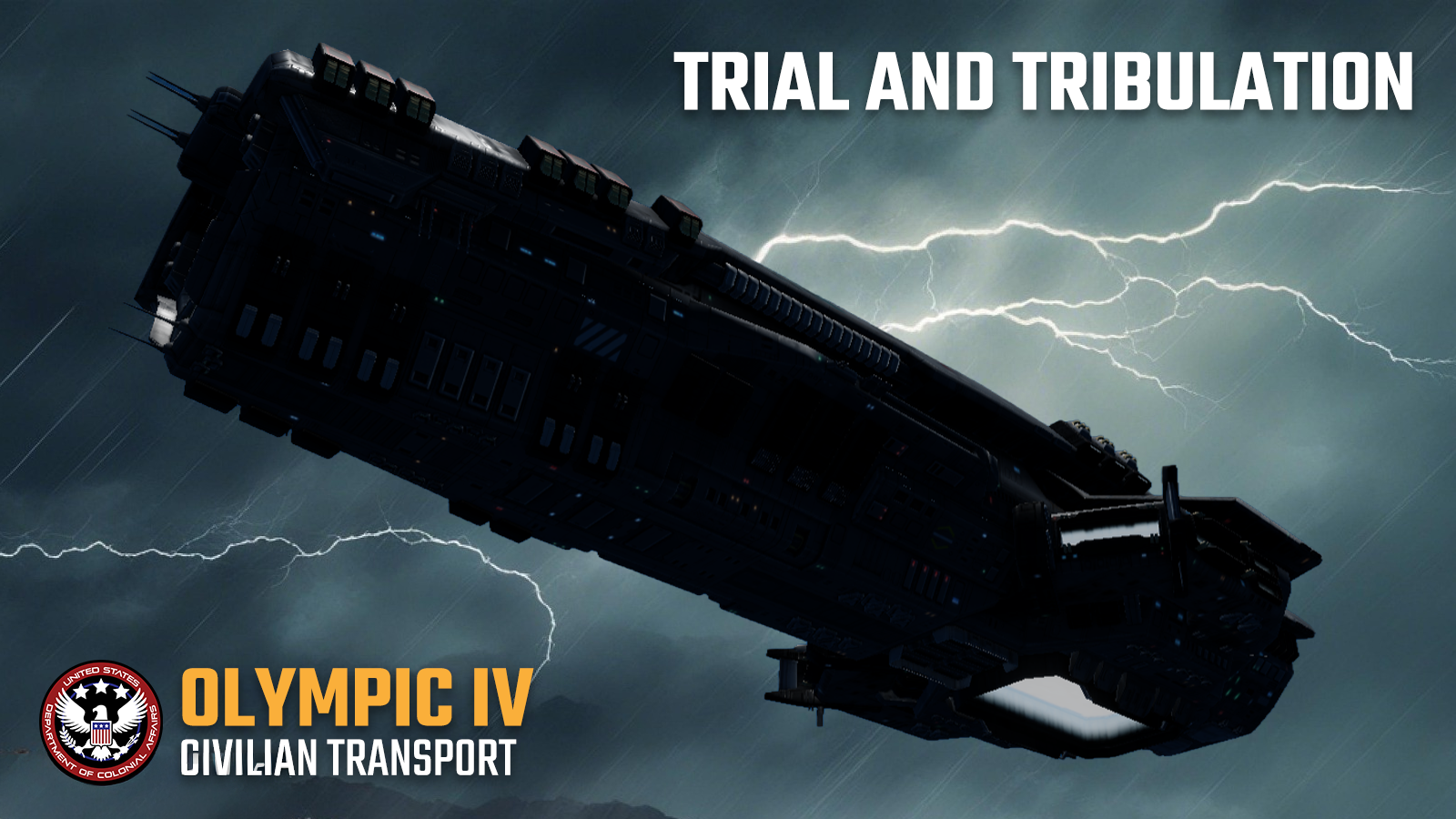
TRIAL AND TRIBULATION
COMMANDING OFFICER:
L. Ahmed
ACTIVE COMPLEMENT:
1234
Aptly named after surviving multiple refits and a near-catastrophic test fire, Trial and Tribulation is the most rugged of the Kepler fleet. Its civilian workshops and maker bays allow colonists to fabricate tools, repair drones, and even print custom furniture during transit.
INDIVIDUAL VESSELS (Modified Configuration)
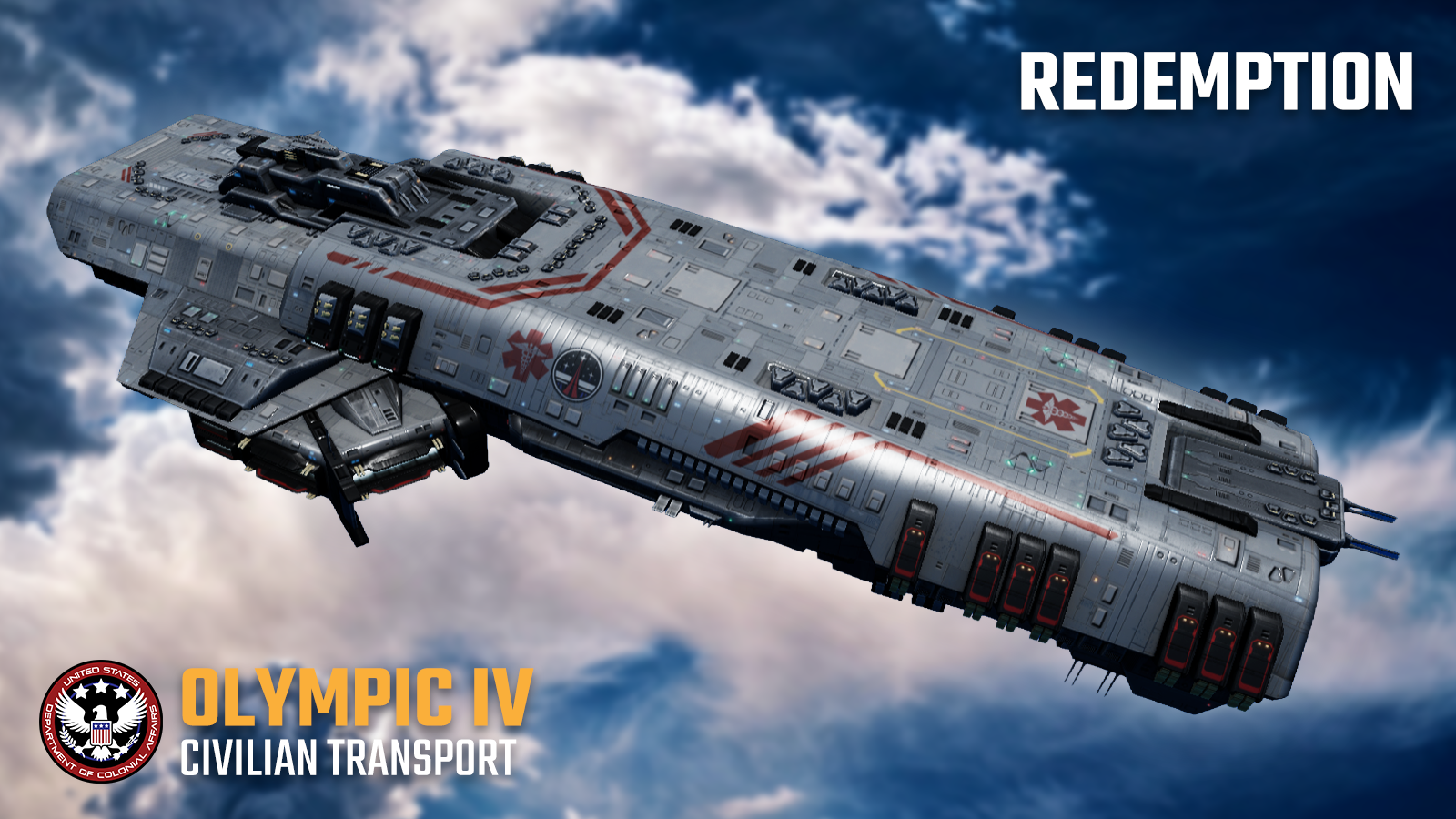
REDEMPTION
COMMANDING OFFICER:
H. Morgan
ACTIVE COMPLEMENT:
455
Enduring a massive Windfall retrofit that disgruntled Kepler engineers but pleased TraumaTek benefactors, the Redemption drastically reduced its passenger spaces to make way for a fully-functioning “hospital in the stars.” Even after planetfall, the Redemption will remain in low orbit until full medical facilities can be established on the surface.
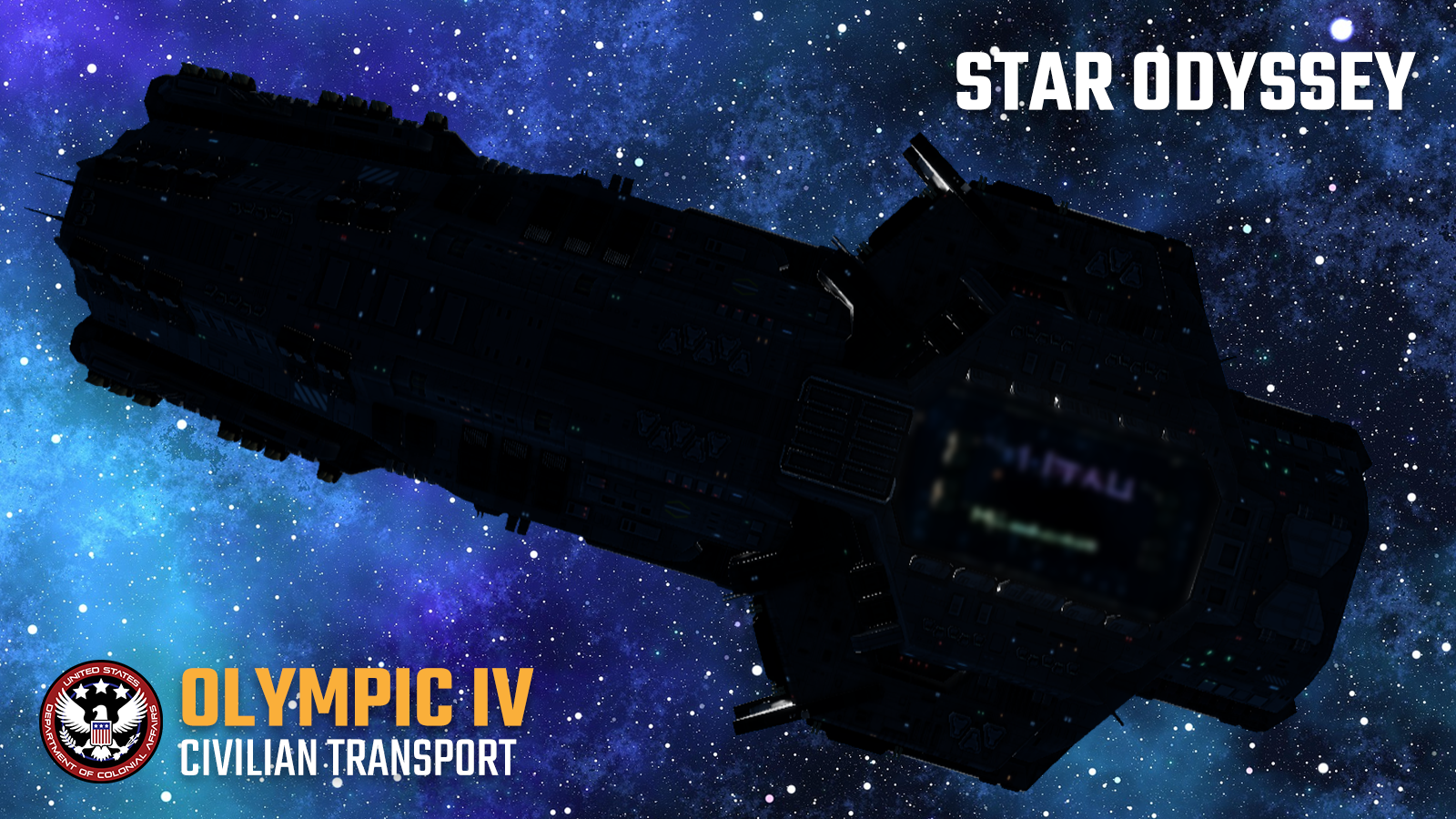
STAR ODYSSEY
COMMANDING OFFICER:
I. Smith
ACTIVE COMPLEMENT:
500
<INFORMATION CLASSIFIED.>
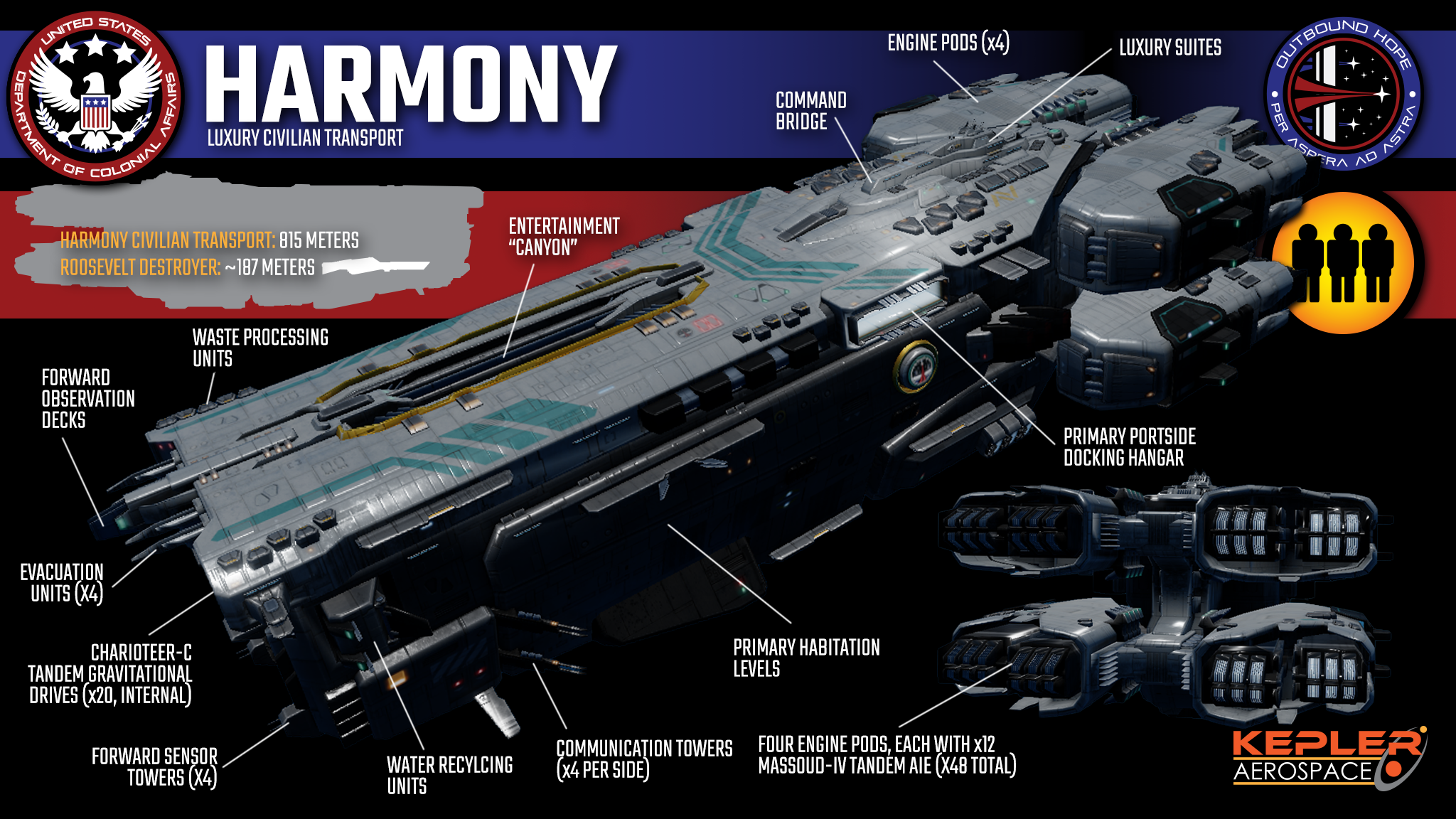
MANUFACTURER:
Kepler Aerospace, Inc.
COMMISSIONED:
2217
LENGTH:
815 Meters
COMPLEMENT:
Crew: 250, Passengers: ~2250 (Standard long-distance/OHM passenger configuration)
ARMAMENTS:
None
STANDARD PROPULSION:
x48 Massoud-IV Tandem AIE
GRAVITATIONAL PROPULSION:
x20 Charioteer-C Tandem Gravitational Drives
In 2218, an SNN commentator described the launch of the Harmony transports to be “the Icarus moment for Kepler CEO Elias Maren.” While Kepler spokespersons – and even Maren himself – rushed to refute the claim and label the Harmony vessels to be “the next chapter in luxury vacation experiences” the next several months only proved the validity of the statement. The six ships the company had manufactured failed to find a buyer, with each of their price tags nearing a trillion dollars. Maren and others began to try and explain away the poor investment as a “ship not ready for the modern age” while talks of bankruptcy began to stir behind the scenes.
On the heels of the immensely-successful Olympic line, the Harmony ships were meant to spare no expense and redefine a new standard of luxury. With wide, opulent interior spaces decorated in an ornate art deco style, the ships were intended to appeal to the ultra wealthy like never before. Several prominent luxury cruise lines had expressed interest in the vessels in their early development stages – before their price tags began to skyrocket into the obscene.
The design itself is close to perfection. Like every Kepler ship of the 23rd century, the Harmony ships incorporate the elegant “tandem” propulsion systems, improving on the Mahmoud AIE and Charioteer Gravitational Drive systems that had been popularized in the earlier Olympic IV models. Living spaces are meant to be massive and lavish, with many suites incorporating smaller quarters intended for assistants, nannies and other staff of potential high-end guests. Elaborate promenades, green spaces and entertainment facilities were intended to be second-to-none. Restaurants, clubs and shops cluster around a central “entertainment canyon” – a depression in the ship’s hull that allows for a multi-level view of the stars. Under atmospheric conditions, the canyon’s transparent roof can be retracted into the hull, allowing the canyon to enjoy the local breeze.
While just slightly larger than the Olympic IV, the Harmony vessels were designed to support no more than 3000 passengers at a time – roughly half of their Olympic counterparts. Kepler officials speculated that cruise lines could easily set ticket costs in the millions and hypothesized elaborate voyages between the Jovian moons or through the asteroid belt.
But none of this was meant to be. The six Harmony vessels sat unused for more than a year while Kepler struggled with how to make up their crippling losses.
Their salvation came from an unlikely source. In October of 2218, Kepler’s greatest rival – Windfall Starship Systems – began to catch wind of a possible anti-trust lawsuit against their near-total control of the Outbound Hope Mission project. While Windfall had already established plans to develop passenger transports of their own, they opted to forgo their construction and urged the Department of Colonial Affairs to consider the purchase of all six Harmony transports and a small fleet of Olympic IV vessels. The DCA agreed, ultimately deciding on a price less than half of what Kepler had hoped to recover. While some DCA leaders suggested reserving some or all of the Harmony ships for a renewed colonial roster of the wealthy and elite, the proposal was ultimately rejected. Spaces once meant to be occupied only by the upper echelons of society would now be inhabited by Outbound colonists from all walks of life and class.
With the ability to showcase their finest ships as part of the Outbound Fleet, Kepler has managed to stay in business. With over 15,000 calling the Harmony transports home for the weeks-long voyage starward, Kepler hopes it can recapture the public eye and reestablish its place among the stars in the years ahead.
INDIVIDUAL VESSELS
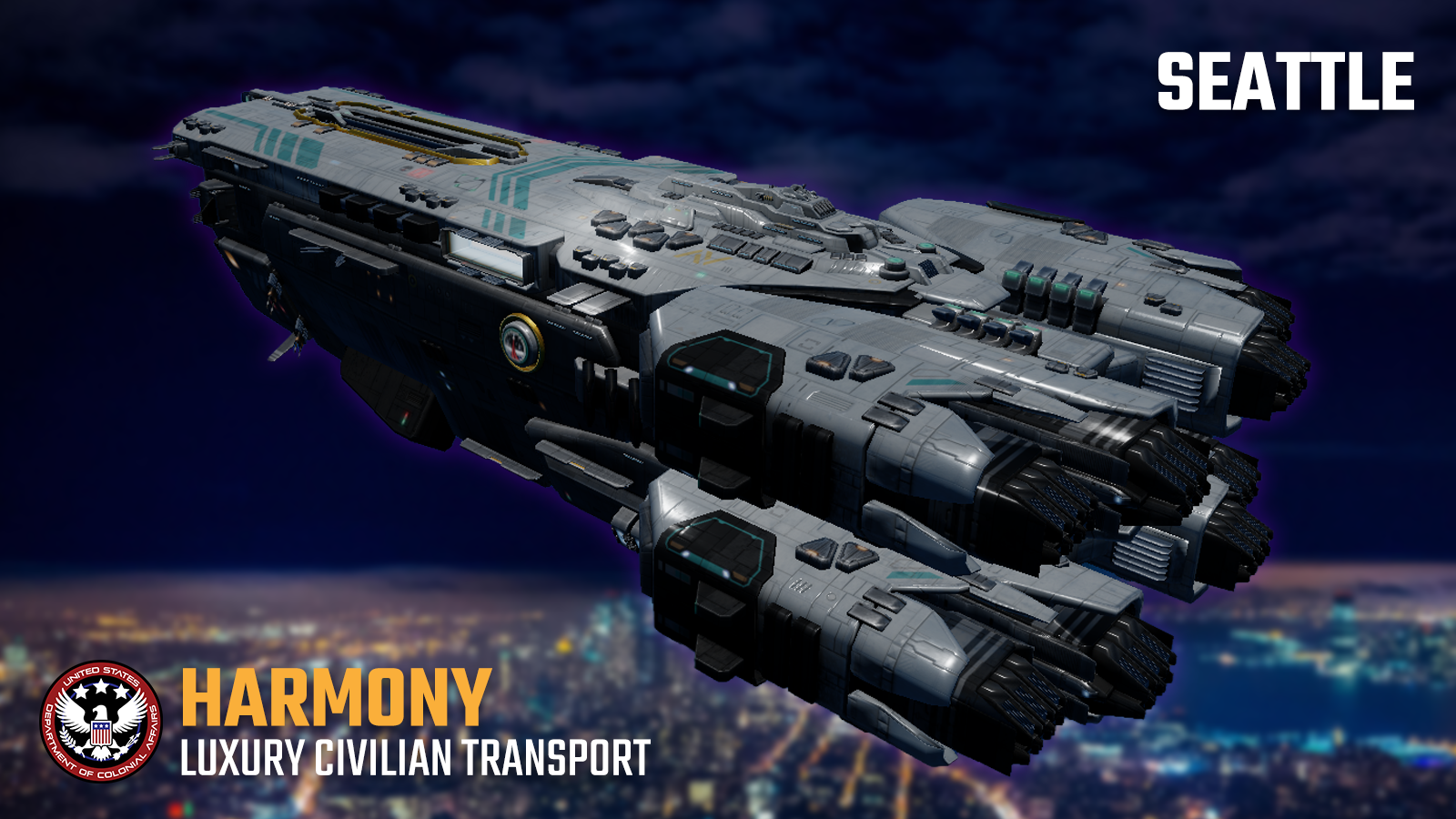
SEATTLE
COMMANDING OFFICER:
C. Harrell
ACTIVE COMPLEMENT:
2469
The first of its class and prototype for the Harmony line, Seattle gleams with polished chrome and sweeping art-deco murals. Its “entertainment canyon” remains a favorite gathering place for passengers, offering breathtaking stellar panoramas during transit. Despite steep maintenance costs, Seattle endures as the matriarch of Kepler’s Harmony line.
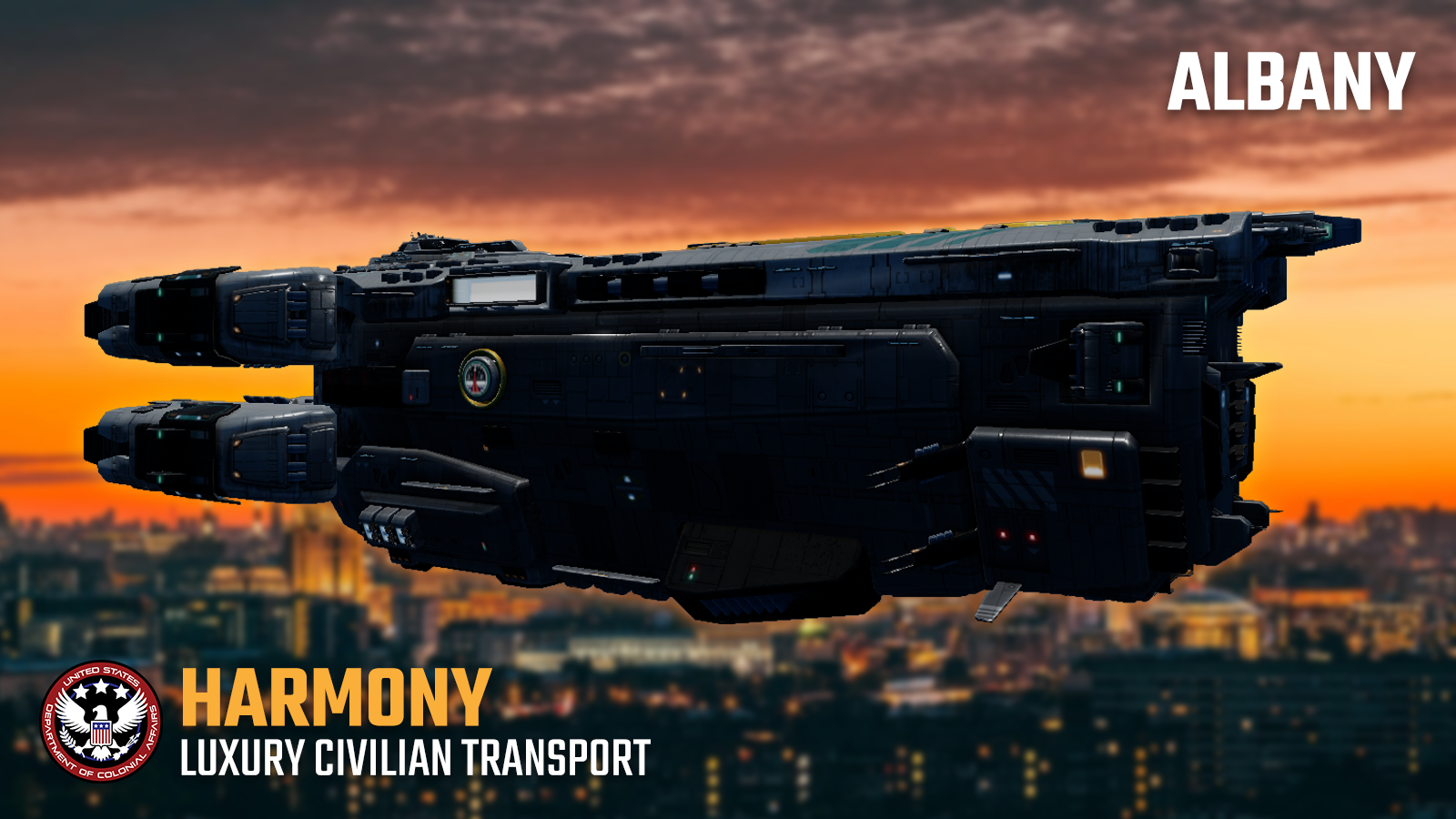
ALBANY
COMMANDING OFFICER:
L. Sheehan
ACTIVE COMPLEMENT:
2443
Designed with stability and comfort in mind, Albany is considered the fleet’s most balanced liner—neither the most extravagant nor the most stripped down. Its interiors blend old-world craftsmanship with cutting-edge automation, creating a sense of grounded elegance amid the stars. The crew refer to her affectionately as “The Steady Hand.”
TOPEKA
COMMANDING OFFICER:
N. Padilla
ACTIVE COMPLEMENT:
2501
Topeka features the Outbound fleet’s finest dining hall and ornate promenade deck. Unfortunately, her life-support and climate systems are notoriously unstable, leading crew to joke that “she prefers her guests lightly roasted.” Passengers adore her grandeur; the crew less so.
CHICAGO
COMMANDING OFFICER:
C. Johnson
ACTIVE COMPLEMENT:
2499
A ship built on spectacle, Chicago embodies Kepler Aerospace’s flair for showmanship. Its crowning feature, a zero-gravity ballroom, quickly became the fleet’s most talked-about attraction—and a logistical nightmare for maintenance crews. To passengers, it represents glamour incarnate; to engineers, a problem that never sleeps.
DENVER
COMMANDING OFFICER:
N. Johnston
ACTIVE COMPLEMENT:
2367
Marketed as the “family ship,” Denver was built around sprawling communal gardens and recreation spaces meant to echo Earth’s public parks. At the insistence of several high-profile clients, the ship even includes a small amusement park centered around the ever-popular “Gizmo the Space Robot,” a popular children’s character.
SYRACUSE
COMMANDING OFFICER:
C. Walsh
ACTIVE COMPLEMENT:
2441
In what officials quickly labeled an “unnecessary excess,” the Syracuse houses a small but impressive collection of zoo animals ranging from dozens of fish, reptiles and insects to a small herd of zebras and other mid-sized ungulates. While not expected to be released into the wild of the colony, these animals are as much about entertaining the public as they are satisfying scientific questions about the new world.
Civilian Resource Vessels
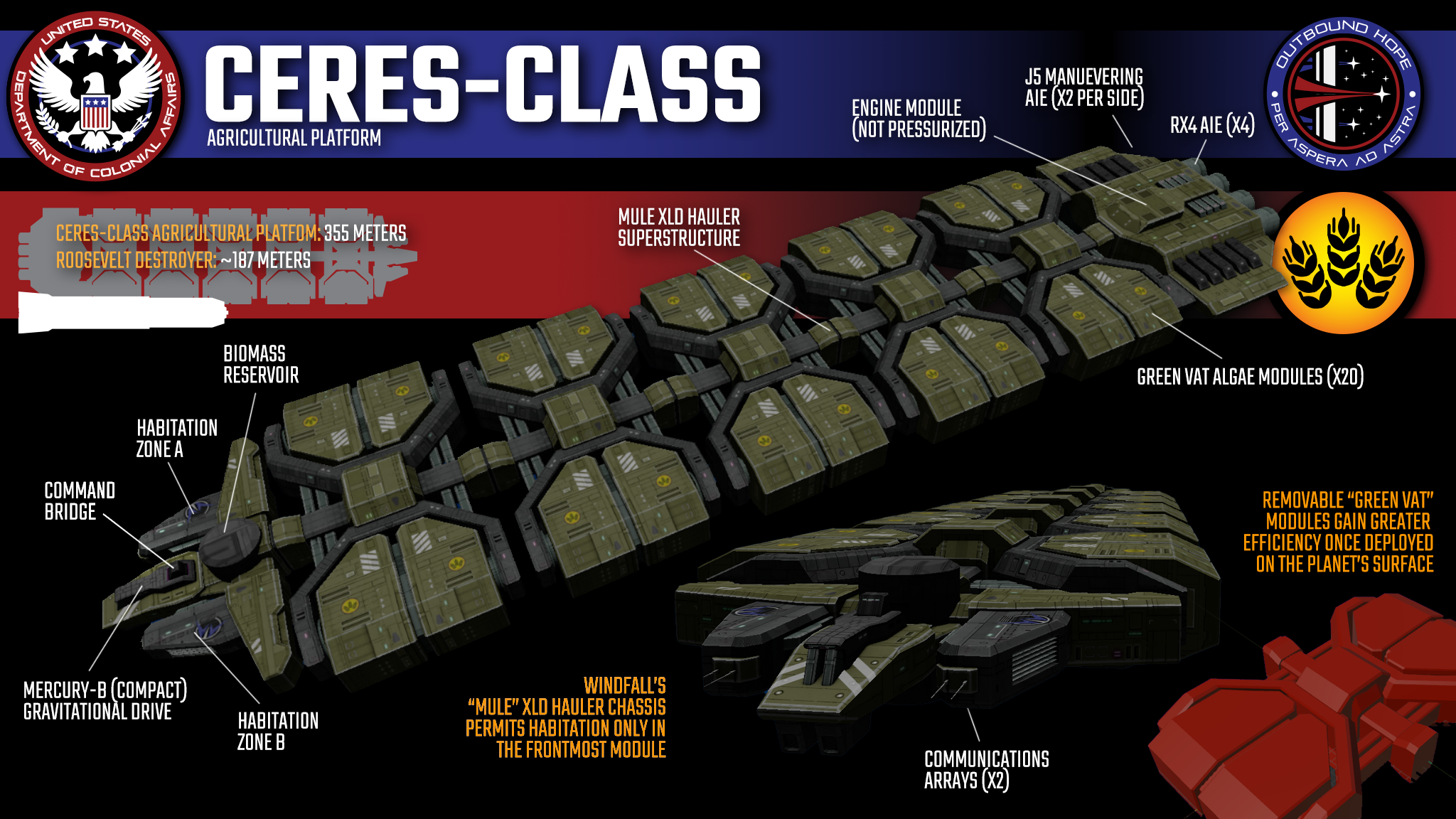
SHIP BASE CHASSIS:
WSS “Mule” XLD-Hauler
MANUFACTURER:
Windfall Starship Systems, Inc.
COMMISSIONED:
2218
LENGTH:
355 Meters
COMPLEMENT:
Crew: 3, Workers: 7-17
ARMAMENTS:
None
STANDARD PROPULSION:
x4 RX4 AIE
x4 J5 Maneuvering AIE
GRAVITATIONAL PROPULSION:
x1 Mercury-B (Compact) Gravitational Drive
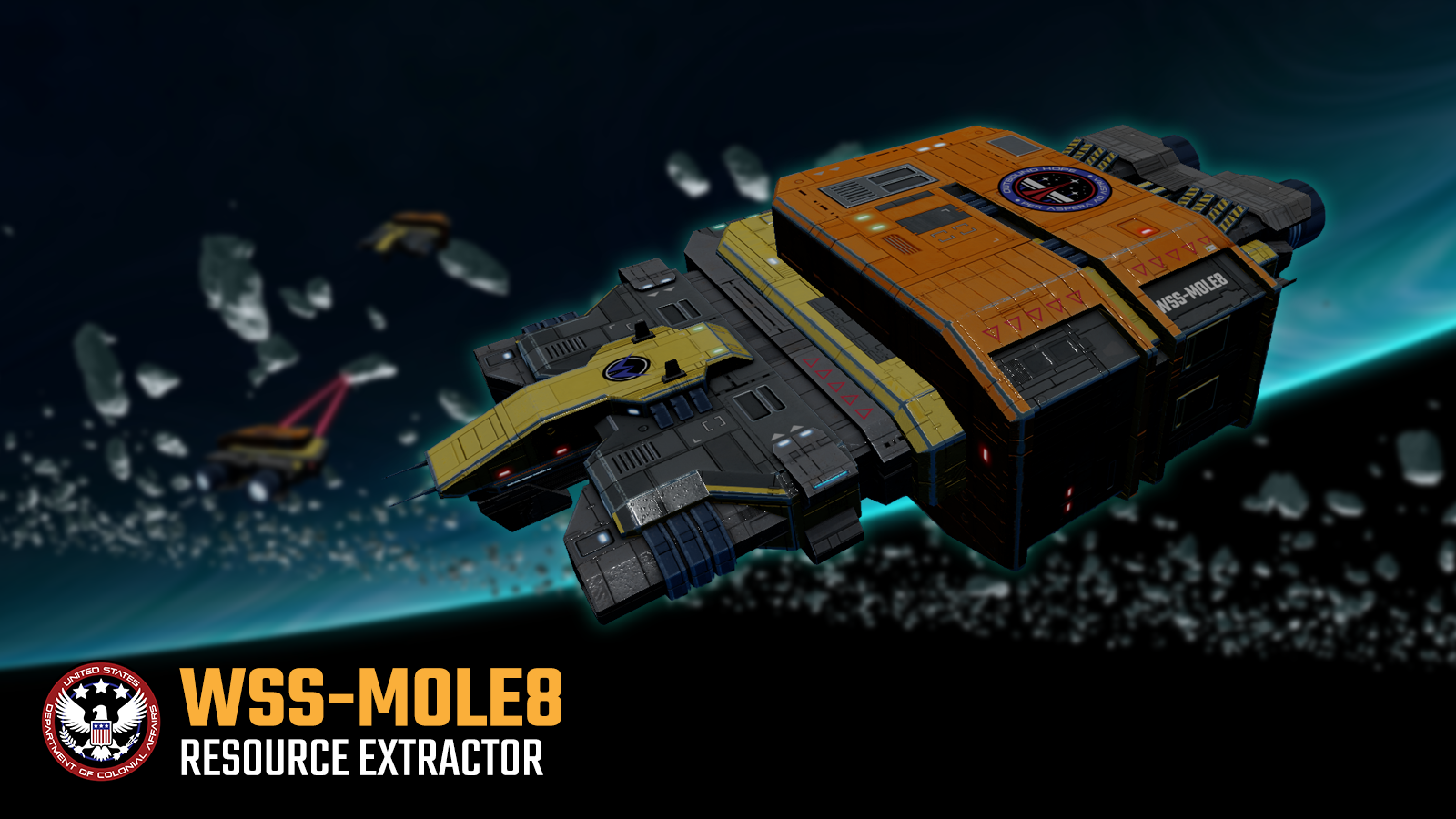
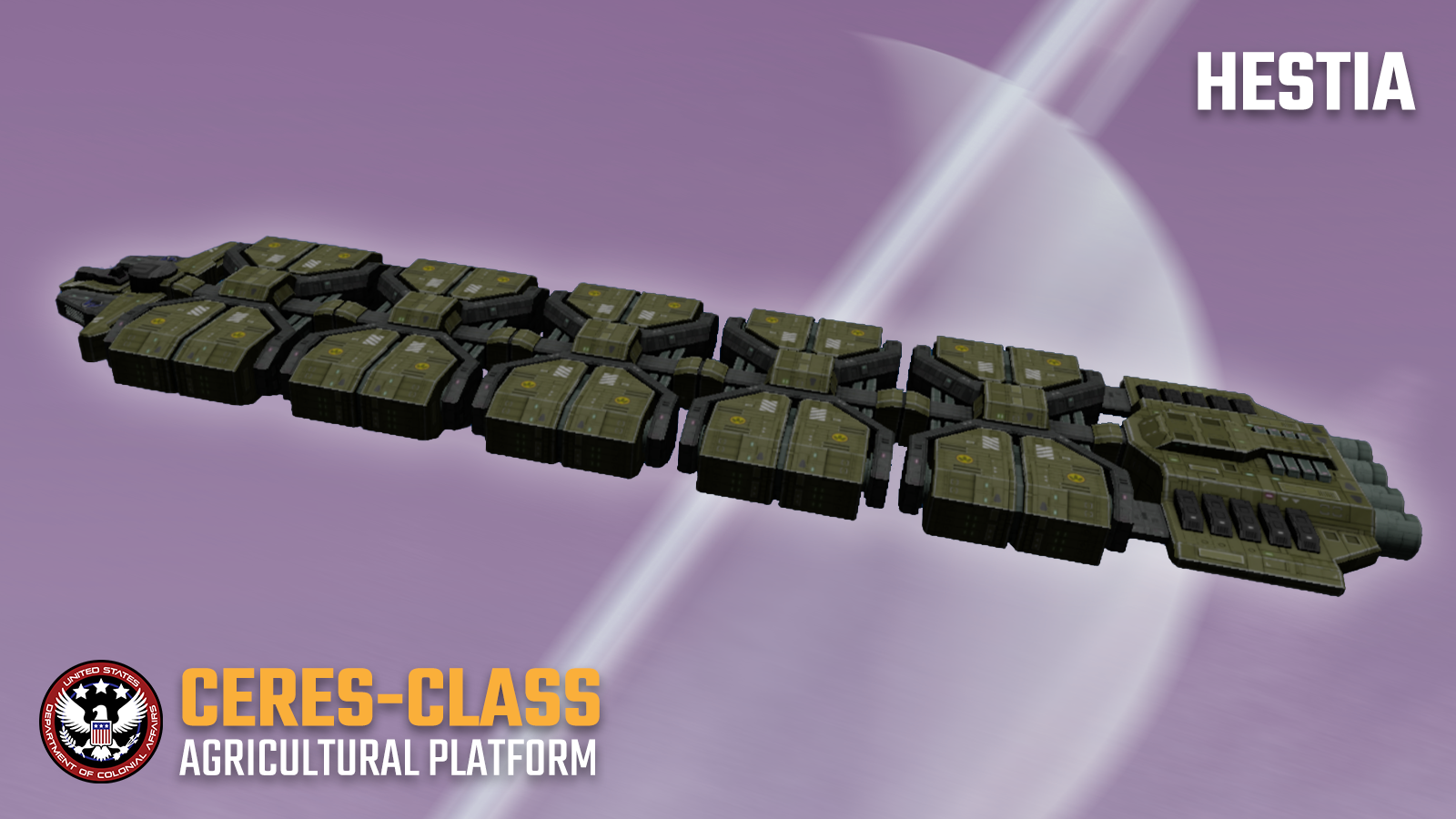
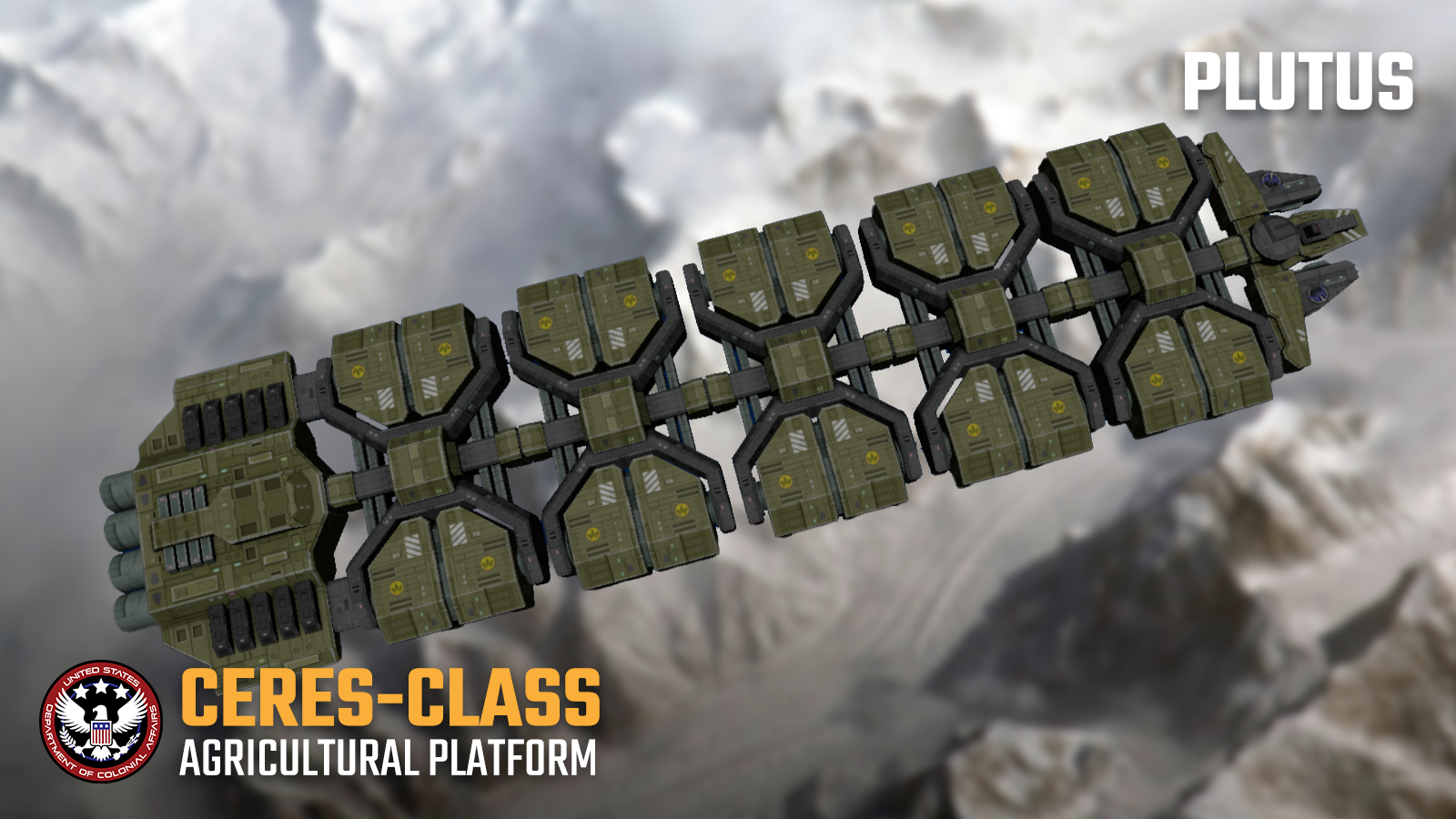
The CERES-Class agricultural platforms are five food production vessels constructed for the Outbound Hope Mission using the popular and multipurpose “Mule” XLD Hauler chassis created by Windfall Starship Systems. Given the importance of a strong food supply for the colony, these ships were among the first approved and manufactured for the 2219 Outbound project, having been officially rolled out in the early days of 2218. Collectively with the Gaia-II — an experimental PERSEPHONE-Class ship of similar design — the ships are meant to establish a viable and even redundant food production system until planet-side agriculture is able to surpass them.
The Ceres platforms produce the vast majority of foodstuffs by growing and harvesting vast colonies of genetically-enhanced algae. In twenty sizeable aquatic chambers known as “green vats,” algae is cultivated and autonomously collected using a combination of artificial sunlight and nutrient-rich “dietary matrix.” This matrix — colloquially known as “dough” — is then placed in barrels and distributed to the ships of the fleet.
All Outbound ships are outfitted with food synthesizers capable of taking the matrix and using it to replicate any number of food items. Much like an archaic 3D printer, the synthesizers are able to realign the proteins and sugars of the matrix while adding various artificial flavors and chemical texture cultivators. In doing so, they can create a wide variety of food-like substances relatively indistinguishable from the inspiration.
Fully-deployed and secured to the planet’s surface, a single Ceres platform is able to produce roughly 12-15,000 kilograms of food per day, benefitting immensely from planetary gravity, minerals and natural sunlight.
Like any ship built along the Mule design, living quarters aboard Ceres ships are small but optimized for their crew size. Living areas are modest and compact, with private quarters but a public recreation space, gym, kitchen and lavatories. Like many Outbound ships, they are not designed for long-term habitation and crew members are welcome to visit any of the larger transport vessels during the weeks-long voyage starward.
INDIVIDUAL VESSELS
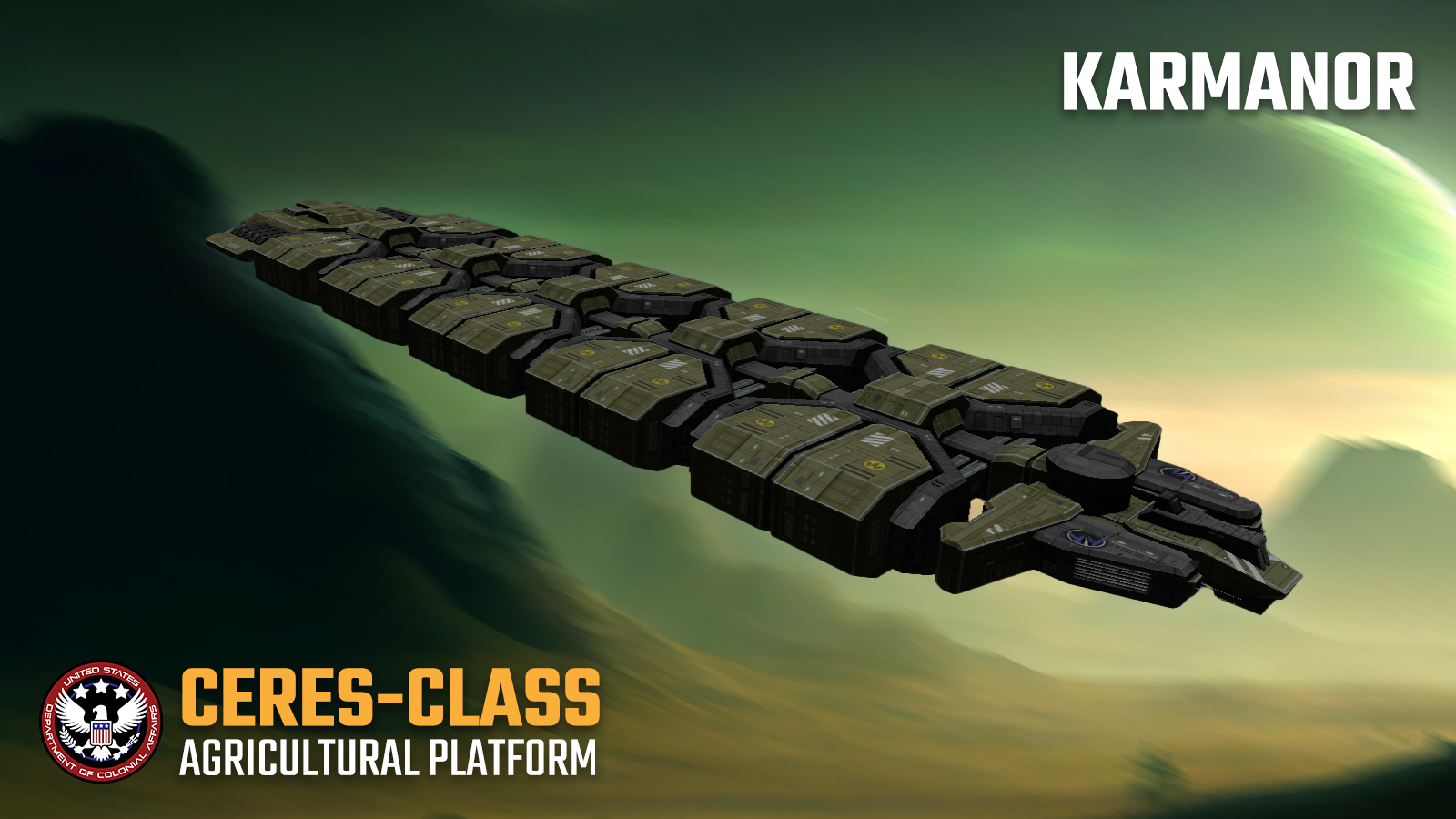
KARMANOR
COMMANDING OFFICER:
O. Kowalski
ACTIVE COMPLEMENT:
17
Oliver Kowalski — captain of the Karmanor — was the original engineer behind the sophisticated green vat system. He insisted that he be allowed to escort his work personally into the new star system and maximize its use.
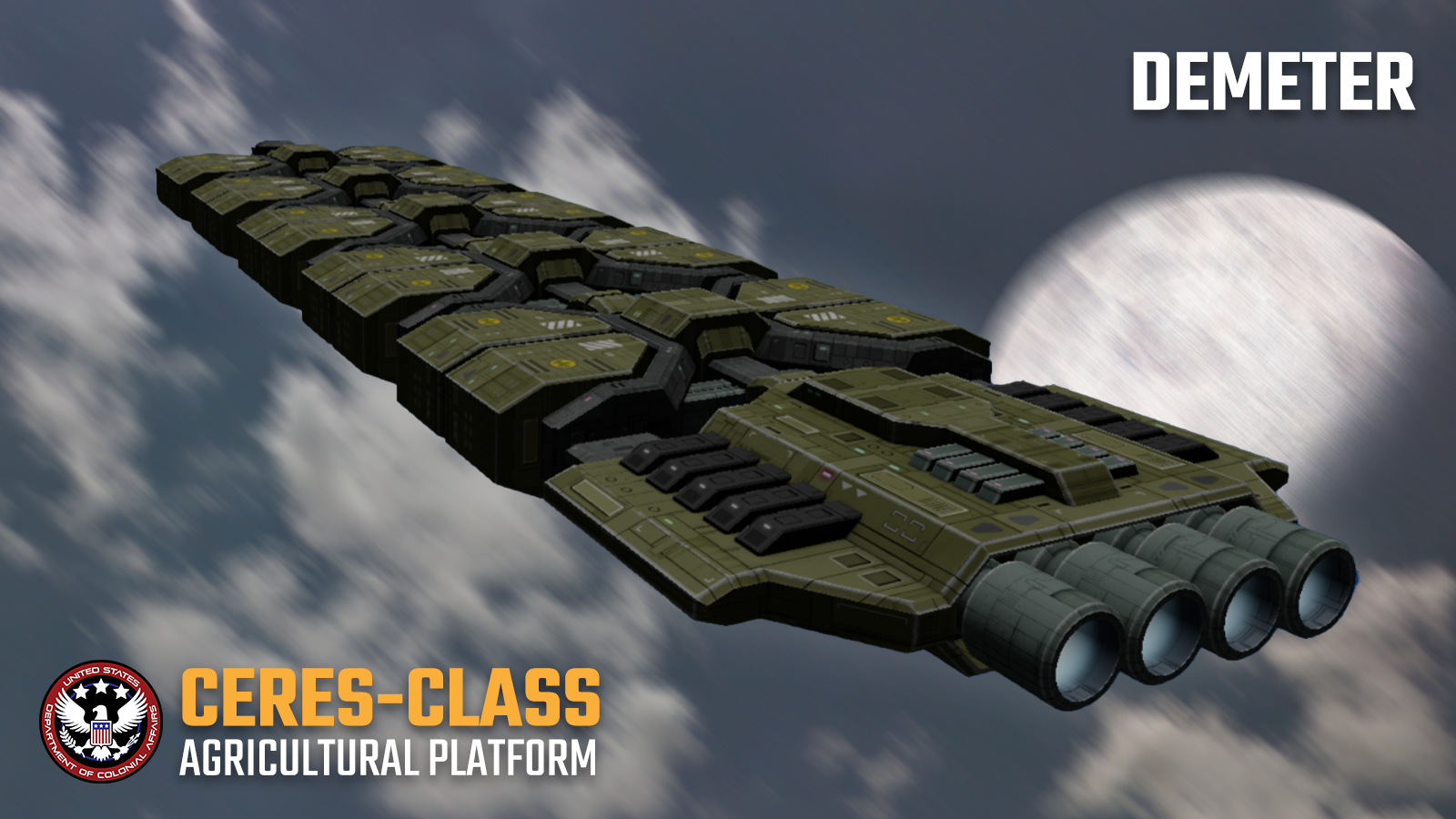
DEMETER
COMMANDING OFFICER:
A. Tanaka
ACTIVE COMPLEMENT:
19
Thanks to a generous grant from Gaia Terraforming, the Demeter has been outfitted with several hydroponics bays in lieu of its foremost four green vats. This allows the vessel to also produce a limited quantity of traditional produce, genetically altered to accelerate growth rates to meet the needs of colonists.
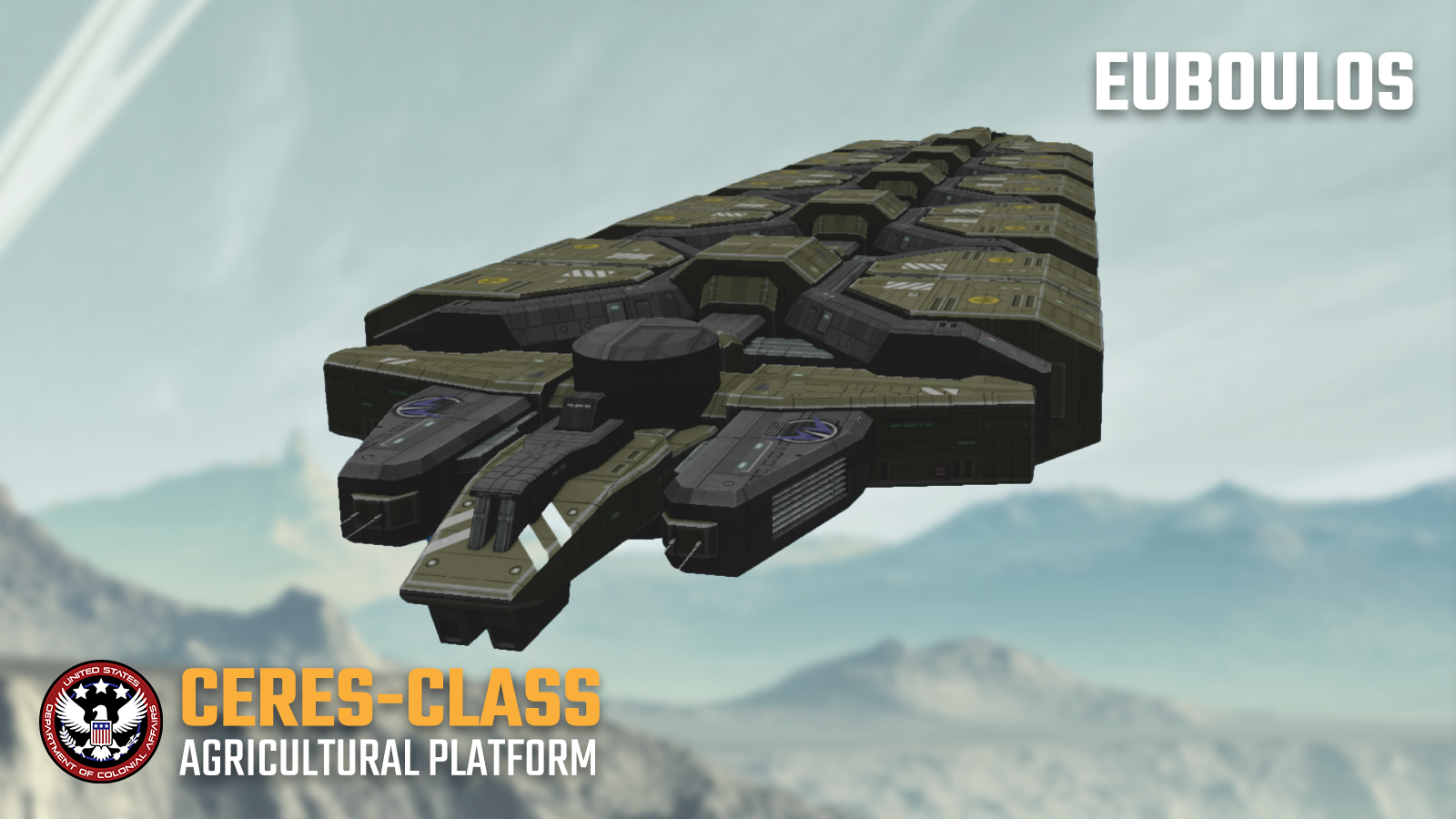
EUBOULOS
COMMANDING OFFICER:
J. Nowak
ACTIVE COMPLEMENT:
20
The Euboulos houses a minor compartment called the “Yeast Vault.” Within, hundreds of yeast strains are cryogenically preserved—some genetically engineered, others traditional sourdough starters from Earth. While often overlooked, these organisms help to underpin everything from bread to nutrient slurries, ensuring that variety and flavor remain alive in the colony’s diet.
HESTIA
COMMANDING OFFICER:
L. Vargas
ACTIVE COMPLEMENT:
20
The Hestia recycles heat from its reactor coils to warm a narrow greenhouse corridor affectionately dubbed the “Spice Spine.” Lined with thermal-tolerant herbs like rosemary, thyme, and chili peppers. Crew members often visit during downtime to escape the sterile atmosphere of space.
PLUTUS
COMMANDING OFFICER:
D. Oluwaseun
ACTIVE COMPLEMENT:
16
Tucked behind the living quarters of the Plutus is “The Hive” — a cryogenically frozen collection of three massive bee colonies. Once established within the new world, these bees will help to create an effective and robust system of pollination.
MANUFACTURER:
Windfall Starship Systems, Inc.
COMMISSIONED:
2214
LENGTH:
485 Meters
COMPLEMENT:
10-15 while in-transit; 50-75 while fully deployed and operational
ARMAMENTS:
None
STANDARD PROPULSION:
x3 Watchtower-Class 310 AIE
x4 400-TORCHLIGHT Maneuvering AIE
GRAVITATIONAL PROPULSION:
x1 Venus-C Gravitational Drive
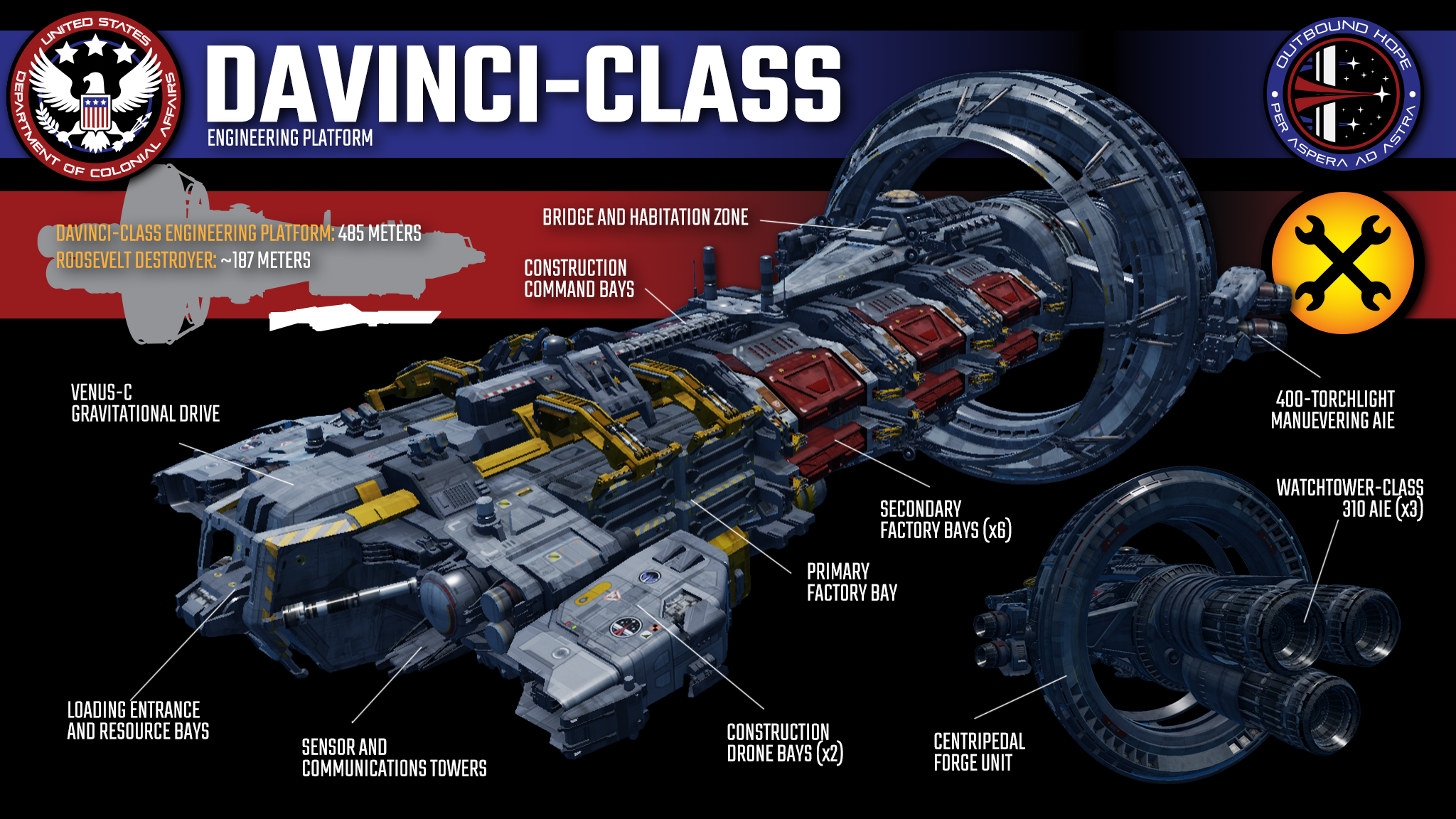
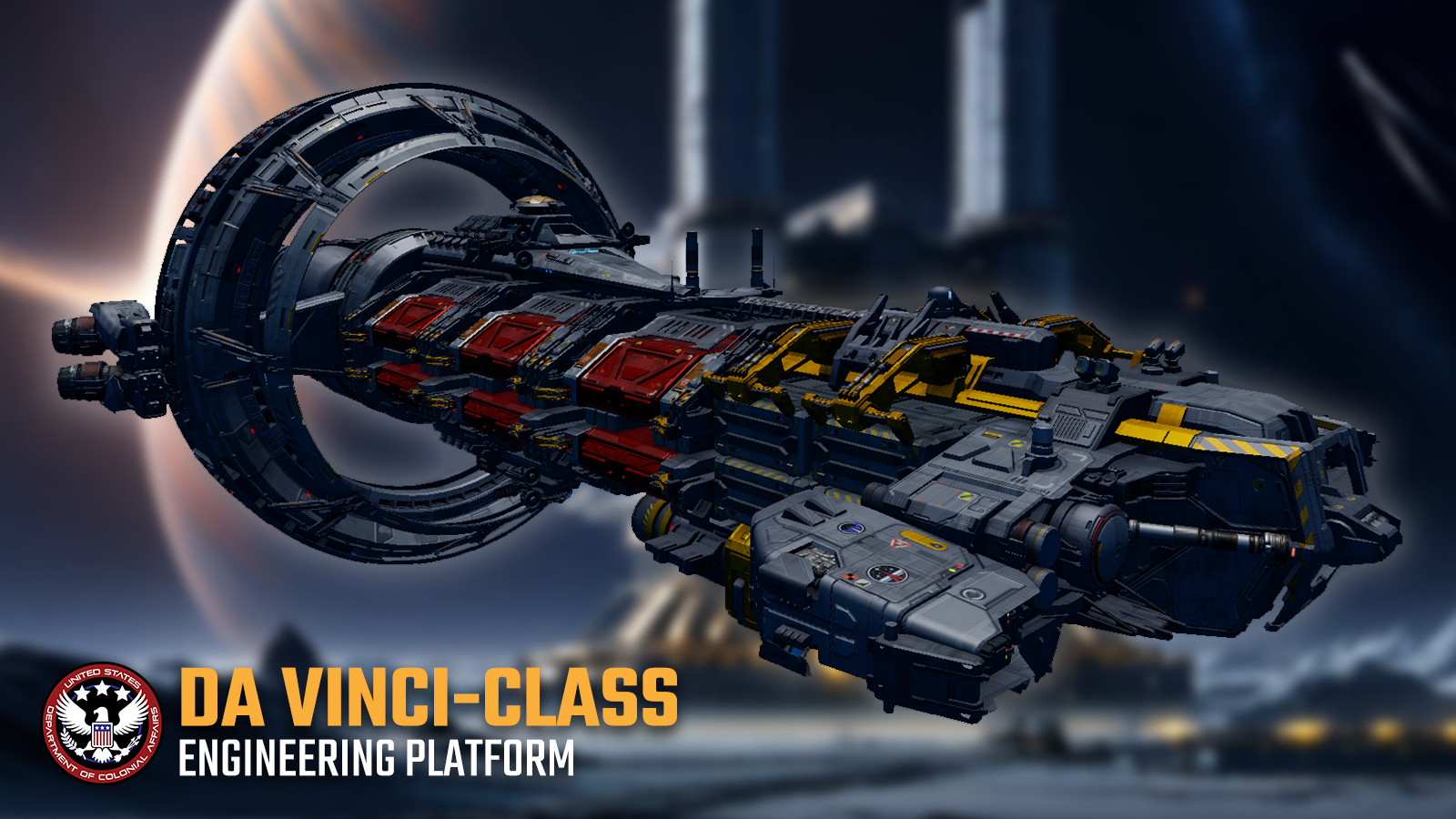
The DaVinci-Class Engineering Platform is a fully independent, deep-space manufacturing vessel designed to take refined resources and turn them into finished orbital infrastructure without planetary support. Though first produced in 2214, the DaVinci is one of a long line of construction vessels meant to operate far from home, allowing a minimal crew to begin building a foothold for civilization out in the void of space.
While ships like the Vulcan-Class industrial platforms are equal parts refinery and factory, the DaVincis concentrate far more on processing already-refined materials into well-engineered structures. Each ship possesses a massive centripetal forge in its aft section, which allows the ship to manufacture the sizeable beams and supports that other portions of the platform will process into still-larger structures. From immense bays on either side of the fore of the ship, teams of construction drones or human-driven engineering vessels can deploy to assemble objects as big as space stations – or as small as family-sized housing units. Though DaVinci ships can — theoretically — be used to construction new vessels, doing so would be far less efficient than a traditional drydock or shipwright station
The first team of six DaVinci platforms were developed to assist in constructing Heimdall Station, a sizable military platform completed near the Bifrost ring in 2215. The DaVinci ships proved remarkably hardy and efficient, prompting the Department of Colonial Affairs and the USSC to depend heavily on the ships in the years to follow. In 2218, the DCA opted to allocate three of their DaVinci platforms to the Outbound Hope Mission with the intent to help the new colony in establishing orbital resource facilities and planetside structures for habitation and administration.
INDIVIDUAL VESSELS
DV-WSS-013
COMMANDING OFFICER:
T. Park
ACTIVE COMPLEMENT:
12
DV-WSS-014
COMMANDING OFFICER:
Z. Kaplan
ACTIVE COMPLEMENT:
12
DV-WSS-015
COMMANDING OFFICER:
A. González
ACTIVE COMPLEMENT:
12
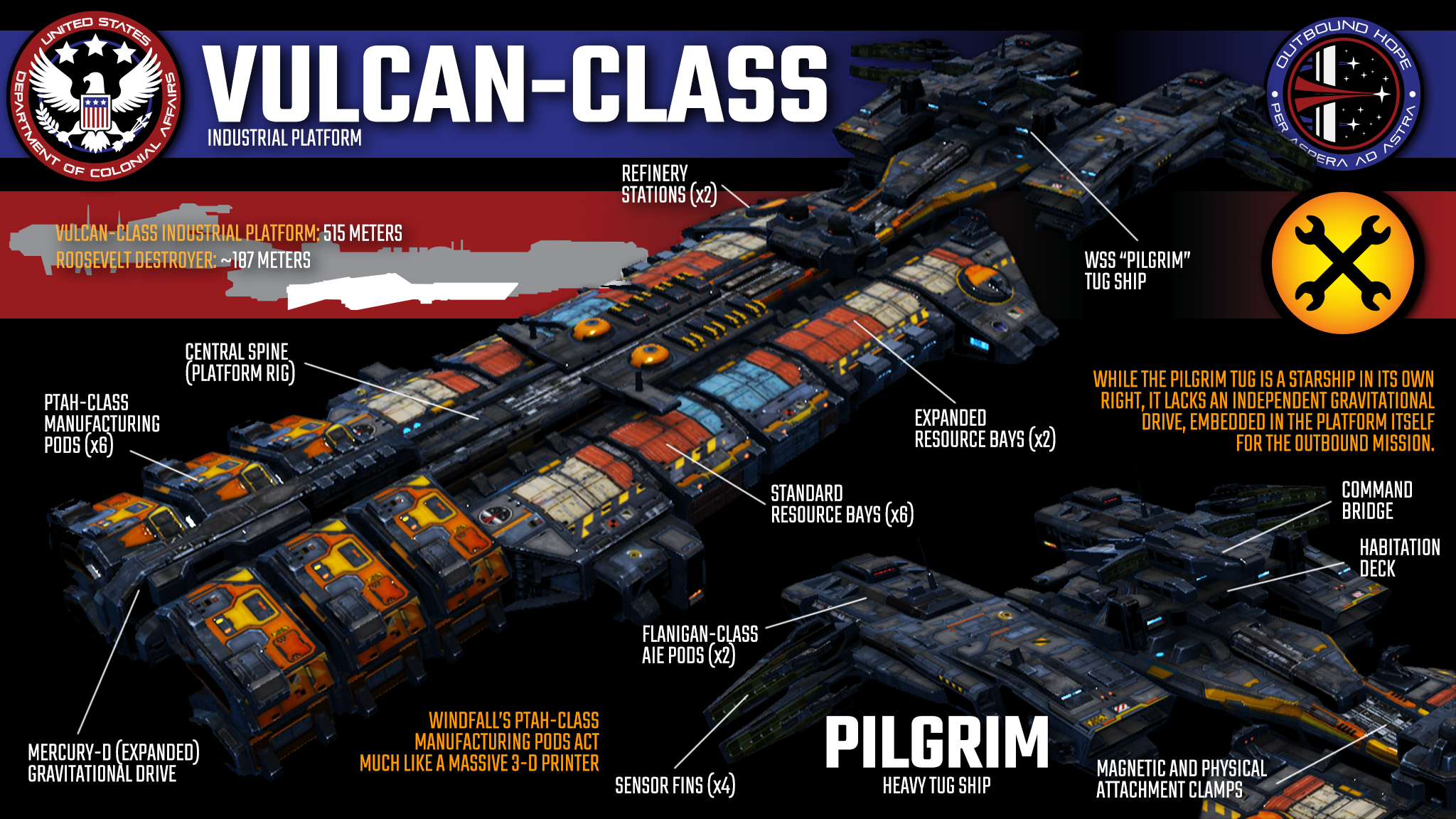
SHIP BASE CHASSIS:
WSS “Pilgrim” Heavy Tug Ship, additional platform rig
MANUFACTURER:
Windfall Starship Systems, Inc.
COMMISSIONED:
2218
LENGTH:
515 Meters
COMPLEMENT:
Crew: 4, Industrial Supervisors: 1-6
ARMAMENTS:
None
STANDARD PROPULSION:
x2 Flanigan-Class AIE Pods
GRAVITATIONAL PROPULSION:
x1 Mercury-D (Expanded) Gravitational Drive
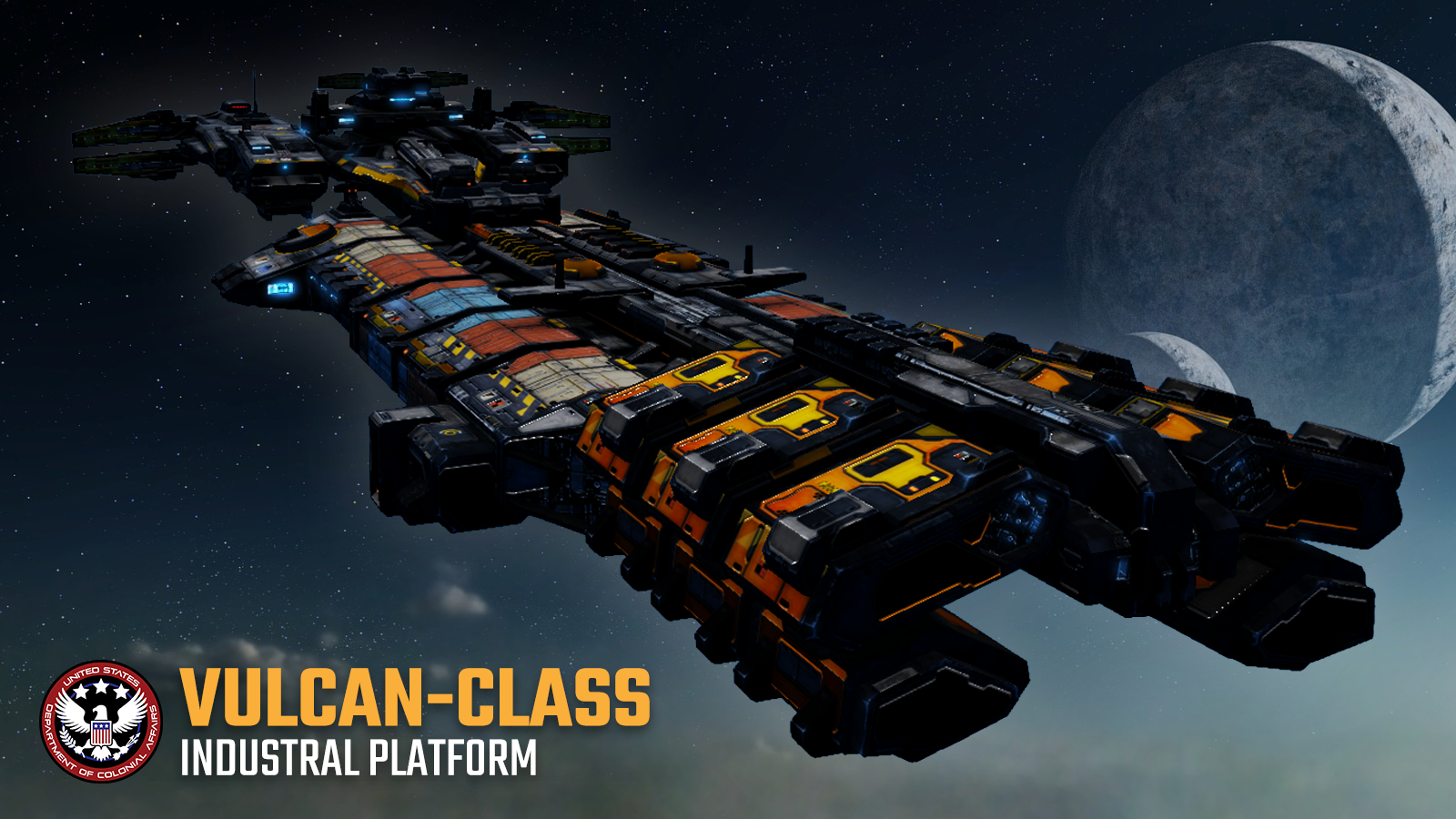
The Vulcan-Class Industrial Platform is Windfall’s attempt to satisfy the manufacturing needs of the Outbound Hope Mission by combining together several previously-existing elements into a somewhat disjointed – yet effective – industrial machine.
Initial designs for the mission involved a need for large-scale manufacturing, particularly during the settlement portion of the operation. The inclusion of three Da Vinci-Class Engineering vessels would satisfy the large-scale construction projects, but other needs persisted – particularly on a smaller scale. The Vulcan-Class platforms were meant to scratch two such itches: They would serve as both mobile resource refineries and as manufacturing centers to meet the needs of the colony’s significant population.
While many starship designs included some abilities in both of these areas, larger-scale operations were usually assigned to terrestrial or station-based setups. Windfall engineers looked to establish something grander, though its ultimate “Hephaestus” design was scrapped by unanticipated budget shortfalls. Instead, engineers looked to what already existed in an attempt to meet the needs of the operation.
The workhorse of what would become the Vulcan-Class Industrial Platform is a pre-existing design – the WSS “Pilgrim” tug ship. These heavy vessels are often utilized around Windfall shipyards and are intended to haul heavy cargo and ship components between stations. While generally slow, their propulsion systems are remarkably dependable and able to safely maneuver large and delicate objects.
Mounting the Pilgrim to a spine-like platform rig gives the vessel the ability to secure more than a dozen essential industrial pods – typically designed as independent, automated units on space stations throughout the Sol system.
At the bow of the platform, Windfall engineers placed three pairs of Ptah-Class manufacturing pods, recently designed by Windfall for the Jovian Trade Collective and their growing enterprises throughout Jupiter and its moons. Each pod is secured to the rig to operate as its own, automated factory. Pulling refined resources from the set of storage units further aft, printers and independent construction rigs can repurpose themselves to create anything from simple panels of ceramic deck plating to sophisticated equipment.
The rest of the ship accommodates earlier steps in the production process. Six resource bays and two expanded bays are secured next, meant to hold harvested resources or finished goods. Docking ports on each of them are meant to cater to the MOLE extractor units also slated for the fleet. At the stern, two wedge-shaped refinery stations process ores and dust into usable materials.
The entire industrial process is automated by a sophisticated civilian-grade AI (CAI) that manages the entire operation from a central core aboard the Pilgrim. With no atmosphere outside of the tug, everything is entirely independent and controlled remotely by human operators. A robotic transportation system channels resources in the storage bays to and from the refineries and manufacturing pods as needed.
Meant exclusively as a short-range vessel, the Pilgrim tug design lacks any gravitational drive, which became the final piece of the platform puzzle. Fitting a standard Mercury-D drive between the manufacturing pods allowed the newly-minted Vulcan-Class Industrial Platform to keep up with the rest of the Outbound Fleet.
Pleased with Windfall’s design, the Department of Colonial Affairs now intends to send three such vessels through the Bifrost Station and on to new adventures.
INDIVIDUAL VESSELS
VL-WSS-041
COMMANDING OFFICER:
D. Moreau
ACTIVE COMPLEMENT:
8
VL-WSS-042
COMMANDING OFFICER:
A. Sokolov
ACTIVE COMPLEMENT:
10
VL-WSS-043
COMMANDING OFFICER:
T. Liu
ACTIVE COMPLEMENT:
9
MANUFACTURER:
Windfall Starship Systems, Inc.
COMMISSIONED:
2219
LENGTH:
399 Meters
COMPLEMENT:
Crew: 3, Workers: 3
ARMAMENTS:
None
STANDARD PROPULSION:
x1 Watchtower-Class 450 AIE
x24 “Stellar Force” Micromanuevering Engines
GRAVITATIONAL PROPULSION:
x2 GEN-6 Aurora Gravitational Drives
The Persephone-Class Agricultural Platform represents the cutting edge of extraterrestrial food production technology. Developed by Windfall Starship Systems in the decade prior to the Outbound Hope Mission’s launch, the class was designed to address one of humanity’s most persistent challenges: sustainable, high-efficiency food generation beyond Earth.
Conceived as the successor to the aging Ceres-Class platforms, the Persephone design achieves a dramatic increase in output while simultaneously reducing crew requirements. This is made possible through the integration of advanced Civilian-AI (CAI) systems, which oversee nearly every aspect of the ship’s operation. From nutrient cycling to harvest timing, the CAI ensures a level of precision and consistency that earlier platforms failed to meet.
The defining feature of the Persephone-Class is its rotating agricultural ring, a structure roughly 205 meters in diameter that encircles the vessel’s central spine. This rotating band serves as the primary site of agricultural production, generating sustained artificial gravity by way of centripetal force rather than NearGrav technologies. This stabilizes growth conditions and allows for uniform distribution of biological material.
Within this ring, dense arrays of cultivation systems are arranged to maximize efficiency. These systems are optimized most commonly for the production of protein-rich algae, a highly adaptable and resource-efficient food source capable of being processed into a wide variety of consumables. Artificial lighting cycles, tightly controlled by the CAI, simulate ideal growth environments while integrated harvesting and processing systems ensure that production flows continuously with minimal interruption. The CAI’s constant monitoring and adjustment of environmental conditions allows the system to operate at peak efficiency at all times, reducing waste and maximizing yield.
The result is a self-contained agricultural ecosystem, capable of sustaining large populations with far greater reliability than previous orbital platforms. This makes the Persephone-Class particularly valuable for distant or developing colonies, where supply chains are fragile and self-sufficiency is critical.
Systems aboard a Persephone ship are so well-maintained and calibrated that – once full production of the vessel is established – buyers will have the opportunity to install a medical suite whose systems are specially-calibrated to produce useful medical products and pharmaceuticals. This option is available thanks to a corporate partnership between Windfall and the TraumaTek corporation.
As the Persephone-Class line is still in its infancy, a single vessel, the Gaia-II, has been assigned to accompany the Outbound Hope Fleet as a proof-of-concept platform. Its presence within the fleet is both practical and symbolic, providing a stable and renewable food source while demonstrating the long-term viability of the design under deep-space conditions.
INDIVIDUAL VESSELS
GAIA-II
COMMANDING OFFICER: J. Nielsen
ACTIVE COMPLEMENT: 6
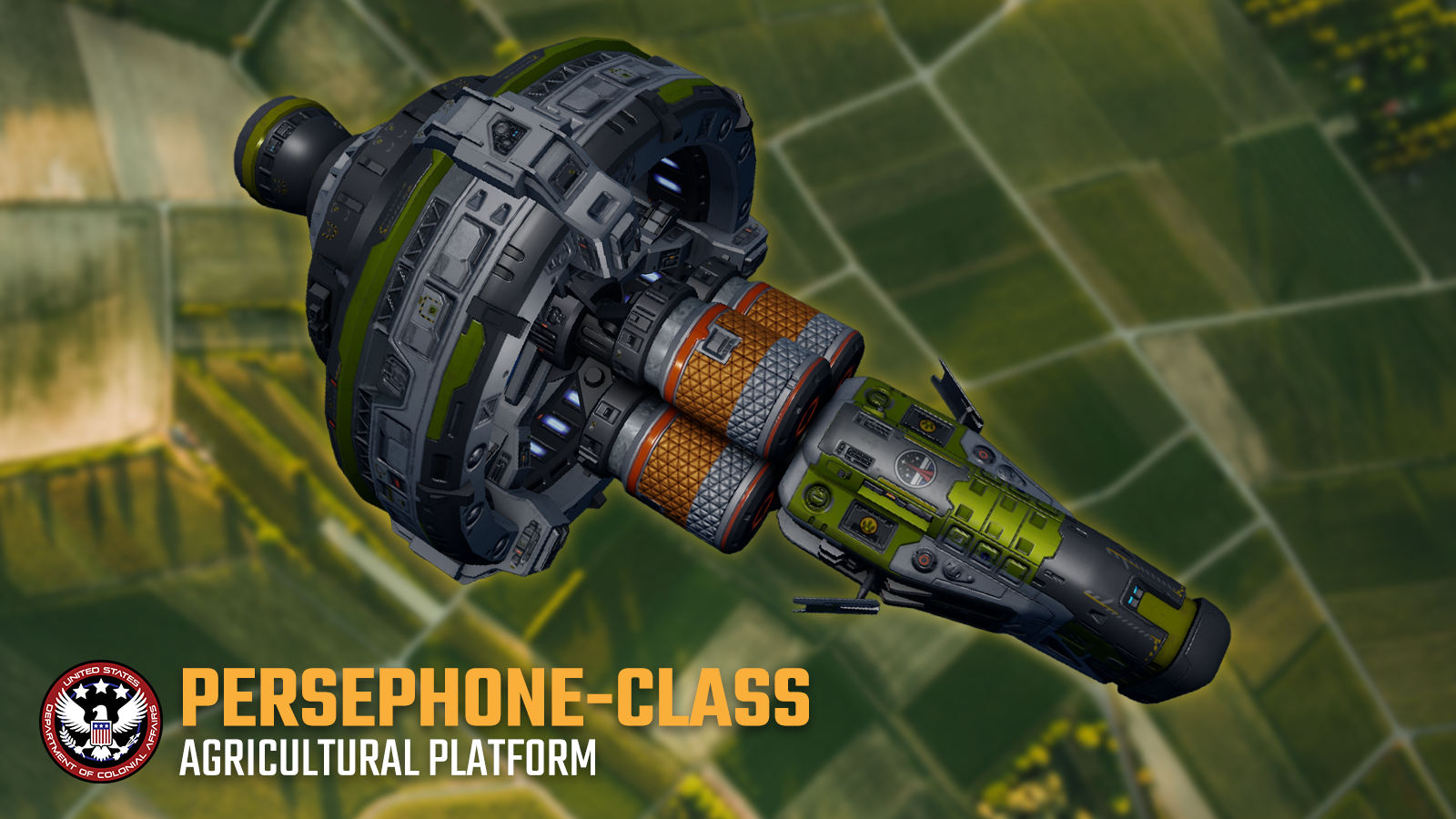
SHIP BASE CHASSIS:
WSS “Journey” Hauler
MANUFACTURER:
Windfall Starship Systems, Inc.
COMMISSIONED:
2212
LENGTH:
284 Meters
COMPLEMENT:
Crew: 2-6
ARMAMENTS:
None
STANDARD PROPULSION:
x4 Leviathan-Class 250 AIE
x2 K6 Maneuvering AIE
GRAVITATIONAL PROPULSION:
x2 “Barrel” 45D Gravitational Drives
The General Supply and Distribution Freighter (GSDF)-3 is a highly common transport vessel capable of long-distance travel and exceptional dependability. Built upon Windfall Starship Systems’ “Journey” hauler chassis, the GSDF-3 prioritizes precision handling and deployment capability over raw cargo volume. While utilized throughout the Sol System in limited industrial roles, the GSDF-3 has found its most critical application within the Outbound Hope Mission, where it serves as a cornerstone of early settlement strategy. Four such vessels, modified by Windfall technicians into specialized transport ships, have been redesigned to support rapid colonial expansion through the delivery of pre-fabricated infrastructure.
Unlike its larger counterpart, the GSDF-4, the GSDF-3 employs a streamlined configuration of three massive reinforced cargo pods. Small crews of 2-6 individuals are housed in the habitation module that sits above the main magnetic clamps that hold the first of the pods. By many ships’ standards, the GSDF-3 living quarters are remarkably spacious and often customized to meet the needs of the crew or family operating the vessel. In Sol, it is not at all uncommon for families far larger than six to call the ships home while parents and kin operate the vessel as a primary means of income.
The smaller “Journey” chassis allows for greater maneuverability and control, an important consideration when transporting delicate or highly specialized construction assets – as is the case within the Outbound Hope Mission. Here, pods are specifically engineered to house pre-fabricated structures, including family housing modules, economic centers, and essential support facilities. Each pod is fitted with stabilization systems and deployment interfaces, ensuring that structures can be delivered intact and made ready for rapid assembly upon arrival. This focused design reflects a focus on mission-critical delivery, where accuracy and reliability outweigh sheer carrying capacity.
Upon reaching the destination, GSDF-3 haulers are expected to offload their cargo in carefully coordinated sequences, enabling the rapid establishment of shelters, operational hubs, and systems supporting quality of life. Unlike the GSDF-4, the GSDF-3 is rated for atmospheric travel, allowing the ship to glide in carefully over designated landing sites to deploy their essential cargo.
INDIVIDUAL VESSELS
GSDF-03-521
COMMANDING OFFICER:
D. Brown
ACTIVE COMPLEMENT:
4
GSDF-03-772
COMMANDING OFFICER:
P. Ivanov
ACTIVE COMPLEMENT:
5
GSDF-03-773
COMMANDING OFFICER:
H. Malone
ACTIVE COMPLEMENT:
4
GSDF-03-821
COMMANDING OFFICER:
M. García
ACTIVE COMPLEMENT:
6
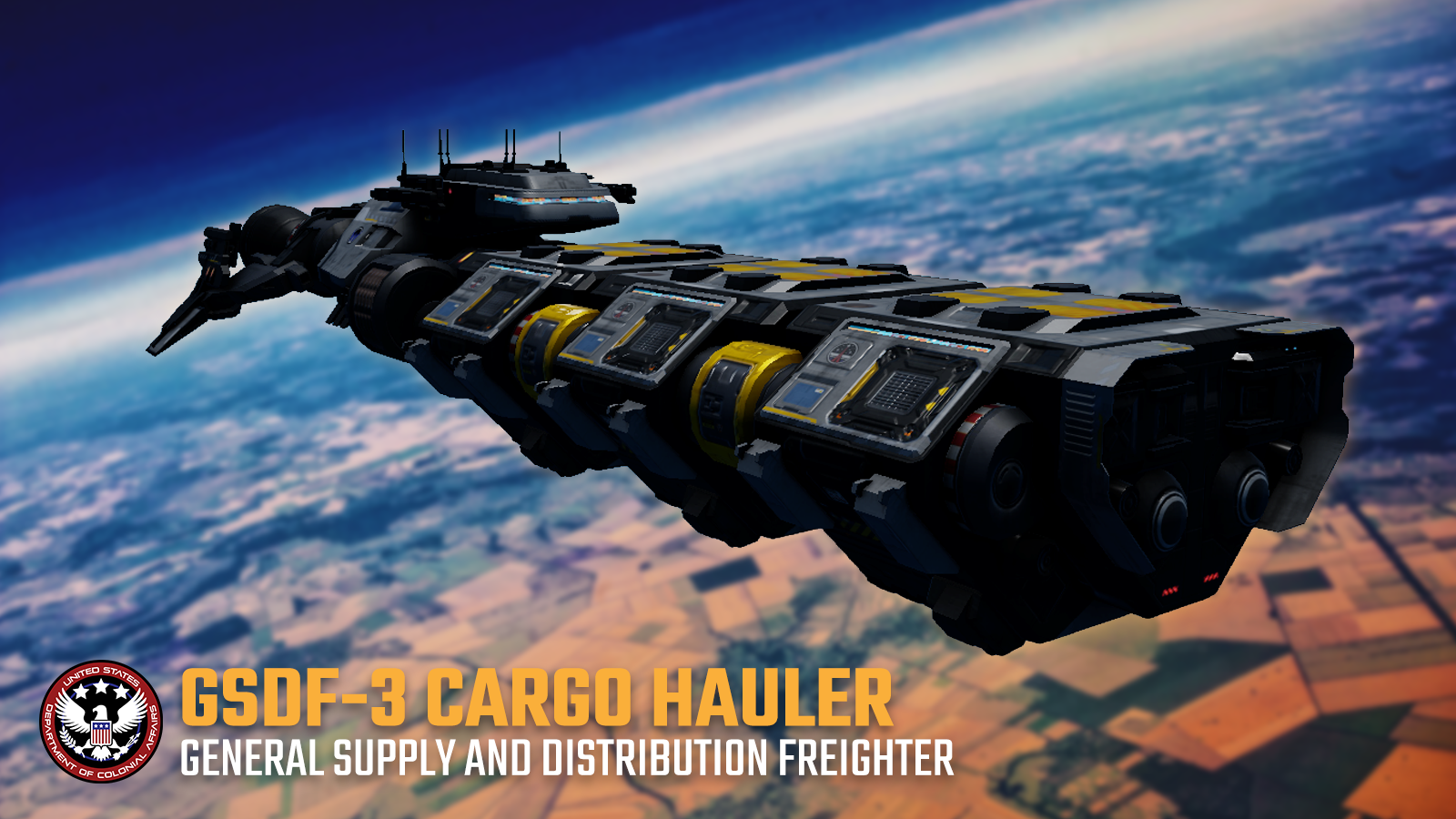
SHIP BASE CHASSIS:
WSS “Mule” XLD-Hauler
MANUFACTURER:
Windfall Starship Systems, Inc.
COMMISSIONED:
2216
LENGTH:
355 Meters
COMPLEMENT:
Crew: 8-12
ARMAMENTS:
None
STANDARD PROPULSION:
x4 RX4 AIE
x4 J5 Maneuvering AIE
GRAVITATIONAL PROPULSION:
x1 Mercury-B (Compact) Gravitational Drive
The General Supply and Distribution Freighter (GSDF)-4 Expanded Cargo Hauler is a heavy transport vessel built around Windfall Starship Systems’ widely utilized “Mule” XLD-Hauler chassis, a platform long regarded as the backbone of civilian and industrial logistics across the Sol System. Designed as a direct evolution of earlier cargo models, the GSDF-4 emphasizes scalability, durability, and ease of maintenance over specialization.
While commonly employed throughout established trade networks, the class has taken on renewed importance as part of the Outbound Hope Mission, where reliable cargo transport is essential to long-term success.
The GSDF-4’s defining characteristic is its configuration of ten massive external cargo pods, mounted along the Mule chassis in a modular arrangement. This design philosophy mirrors that of larger platforms (such as the Ceres Agricultural design), allowing individual pods to be detached, replaced, or serviced without requiring extensive downtime for the ship itself.
This modularity has proven especially valuable for Outbound Hope engineers, who must maintain operational readiness far from established infrastructure. Damaged pods can be swapped and replaced with minimal disruption, ensuring continuous transport capability even under challenging conditions.
Unlike more specialized haulers, the GSDF-4 is built for versatility. Its cargo pods are typically loaded with raw materials, industrial components, and general goods, making the vessel a critical link in sustaining both construction efforts and civilian life within the fleet.
Where the GSDF-3 focused on more mission-specific logistical support, the GSDF-4 serves as a general-purpose workhorse. Its role within the Outbound Hope fleet is straightforward but indispensable: to move the materials that make expansion possible. Whether transporting refined metals, structural components, or bulk resources harvested en route, the GSDF-4 ensures that the fleet’s more specialized vessels can continue their work without interruption.
Though lacking the prominence of warships or the innovation of agricultural or industrial platforms, the GSDF-4 Expanded Cargo Hauler represents a quieter kind of necessity. Built on a proven chassis and designed for endurance rather than glory, it stands as a reminder that even humanity’s boldest ventures rely on the steady movement of goods through the void.
INDIVIDUAL VESSELS
GSDF-04-723
COMMANDING OFFICER:
S. Mensah
ACTIVE COMPLEMENT:
8
GSDF-04-801
COMMANDING OFFICER:
R. Mansour
ACTIVE COMPLEMENT:
9
GSDF-04-808
COMMANDING OFFICER:
H. Ali
ACTIVE COMPLEMENT:
8
GSDF-04-810
COMMANDING OFFICER:
V. Marino
ACTIVE COMPLEMENT:
8
GSDF-04-822
COMMANDING OFFICER:
B. Zhang
ACTIVE COMPLEMENT:
7
GSDF-04-832
COMMANDING OFFICER:
K. Reddy
ACTIVE COMPLEMENT:
9
GSDF-04-846
COMMANDING OFFICER:
J. Wilson
ACTIVE COMPLEMENT:
12
GSDF-04-858
COMMANDING OFFICER:
A. Yusuf
ACTIVE COMPLEMENT:
7
GSDF-04-860
COMMANDING OFFICER:
M. López
ACTIVE COMPLEMENT:
8
GSDF-04-867
COMMANDING OFFICER:
N. El-Sayed
ACTIVE COMPLEMENT:
9
GSDF-04-870
COMMANDING OFFICER:
D. Johnson
ACTIVE COMPLEMENT:
9
GSDF-04-871
COMMANDING OFFICER:
M. Bello
ACTIVE COMPLEMENT:
8
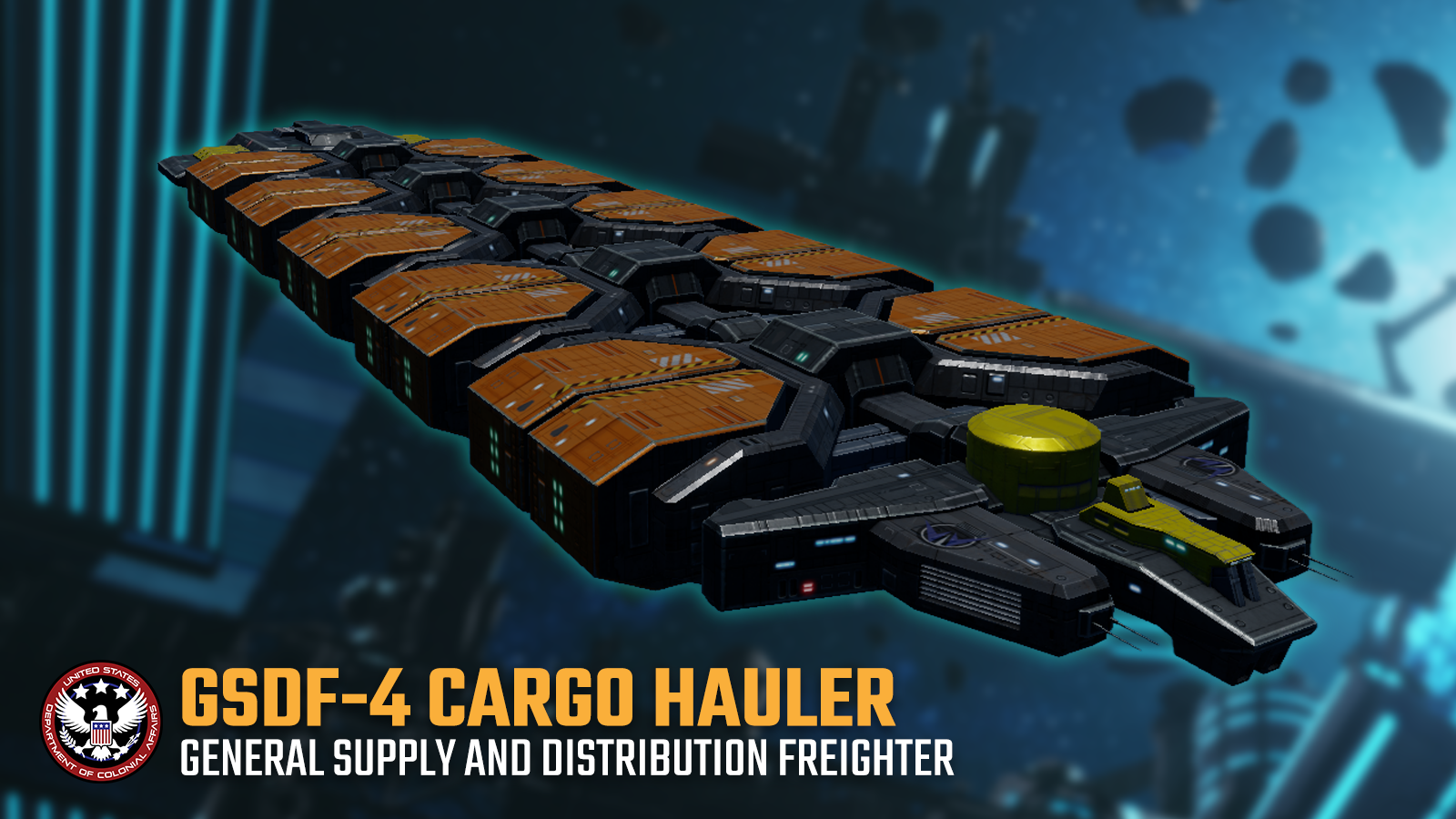
SHIP BASE CHASSIS:
WSS “Mule” XLD2-Hauler
MANUFACTURER:
Windfall Starship Systems, Inc.
COMMISSIONED:
2218
LENGTH:
355 Meters
COMPLEMENT:
Crew: 4-6
ARMAMENTS:
None
STANDARD PROPULSION:
x4 RX5 AIE
x4 J5 Maneuvering AIE
GRAVITATIONAL PROPULSION:
x1 Mercury-D (Compact) Gravitational Drive
The Outbound Hope Liquid Transport and Refinery Tanker serves as one of the most vital logistical assets within the fleet, ensuring the continuous circulation, purification, and redistribution of water across all mission vessels. Built upon Windfall Starship Systems’ updated “Mule” XLD2-Hauler chassis, the tanker combines the proven durability of the Mule platform with highly specialized liquid handling and processing systems.
Originally, four such vessels were commissioned for the mission. However, in the months leading up to launch, one tanker was destroyed in an attack carried out by Anti-Colonial Alliance operatives, underscoring both the vulnerability and importance of the fleet’s support infrastructure. The remaining three tankers now operate under increased security and heightened operational demands.
The tanker’s most prominent feature is its array of ten massive spherical storage tanks, mounted externally along the Mule chassis. Each tank holds approximately 33.5 million liters of liquid — equivalent to nearly thirteen Olympic-sized swimming pools — granting the vessel an immense total capacity critical to sustaining the interstellar journey and subsequent colonial project.
The spherical design allows for optimal pressure distribution and structural integrity, particularly during acceleration and docking maneuvers. These tanks are not merely for storage; each is integrated into a broader network of filtration and reclamation systems that allow the vessel to process contaminated water and liquid waste into reusable reserves.
Internally, advanced purification systems operate continuously, cycling incoming materials through multi-stage filtration, chemical balancing, and sterilization processes. The result is a steady output of clean, potable water ready for redistribution throughout the fleet.
Rather than acting as a static reservoir, the tanker is designed for constant interaction with other vessels. Throughout the journey, it routinely docks with ships across the Outbound Hope fleet, exchanging depleted reserves for freshly purified water while simultaneously taking on wastewater and other liquid byproducts. While modern ships typically include some minor filtration systems, this grander, cyclical system transforms the tankers into the mobile backbone of life support infrastructure, ensuring that no single vessel must rely solely on its internal reserves. In doing so, it significantly extends the operational longevity and resilience of the entire fleet.
INDIVIDUAL VESSELS
LTR-OH 001
COMMANDING OFFICER:
L. Kovac
ACTIVE COMPLEMENT:
4
LTR-OH 002
COMMANDING OFFICER:
D. Schmidt
ACTIVE COMPLEMENT:
4
LTR-OH 003
SHIP DESTROYED PRIOR TO LAUNCH
LTR-OH 004
COMMANDING OFFICER:
T. Aziz
ACTIVE COMPLEMENT:
6
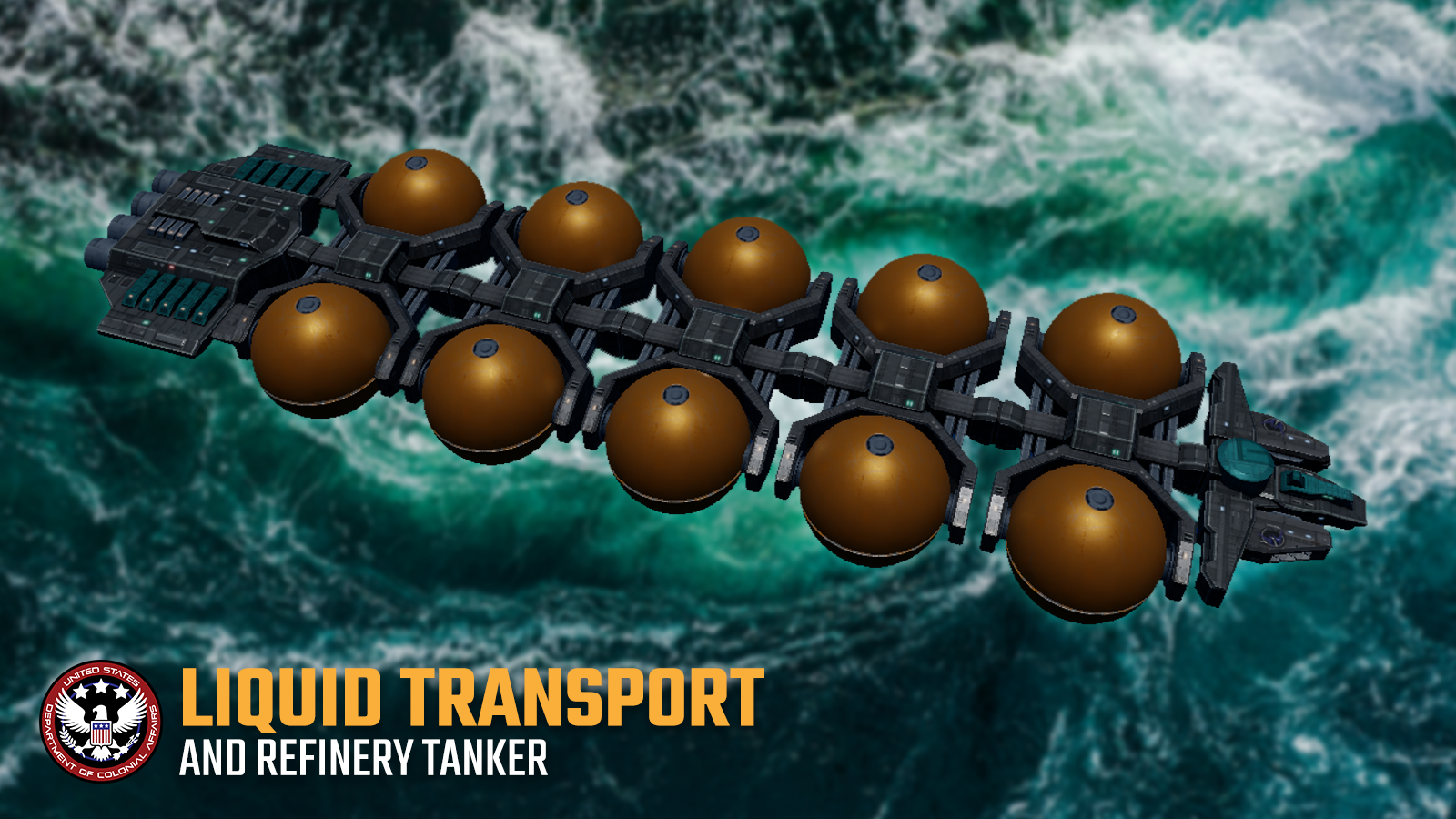
SHIP BASE CHASSIS:
WSS “MOLE” Resource Extraction Rig
MANUFACTURER:
Windfall Starship Systems, Inc.
COMMISSIONED:
2219
LENGTH:
17 Meters
COMPLEMENT:
Crew: 3, Workers: 3-5
ARMAMENTS:
None
STANDARD PROPULSION:
x2 RX2 AIE
x4 J3 Maneuvering AIE
GRAVITATIONAL PROPULSION:
x1 Hermes-14 (Light) Gravitational Drive
The OH-MOLE8 Resource Extractor is a highly specialized adaptation of Windfall Starship Systems’ compact “MOLE” extraction rig, modified specifically for service within the Outbound Hope Mission. Despite its modest size, the OH-MOLE8 stands apart from standard civilian models through the inclusion of a miniaturized gravitational drive—an addition that allows it to travel alongside the Outbound Fleet and operate far beyond traditional industrial zones.
This capability, rare among vessels of its scale, defines the “Outbound Hope” designation and transforms the MOLE from a localized mining tool into a deep-space resource asset.
Built for efficiency in extreme environments, the OH-MOLE8 is equipped with twin high-output plasma drills capable of cutting through dense asteroid material and fractured planetoid surfaces. These drills are used not only to extract resources directly, but also to destabilize and fragment larger bodies into manageable debris fields.
Once material has been broken apart, the vessel deploys swarms of autonomous harvest drones. These drones rapidly scan surrounding debris, identifying valuable elements and transporting them back to the ship’s internal bays with minimal need for human oversight. Within the MOLE’s compact processing systems, collected materials are sorted, compressed, and formed into standardized cube-shaped packages optimized for storage and transfer.
The entire process is designed to maximize yield while minimizing operational complexity, allowing the small vessel to punch far above its weight in terms of productivity.
Within the Outbound Hope fleet, a complement of ten OH-MOLE8 units operates in coordination with the much larger Vulcan-class industrial platform. While the Vulcan platforms handle large-scale refinement and manufacturing, the MOLEs serve as their forward extraction arm.
Working ahead of or alongside the fleet, these ships harvest raw materials from asteroids and other celestial bodies, delivering processed resource packages directly to the Vulcans for refinement and eventual use. This partnership creates a continuous supply chain, enabling the fleet to generate critical materials without reliance on pre-existing infrastructure.
Small, rugged, and relentlessly efficient, the OH-MOLE8 embodies the practical ingenuity at the heart of the Outbound Hope Mission. While larger ships may carry the ambitions of humanity, it is vessels like the MOLE that provide the raw materials to make those ambitions possible.
INDIVIDUAL VESSELS
OH-MOLE 001
COMMANDING OFFICER:
M. Silva
ACTIVE COMPLEMENT:
7
OH-MOLE 002
COMMANDING OFFICER:
L. O’Connor
ACTIVE COMPLEMENT:
6
OH-MOLE 003
COMMANDING OFFICER:
F. Al-Farsi
ACTIVE COMPLEMENT:
7
OH-MOLE 004
COMMANDING OFFICER:
A. Okafor
ACTIVE COMPLEMENT:
8
OH-MOLE 005
COMMANDING OFFICER:
J. Kowalski
ACTIVE COMPLEMENT:
7
OH-MOLE 006
COMMANDING OFFICER:
M. Novak
ACTIVE COMPLEMENT:
7
OH-MOLE 007
COMMANDING OFFICER:
E. Smith
ACTIVE COMPLEMENT:
6
OH-MOLE 008
COMMANDING OFFICER:
L. Benali
ACTIVE COMPLEMENT:
7
OH-MOLE 009
COMMANDING OFFICER:
O. Johansson
ACTIVE COMPLEMENT:
7
OH-MOLE 010
COMMANDING OFFICER:
H. Kim
ACTIVE COMPLEMENT:
5